
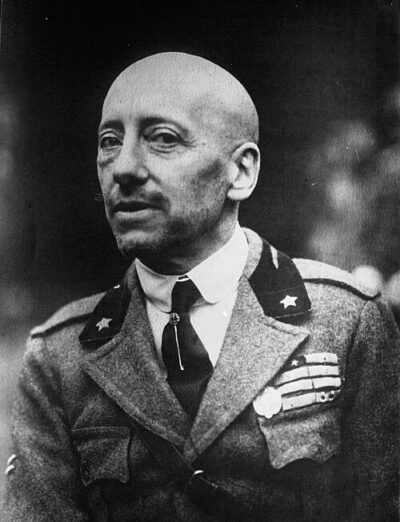
Gabriele D'Annunzio
Gabriele D'Annunzio was an Italian writer, poet, playwright, soldier and politician. Born March 12, 1863, in Pescara. Died March 1, 1938, in Gardone Riviera. Positions held include member of the Chamber of Deputies of the Kingdom of Italy (1897–1900). Known for Il Piacere, The Maidens of the Rocks and Francesca da Rimini. Educated at Sapienza University of Rome and Convitto Nazionale Cicognini.
Facts
39 facts · 2 confirmed by two sources · 10 cited · 27 from one source
Where this comes from
Papalocal keeps its own record. It started from these sources; what each one said is kept here as it was copied, so a change on their side never changes this page by itself. Tap one to read its version.
What Wikidata says · copied November 16, 2026 · revision 2565593472
- Described as
- Italian writer, poet, playwright, soldier and politician (1863-1938)
- Other names
- Gabriele d'Annunzio
- Born
- March 12, 1863 · 20 references
- Died
- March 1, 1938 · 21 references
- Born in
- Pescara · 4 references
- Died in
- Gardone Riviera · 1 reference
- Buried in
- Vittoriale degli italiani
- Cause of death
- cerebral hemorrhage
- Citizen of
- Kingdom of Italy
- Occupation
- playwright · 2 references; politician · 4 references; military personnel · 1 reference; poet · 5 references; journalist · 4 references; writer · 6 references; essayist; screenwriter
- Positions held
- member of the Chamber of Deputies of the Kingdom of Italy (1897–1900) · 1 reference
- Political party
- Historical Right; Historical Far Left; Italian Nationalist Association
- Education
- Sapienza University of Rome; Convitto Nazionale Cicognini
- Member of
- Academie Royale de Langue et de littérature Françaises (1921–1938) · 1 reference; Accademia della Crusca; Royal Academy of Italy (1937–) · 2 references
- Known for
- Il Piacere; The Maidens of the Rocks; Francesca da Rimini; The Intruder; The Dream of a Spring Morning
- Spouse
- Maria Hardouin
- Children
- Mario D'Annunzio; Gabriellino D'Annunzio; Ugo Veniero D'Annunzio; Renata D'Annunzio; Gabriele Cruillas
- Religion
- atheism
- Military branch
- Royal Italian Army · 1 reference
- Military rank
- Lieutenant Colonel; Private
- Wikipedias with a page
- 109
Wikidata item Q193236 (wikidata.org/wiki/Q193236), public domain (CC0). Copied November 16, 2026.
What Wikipedia says · copied November 16, 2026 · revision 1384337707
General Gabriele D'Annunzio, Prince of Montenevoso (12 March 1863 – 1 March 1938), sometimes written d'Annunzio as he used to sign himself, was an Italian poet, playwright, orator, journalist, aristocrat, and Royal Italian Army officer during World War I. He occupied a prominent place in Italian literature from 1889 to 1910 and in its political life from 1914 to 1924. He had the epithets il Profeta (The Prophet) and il Vate (The Poet): vate stems from the Latin vates, meaning a prophetic, divinatory, or inspirational poet.
D'Annunzio was associated with the Decadent movement in his literary works, which interplayed closely with French symbolism and British aestheticism. Such works represented a turn against the naturalism of the preceding romantics and was both sensuous and mystical. He came under the influence of Friedrich Nietzsche, which would find outlets in his literary and later political contributions. His affairs with several women, including Eleonora Duse and Luisa Casati, received public attention. In his politics, which evolved many times, he associated himself with socialism and the progressivist views of the political left, responding to the illiberal and reactionary policies of Luigi Pelloux, as well as with the Historical Far Left.
During World War I, D'Annunzio's image in Italy transformed from literary figure to national war hero. He was associated with the elite Arditi storm troops of the Italian Army and took part in actions such as the Flight over Vienna. As part of an Italian nationalist reaction against the Paris Peace Conference of 1919, he set up the short-lived Italian Regency of Carnaro in Fiume with himself as Duce. The Charter of Carnaro made music the fundamental principle of the state, which was corporatist in nature. Although D'Annunzio later preached nationalism and never called himself a fascist, he has been credited with partially inventing Italian fascism, as both his ideas and his aesthetics were an influence upon Benito Mussolini. At the same time, he was an influence on Italian socialists and an early inspiration to the first phase of the Italian resistance movement to fascism.
- Born, in its opening lines
- March 12, 1863
- Died, in its opening lines
- March 1, 1938
From the Wikipedia article “Gabriele D'Annunzio” (en.wikipedia.org/wiki/Gabriele_D'Annunzio), by its contributors, under CC BY-SA 4.0 (creativecommons.org/licenses/by-sa/4.0/). Copied November 16, 2026; not changed.
Confirmed Two sources agree. Cited One source, and it names where it got it. One source One source, without a reference of its own. Sources disagree The sources disagree. We show the best-supported value and keep theirs below.
