
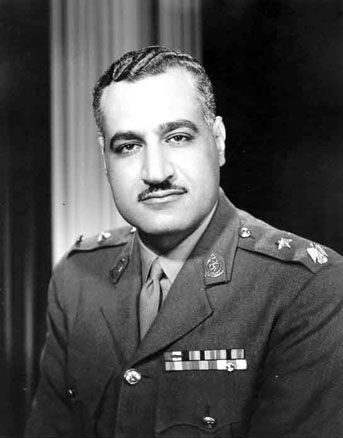
Gamal Abdel Nasser
Gamal Abdel Nasser was a President of Egypt from 1956 to 1970. Born January 15, 1918, in Bakos. Died September 28, 1970, in Cairo. Positions held include President of Egypt (1956–1970), Prime Minister of Egypt (2 times) (1954–1970) and chairperson of the Organisation of African Unity (1964–1965). Educated at Cairo University and Egyptian Military College. Awards include Order of Lenin, Hero of the Soviet Union and Order of the Companions of O. R. Tambo.
Facts
46 facts · 2 confirmed by two sources · 8 cited · 36 from one source
Where this comes from
Papalocal keeps its own record. It started from these sources; what each one said is kept here as it was copied, so a change on their side never changes this page by itself. Tap one to read its version.
What Wikidata says · copied November 16, 2026 · revision 2567133358
- Described as
- President of Egypt from 1956 to 1970
- Other names
- Gamal Abd el-Nasser, Jamal Abd an-Nasir, Nasser, Gamal Abd al-Nasser, Gamal Abdel Nasser Hussein, Gamal abd an-Nassir, Jamāl ʻAbd al-Nāṣir, Jamāl ʻAbd al-Nāṣir Ḥusayn
- Born
- January 15, 1918 · 8 references
- Died
- September 28, 1970 · 8 references
- Born in
- Bakos
- Died in
- Cairo · 2 references
- Buried in
- Gamal Abdel Nasser Mosque · 1 reference
- Cause of death
- myocardial infarction · 1 reference
- Citizen of
- Sultanate of Egypt (–1922); Kingdom of Egypt (1922–1953); Republic of Egypt (1953–1958); United Arab Republic (1958–)
- Occupation
- politician · 2 references; military leader · 1 reference; revolutionary; president; military officer · 1 reference
- Positions held
- President of Egypt (1956–1970); Prime Minister of Egypt (2 times) (1954–1970); chairperson of the Organisation of African Unity (1964–1965); Secretary General of the Non-Aligned Movement (1964–1970); prime minister
- Political party
- Arab Socialist Union
- Education
- Cairo University; Egyptian Military College · 1 reference
- Member of
- Free Officers Movement
- Awards
- Order of Lenin; Hero of the Soviet Union (1964); Order of the Companions of O. R. Tambo (2004); Order of the Nile; Order of the Republic · 1 reference; Order of Merit · 1 reference; Order of the Virtues · 1 reference; Order of the Yugoslav Star (1955) · 1 reference; Order of the Republic (1965) · 1 reference; Grand Cross of the Order of Polonia Restituta · 1 reference; Grand Cross with Collar of the Order of the White Rose of Finland (1967) · 1 reference; Order of the Crown of the Realm (1965); Order of the White Lion (1966)
- Field
- politics; military
- Spouse
- Tahia Kazem (1944–1970)
- Children
- Khalid Abdel Nasser · 1 reference; Mona Gamal Abdel Nasser; Hoda Gamal Abdel Nasser
- Religion
- Islam
- Military branch
- Egyptian Army
- Military rank
- colonel
- Wikipedias with a page
- 129
Wikidata item Q39524 (wikidata.org/wiki/Q39524), public domain (CC0). Copied November 16, 2026.
What Wikipedia says · copied November 16, 2026 · revision 1384087199
Gamal Abdel Nasser Hussein (15 January 1918 – 28 September 1970) was an Egyptian military officer and revolutionary who served as the second president of Egypt from 1954 until his death in 1970. Nasser led the Egyptian revolution of 1952 and introduced far-reaching land reforms the following year. Following a 1954 assassination attempt by a Muslim Brotherhood member, he cracked down on the organization, put President Mohamed Naguib under house arrest and assumed executive office. He was formally elected president in June 1956.
Nasser's popularity in Egypt and the Arab world skyrocketed after his nationalization of the Suez Canal and his political victory in the subsequent Suez Crisis, known in Egypt as the Tripartite Aggression. Calls for pan-Arab unity under his leadership increased, culminating with the formation of the United Arab Republic with Syria from 1958 to 1961. In 1962, Nasser began a series of major socialist measures and modernization reforms in Egypt. Despite setbacks to his pan-Arabist cause, by 1963 Nasser's supporters gained power in several Arab countries, but he became embroiled in the North Yemen Civil War, and eventually the much larger Arab Cold War. He began his third presidential term in March 1965 after his political opponents were banned from running. Following Egypt's defeat by Israel in the Six-Day War of 1967, Nasser resigned, but he returned to office after popular demonstrations called for his reinstatement. By 1968, Nasser had appointed himself prime minister, launched the War of Attrition to regain the Israeli-occupied Sinai Peninsula, begun a process of depoliticizing the military, and issued a set of political liberalization reforms. After the conclusion of the 1970 Arab League summit, Nasser suffered a heart attack and died. His funeral in Cairo drew five to six million mourners, and prompted an outpouring of grief across the Arab world.
Nasser remains an iconic figure in the Arab world, particularly for his strides towards social justice and Arab unity, his modernization policies, and his anti-imperialist efforts. His presidency also encouraged and coincided with an Egyptian cultural boom, and the launching of large industrial projects, including the Aswan Dam, and Helwan city. Nasser's detractors criticize his authoritarianism, human rights violations, antisemitism and anti-Zionism, and the dominance of the military over civil institutions that characterised his tenure—an anti-democratic framework which has persisted to the present.
- Born, in its opening lines
- January 15, 1918
- Died, in its opening lines
- September 28, 1970
From the Wikipedia article “Gamal Abdel Nasser” (en.wikipedia.org/wiki/Gamal_Abdel_Nasser), by its contributors, under CC BY-SA 4.0 (creativecommons.org/licenses/by-sa/4.0/). Copied November 16, 2026; not changed.
Confirmed Two sources agree. Cited One source, and it names where it got it. One source One source, without a reference of its own. Sources disagree The sources disagree. We show the best-supported value and keep theirs below.
