
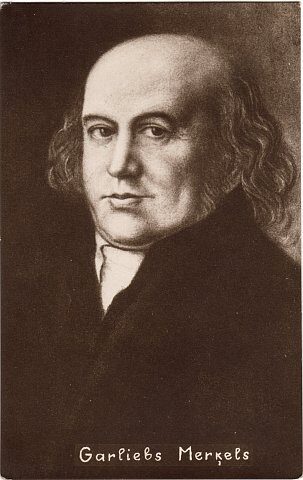
Garlieb Merkel
Garlieb Merkel was a Baltic German writer and publicist. Born October 19, 1769, in Lēdurga. Died May 9, 1850, in Riga. Educated at Riga State Gymnasium No.1 and Leipzig University.
Facts
24 facts · 1 confirmed by two sources · 13 cited · 9 from one source · 1 where the sources disagree
What’s different
- Born: we show October 19, 1769 (Sources disagree). Wikidata also lists October 31, 1769
Where this comes from
Papalocal keeps its own record. It started from these sources; what each one said is kept here as it was copied, so a change on their side never changes this page by itself. Tap one to read its version.
What Wikidata says · copied November 18, 2026 · revision 2565533461
- Described as
- Baltic German writer and publicist (1769-1850)
- Other names
- Garlieb Helwig Merkel
- Born
- October 31, 1769; October 19, 1769 · 1 reference
- Died
- May 9, 1850 · 2 references
- Born in
- Lēdurga
- Died in
- Riga
- Citizen of
- Russian Empire
- Occupation
- journalist · 1 reference; writer · 1 reference; opinion journalist · 2 references; philosopher · 1 reference; literary critic · 1 reference; political activist · 1 reference
- Education
- Riga State Gymnasium No.1; Leipzig University; University of Jena; University of Frankfurt an der Oder
- Field
- literature · 1 reference; literary criticism · 1 reference; opinion journalism · 1 reference; philosophy · 1 reference; activism · 1 reference
- Spouse
- Dorothea Wilhelmina Merkel
- Children
- Albrecht Ernst Emil Merkel · 1 reference
- Father
- Daniel Merkel · 1 reference
- Mother
- Gerdruhte/Gertruhte/Gertrud Elisabeth Merkel/Merckel
- Wikipedias with a page
- 23
Wikidata item Q539977 (wikidata.org/wiki/Q539977), public domain (CC0). Copied November 18, 2026.
What Wikipedia says · copied November 18, 2026 · revision 1371562751
Garlieb Helwig Merkel (1 November [O.S. 21 October] 1769 in Lēdurga Parish (now Sigulda Municipality), Kreis Riga – 9 May [O.S. 27 April] 1850 in Riga) was a Baltic German writer and activist and an early Estophile and Lettophile.
Merkel was born into the family of a rural priest in what is today Latvia. From the age of 17 he worked as a tutor for upper-class German families. In 1790, he joined the circle of Riga intellectuals. Influenced by the ideas he found there, he published the book Die Letten ("Latvians", full title: Die Letten vorzüglich in Liefland am Ende des philosophischen Jahrhunderts, Ein Beytrag zur Völker- und Menschenkunde ("The Admirable Latvians of Livonia at the end of the Century of Philosophy, with an Addendum on Peoples and Anthropology")) in 1796, which described in the darkest terms the life of the Latvian peasantry and the atrocities of the Baltic German landowners and called upon the Imperial Russian government to intervene and ameliorate the lot of the Latvians. The book gained considerable popularity in the German society and was translated into French, Danish and Russian. In 1800, the original German version of the book was re-published. Finally, in the 20th century it was translated also into Latvian.
Merkel's book caused a storm of anger among the landowners of Governorate of Livonia, and Merkel was forced into exile. He moved to Weimar, then in 1800 to Berlin, where he was the co-editor with August von Kotzebue of the weekly Der Freimutige (1803–1806).
In 1816, Merkel returned to Livonia. He published the book My Ten Years in Germany (1818) and Images and Characters from My Life (two volumes, 1839–1840). He also wrote the pamphlet Free Latvians and Estonians (1820), which was published in Leipzig.
A street is named in his honor in downtown Riga.
- Born, in its opening lines
- November 1, 1769
- Died, in its opening lines
- May 9, 1850
From the Wikipedia article “Garlieb Merkel” (en.wikipedia.org/wiki/Garlieb_Merkel), by its contributors, under CC BY-SA 4.0 (creativecommons.org/licenses/by-sa/4.0/). Copied November 18, 2026; not changed.
Confirmed Two sources agree. Cited One source, and it names where it got it. One source One source, without a reference of its own. Sources disagree The sources disagree. We show the best-supported value and keep theirs below.
