
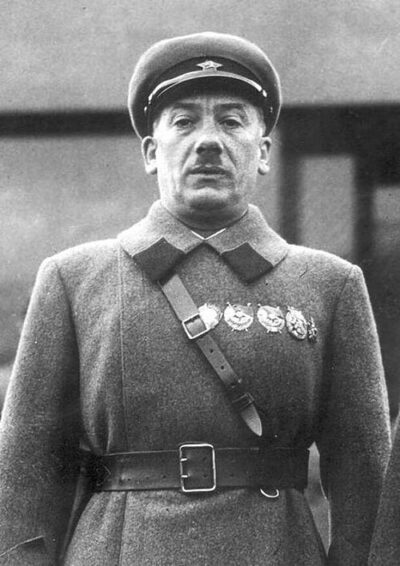
Genrikh Yagoda
Genrikh Yagoda was a Soviet secret police official. Born November 7, 1891, in Rybinsk. Died March 15, 1938, in Kommunarka shooting ground. Positions held include People's Commissar for Internal Affairs (1934–1936) and People's Commissar for Communications of the USSR (1936–1937). Awards include Order of Lenin, Order of the Red Banner (2 times) and Honorary Worker of the VChK–GPU (V).
Facts
27 facts · 2 confirmed by two sources · 0 cited · 25 from one source
Where this comes from
Papalocal keeps its own record. It started from these sources; what each one said is kept here as it was copied, so a change on their side never changes this page by itself. Tap one to read its version.
What Wikidata says · copied November 16, 2026 · revision 2562622973
- Described as
- Soviet secret police official (1891–1938)
- Other names
- Genrich Jagoda, Genrikh Grigoryevich Yagoda
- Born
- November 7, 1891 · 2 references
- Died
- March 15, 1938 · 3 references
- Born in
- Rybinsk
- Died in
- Kommunarka shooting ground
- Buried in
- Kommunarka shooting ground
- Cause of death
- gunshot wound
- Citizen of
- Russian Empire; Russian Soviet Federative Socialist Republic (–1922); Soviet Union
- Occupation
- politician; military personnel · 1 reference
- Positions held
- People's Commissar for Internal Affairs (1934–1936) · 1 reference; People's Commissar for Communications of the USSR (1936–1937)
- Political party
- Communist Party of the Soviet Union (–1938); Russian Social Democratic Labour Party (bolshevik)
- Member of
- Central Committee of the Communist Party of the Soviet Union
- Awards
- Order of Lenin (1933); Order of the Red Banner (2 times) (1927, 1930); Honorary Worker of the VChK–GPU (V) (1922) · 1 reference; Honoured Worker of the Workers‘ and Peasants’ Militia (1933) · 1 reference; Order of the Red Banner of Labour of the Russian SFSR (1932); Honorary Worker of the VChK–GPU (XV) (1932) · 1 reference
- Spouse
- Ida Averbakh · 1 reference
- Religion
- atheism
- Military branch
- infantry
- Military rank
- Gefreiter; Commissar General of State Security
- Wikipedias with a page
- 51
Wikidata item Q141869 (wikidata.org/wiki/Q141869), public domain (CC0). Copied November 16, 2026.
What Wikipedia says · copied November 16, 2026 · revision 1380861185
Genrikh Grigoryevich Yagoda (Russian: Ге́нрих Григо́рьевич Яго́да, romanized: Genrikh Grigor'yevich Yagoda, born Yenokh Gershevich Iyeguda; 7 November 1891 – 15 March 1938) was a Soviet secret police official who served as director of the NKVD, the Soviet Union's security and intelligence agency, from 1934 to 1936. Appointed by Joseph Stalin, Yagoda supervised arrests, show trials, and executions of the Old Bolsheviks Lev Kamenev and Grigory Zinoviev, climactic events of the Great Purge. Yagoda also supervised the construction of the White Sea–Baltic Canal with Naftaly Frenkel, using penal labor from the gulag system, during which 12,000–25,000 laborers died.
Like many NKVD officers who oversaw political repression under Stalin's rule, Yagoda himself ultimately became a victim of the regime's purges. He was demoted from the directorship of the NKVD in favor of Nikolai Yezhov in 1936 and arrested in 1937. Charged with crimes of wrecking, espionage, Trotskyism and conspiracy, Yagoda was a defendant at the Trial of the Twenty-One, the last of the major Soviet show trials of the 1930s. Following his confession at the trial, Yagoda was found guilty and shot.
- Born, in its opening lines
- November 7, 1891
- Died, in its opening lines
- March 15, 1938
From the Wikipedia article “Genrikh Yagoda” (en.wikipedia.org/wiki/Genrikh_Yagoda), by its contributors, under CC BY-SA 4.0 (creativecommons.org/licenses/by-sa/4.0/). Copied November 16, 2026; not changed.
Confirmed Two sources agree. Cited One source, and it names where it got it. One source One source, without a reference of its own. Sources disagree The sources disagree. We show the best-supported value and keep theirs below.
