
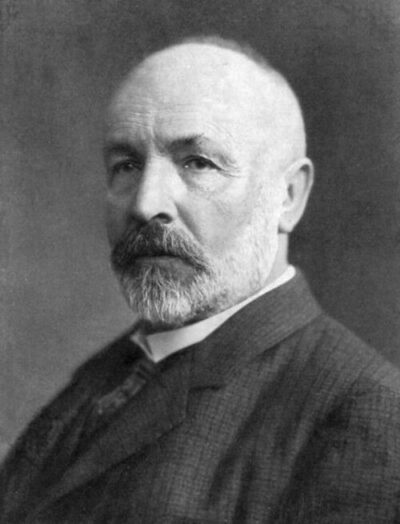
Georg Cantor
Georg Cantor was a German mathematician, inventor of set theory. Born March 3, 1845, in Saint Petersburg. Died January 6, 1918, in Halle (Saale). Known for list of things named after Georg Cantor. Educated at Frederick William University Berlin and Martin Luther University Halle-Wittenberg. Awards include Sylvester Medal.
Facts
37 facts · 2 confirmed by two sources · 20 cited · 15 from one source
Where this comes from
Papalocal keeps its own record. It started from these sources; what each one said is kept here as it was copied, so a change on their side never changes this page by itself. Tap one to read its version.
What Wikidata says · copied November 16, 2026 · revision 2568732268
- Described as
- German mathematician, inventor of set theory (1845–1918)
- Other names
- Georg Ferdinand Ludwig Philipp Cantor, Cantor
- Born
- March 3, 1845 · 8 references
- Died
- January 6, 1918 · 10 references
- Born in
- Saint Petersburg · 4 references
- Died in
- Halle (Saale) · 3 references
- Buried in
- Friedhof Giebichenstein · 1 reference
- Cause of death
- myocardial infarction · 1 reference
- Name at birth
- Georg Ferdinand Ludwig Philipp Cantor · 1 reference
- Citizen of
- German Reich; German Empire · 1 reference
- Occupation
- mathematician · 1 reference; philosopher; university teacher
- Worked for
- Martin Luther University Halle-Wittenberg (1869–1913) · 1 reference
- Education
- Frederick William University Berlin (1863–1867) · 1 reference; Martin Luther University Halle-Wittenberg (–1869) · 1 reference; Technical University of Darmstadt (1860–1862) · 1 reference; ETH Zurich (1862–1863) · 1 reference
- Member of
- German Academy of Sciences Leopoldina; Göttingen Academy of Sciences and Humanities in Lower Saxony; Royal Society of Edinburgh (1905–) · 1 reference; London Mathematical Society (2008–) · 1 reference
- Known for
- list of things named after Georg Cantor
- Awards
- Sylvester Medal (1904) · 1 reference
- Field
- set theory · 1 reference; mathematics; mathematical logic · 1 reference; cardinal number · 1 reference; ordinal number · 1 reference; philosophy of mathematics · 1 reference
- Spouse
- Vally Cantor · 1 reference
- Children
- Erich Cantor; Else Cantor
- Father
- Georg Woldemar Cantor
- Mother
- Maria Cantor
- Siblings
- Constantin Cantor; Sophie Nobiling
- Religion
- Lutheranism
- Wikipedias with a page
- 115
Wikidata item Q76420 (wikidata.org/wiki/Q76420), public domain (CC0). Copied November 16, 2026.
What Wikipedia says · copied November 16, 2026 · revision 1384593102
Georg Ferdinand Ludwig Philipp Cantor ( KAN-tor; German: [ˈɡeːɔʁk ˈfɛʁdinant ˈluːtvɪç ˈfɪlɪp ˈkantoːɐ̯]; 3 March [O.S. 19 February] 1845 – 6 January 1918) was a mathematician who played a pivotal role in the creation of set theory, which has become a fundamental theory in mathematics. Cantor established the importance of one-to-one correspondence between the members of two sets, defined infinite and well-ordered sets, and proved that the real numbers are more numerous than the natural numbers. Cantor's method of proof of this theorem implies the existence of an infinity of infinities. He defined the cardinal and ordinal numbers and their arithmetic. Cantor's work is of great philosophical interest, a fact of which he was well aware. He also repeatedly plagiarized the work of Richard Dedekind.
Originally, Cantor's theory of transfinite numbers was regarded as counter-intuitive – even shocking. This caused it to encounter resistance from mathematical contemporaries such as Leopold Kronecker and Henri Poincaré and later from Hermann Weyl and L. E. J. Brouwer, while Ludwig Wittgenstein raised philosophical objections; see Controversy over Cantor's theory. Cantor, a devout Lutheran Christian, believed the theory had been communicated to him by God. Some Christian theologians (particularly neo-Scholastics) saw Cantor's work as a challenge to the uniqueness of the absolute infinity in the nature of God – on one occasion equating the theory of transfinite numbers with pantheism – a proposition that Cantor vigorously rejected. Not all theologians were against Cantor's theory; prominent neo-scholastic philosopher Konstantin Gutberlet was in favor of it, and Cardinal Johann Baptist Franzelin accepted it as a valid theory (after Cantor made some important clarifications).
The objections to Cantor's work were occasionally fierce: Leopold Kronecker's public opposition and personal attacks included describing Cantor as a "scientific charlatan", a "renegade" and a "corrupter of youth". Kronecker objected to Cantor's proofs that the algebraic numbers are countable, and that the transcendental numbers are uncountable, results now included in a standard mathematics curriculum. Writing decades after Cantor's death, Wittgenstein lamented that mathematics is "ridden through and through with the pernicious idioms of set theory", which he dismissed as "utter nonsense" that is "laughable" and "wrong". Cantor's recurring bouts of depression from 1884 to the end of his life have been blamed on the hostile attitude of many of his contemporaries, though some have explained these episodes as probable manifestations of a bipolar disorder.
The harsh criticism has been matched by later accolades. In 1904, the Royal Society awarded Cantor its Sylvester Medal, the highest honor it can confer for work in mathematics. David Hilbert defended Cantor's work from its critics by declaring, "No one shall expel us from the paradise that Cantor has created."
- Born, in its opening lines
- March 3, 1845
- Died, in its opening lines
- January 6, 1918
From the Wikipedia article “Georg Cantor” (en.wikipedia.org/wiki/Georg_Cantor), by its contributors, under CC BY-SA 4.0 (creativecommons.org/licenses/by-sa/4.0/). Copied November 16, 2026; not changed.
Confirmed Two sources agree. Cited One source, and it names where it got it. One source One source, without a reference of its own. Sources disagree The sources disagree. We show the best-supported value and keep theirs below.
