
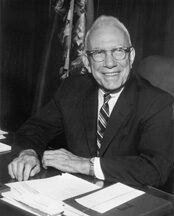
George Aiken
George Aiken was an American politician. Born August 20, 1892, in Dummerston. Died November 19, 1984, in Montpelier. Positions held include member of the Vermont House of Representatives (1931–1935), Governor of Vermont (1937–1941) and Speaker of the Vermont House of Representatives (1933–1935). Educated at Brattleboro Union High School. Awards include American Library Association Honorary Membership.
Facts
20 facts · 2 confirmed by two sources · 14 cited · 4 from one source
Where this comes from
Papalocal keeps its own record. It started from these sources; what each one said is kept here as it was copied, so a change on their side never changes this page by itself. Tap one to read its version.
What Wikidata says · copied November 18, 2026 · revision 2571579735
- Described as
- American politician (1892–1984)
- Other names
- George David Aiken, George D. Aiken
- Born
- August 20, 1892 · 3 references
- Died
- November 19, 1984 · 3 references
- Born in
- Dummerston · 1 reference
- Died in
- Montpelier · 1 reference
- Buried in
- Mount Pleasant Cemetery · 1 reference
- Cause of death
- cerebrovascular disease
- Citizen of
- United States
- Occupation
- politician · 1 reference; fruit grower (–1912) · 1 reference; academic administrator (1920–1937) · 1 reference; entrepreneur · 1 reference; business executive · 1 reference
- Positions held
- member of the Vermont House of Representatives (1931–1935) · 1 reference; Governor of Vermont (1937–1941); Speaker of the Vermont House of Representatives (1933–1935) · 1 reference; Lieutenant Governor of Vermont (1935–1937) · 1 reference; United States senator (1941–1975) · 1 reference
- Political party
- Republican Party
- Education
- Brattleboro Union High School · 2 references
- Awards
- American Library Association Honorary Membership (1982) · 2 references
- Wikipedias with a page
- 18
Wikidata item Q116751 (wikidata.org/wiki/Q116751), public domain (CC0). Copied November 18, 2026.
What Wikipedia says · copied November 18, 2026 · revision 1385993645
George David Aiken (August 20, 1892 – November 19, 1984) was an American politician and horticulturist. A member of the Republican Party, he was the 64th governor of Vermont (1937–1941) before serving in the United States Senate for 34 years, from 1941 to 1975. At the time of his retirement, he was the most senior member of the Senate, a feat which would be repeated by his immediate successor Patrick Leahy.
As governor, Aiken battled the New Deal over its programs for hydroelectric power and flood control in Vermont. As a Northeastern Republican in the Senate, he was one of four Republican cosponsors of the Full Employment Act of 1946. Aiken sponsored the food allotment bill of 1945, which was a forerunner of the food stamp program. He promoted federal aid to education and sought to establish a minimum wage of 65 cents in 1947. Aiken was an isolationist in 1941 but supported the Truman Doctrine in 1947 and the Marshall Plan in 1948.
In the 1960s and 1970s, he steered a middle course on the Vietnam War, opposing Lyndon Johnson's escalation and supporting Richard Nixon's slow withdrawal policies. Aiken was a strong supporter of the small farmer. As acting chairman of the Senate Agriculture Committee in 1947, he opposed high rigid price supports. He had to compromise, however, and the Hope-Aiken Act of 1948 introduced a sliding scale of price supports. In 1950, Aiken was one of seven Republican senators who denounced in writing the tactics of Senator Joseph McCarthy, warning against those who sought "victory through the selfish political exploitation of fear, bigotry, ignorance and intolerance."
- Born, in its opening lines
- August 20, 1892
- Died, in its opening lines
- November 19, 1984
From the Wikipedia article “George Aiken” (en.wikipedia.org/wiki/George_Aiken), by its contributors, under CC BY-SA 4.0 (creativecommons.org/licenses/by-sa/4.0/). Copied November 18, 2026; not changed.
Confirmed Two sources agree. Cited One source, and it names where it got it. One source One source, without a reference of its own. Sources disagree The sources disagree. We show the best-supported value and keep theirs below.
