
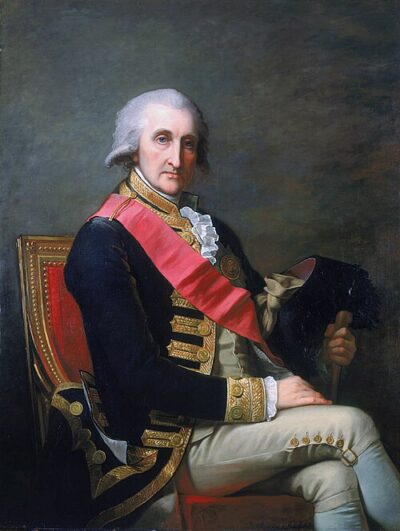
George Brydges Rodney, 1st Baron Rodney
George Brydges Rodney, 1st Baron Rodney was a Royal Navy admiral;. Born February 13, 1718, in London. Died May 24, 1792, in London. Positions held include member of the 11th Parliament of Great Britain, member of the 10th Parliament of Great Britain and member of the 12th Parliament of Great Britain. Educated at Harrow School. Awards include Order of the Bath.
Facts
32 facts · 2 confirmed by two sources · 14 cited · 15 from one source · 1 where the sources disagree
What’s different
- Born: we show February 13, 1718 (Confirmed). Wikidata also lists February 13, 1719
- Born in: we show London (Sources disagree). Wikidata also lists Walton-on-Thames
Where this comes from
Papalocal keeps its own record. It started from these sources; what each one said is kept here as it was copied, so a change on their side never changes this page by itself. Tap one to read its version.
What Wikidata says · copied November 18, 2026 · revision 2570755857
- Described as
- Royal Navy admiral; (1719–1792)
- Other names
- George Rodney, George Bridges Rodney, George Rodney, 1st Baron Rodney, George Bridges Rodney, 1st Baron Rodney, Admiral George Brydges Rodney, 1st Baron Rodney of Rodney Stoke, Admiral Rodney, Vice-Adm. George Brydges Rodney, Lord Rodney, George Brydges Rodney
- Born
- February 13, 1719 · 1 reference; February 13, 1718 · 1 reference
- Died
- May 24, 1792 · 5 references
- Born in
- Walton-on-Thames; London · 1 reference
- Died in
- London · 1 reference
- Buried in
- Church of St Mary, Old Alresford · 1 reference
- Name at birth
- George Brydges Rodney
- Citizen of
- Kingdom of Great Britain
- Occupation
- politician; naval officer; admiral · 1 reference
- Positions held
- member of the 11th Parliament of Great Britain; member of the 10th Parliament of Great Britain; member of the 12th Parliament of Great Britain; member of the 13th Parliament of Great Britain; member of the 15th Parliament of Great Britain
- Education
- Harrow School
- Awards
- Order of the Bath · 1 reference
- Spouse
- Jane Compton (1753–) · 2 references; Henrietta Clies (1764–) · 2 references
- Children
- James Rodney · 1 reference; Jane Rodney · 1 reference; Margaret Anne Rodney · 1 reference; George Rodney, 2nd Baron Rodney · 1 reference; John Rodney · 1 reference; Sarah Brydges Rodney · 1 reference; Edward Rodney · 1 reference
- Father
- Henry Rodney · 1 reference
- Mother
- Mary Newton · 1 reference
- Military branch
- Royal Navy
- Military rank
- admiral (1778–); vice admiral (1762–); rear admiral (1759–)
- Wikipedias with a page
- 23
Wikidata item Q332426 (wikidata.org/wiki/Q332426), public domain (CC0). Copied November 18, 2026.
What Wikipedia says · copied November 18, 2026 · revision 1384289729
Admiral of the White George Brydges Rodney, 1st Baron Rodney, KB (1718 – 24 May 1792) was a Royal Navy officer, politician and colonial administrator. He is best known for his service in the American War of Independence, particularly his victory over the French at the Battle of the Saintes in 1782. It has often been claimed that Rodney pioneered the tactic of breaking the line, though this is disputed.
Rodney went to sea at the age of 14, with his first major action being the Second Battle of Cape Finisterre in 1747. He made a large amount of prize money during the 1740s, allowing him to purchase a large country estate and a seat in the British House of Commons. During the Seven Years' War, Rodney was involved in a number of amphibious operations such as the Rochefort and Le Havre raids and capture of Louisbourg. He became well known for his role in the capture of Martinique in 1762. Following the 1763 Treaty of Paris, Rodney's financial situation stagnated. He spent large sums of money pursuing his political ambitions, and by 1774 had run up large debts and was forced to flee Britain to avoid his creditors. He was in a French jail when war broke out between Britain and France in 1778. Thanks to a French benefactor, Rodney was able to secure his release and return to Britain where he was appointed to a new command.
Rodney successfully relieved Gibraltar during the Franco-Spanish siege and defeated a Spanish fleet at the 1780 Battle of Cape St. Vincent. He then was posted to the Jamaica Station, where he led the capture of Sint Eustatius of 1781. Later that year, Rodney briefly returned home as he was suffering from ill health. Orders for his recall had been sent when Rodney won a decisive victory at the Battle of the Saintes in April 1782, ending Franco-Spanish plans to invade Jamaica. On his return to Britain, Rodney was made a peer and was awarded an annual pension of £2,000. He lived in retirement until his death in 1792.
- Born, in its opening lines
- 1718
- Died, in its opening lines
- May 24, 1792
From the Wikipedia article “George Rodney, 1st Baron Rodney” (en.wikipedia.org/wiki/George_Rodney,_1st_Baron_Rodney), by its contributors, under CC BY-SA 4.0 (creativecommons.org/licenses/by-sa/4.0/). Copied November 18, 2026; not changed.
Confirmed Two sources agree. Cited One source, and it names where it got it. One source One source, without a reference of its own. Sources disagree The sources disagree. We show the best-supported value and keep theirs below.
