
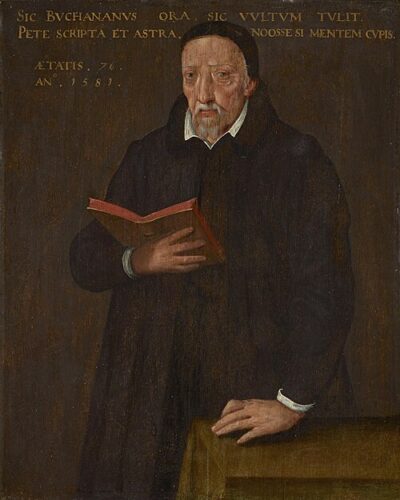
George Buchanan
George Buchanan was a Scottish historian and humanist scholar. Born February 1, 1506, in Killearn. Died September 28, 1582, in Edinburgh. Positions held include Member of the Parliament of Scotland, Director of Chancery and Keeper of the Privy Seal of Scotland. Known for De jure regni apud Scotos. Educated at University of St Andrews and University of Paris.
Facts
26 facts · 2 confirmed by two sources · 6 cited · 18 from one source
Where this comes from
Papalocal keeps its own record. It started from these sources; what each one said is kept here as it was copied, so a change on their side never changes this page by itself. Tap one to read its version.
What Wikidata says · copied November 16, 2026 · revision 2564368992
- Described as
- Scottish historian and humanist scholar (1506–1582)
- Other names
- Seòras Bochanan
- Born
- February 1, 1506 · 3 references
- Died
- September 28, 1582 · 2 references
- Born in
- Killearn · 1 reference
- Died in
- Edinburgh · 2 references
- Buried in
- Greyfriars Kirkyard
- Citizen of
- Scotland
- Occupation
- linguist; poet; historian · 1 reference; translator; playwright; writer · 1 reference; philosopher · 1 reference; preceptor
- Positions held
- Member of the Parliament of Scotland; Director of Chancery; Keeper of the Privy Seal of Scotland
- Worked for
- College of Guienne; University of St Andrews · 1 reference; Collège Sainte-Barbe; University of Paris
- Education
- University of St Andrews; University of Paris
- Known for
- De jure regni apud Scotos
- Father
- Thomas Buchanan · 1 reference
- Mother
- Agnes Heriot · 1 reference
- Wikipedias with a page
- 33
Wikidata item Q715169 (wikidata.org/wiki/Q715169), public domain (CC0). Copied November 16, 2026.
What Wikipedia says · copied November 16, 2026 · revision 1385564342
George Buchanan (Scottish Gaelic: Seòras Bochanan; February 1506 – 28 September 1582) was a Scottish historian and humanist scholar. According to historian Keith Brown, Buchanan was "the most profound intellectual sixteenth-century Scotland produced." His ideology of resistance to royal usurpation gained widespread acceptance during the Scottish Reformation. Brown says the ease with which King James VII was deposed in 1689 shows the power of Buchananite ideas.
His treatise De Jure Regni apud Scotos, published in 1579, discussed the doctrine that the source of all political power is the people, and that the king is bound by those conditions under which the supreme power was first committed to his hands, and that it is lawful to resist, even to punish, tyrants.
The importance of Buchanan's writings is shown by the suppression of his work by James VI and the British legislatures in the century following their publication. It was condemned by an act of Parliament, the Treason (No. 2) Act 1584 (May c. 8 (S)), and burned by the University of Oxford in 1664 and 1683.
- Born, in its opening lines
- February 1506
- Died, in its opening lines
- September 28, 1582
From the Wikipedia article “George Buchanan” (en.wikipedia.org/wiki/George_Buchanan), by its contributors, under CC BY-SA 4.0 (creativecommons.org/licenses/by-sa/4.0/). Copied November 16, 2026; not changed.
Confirmed Two sources agree. Cited One source, and it names where it got it. One source One source, without a reference of its own. Sources disagree The sources disagree. We show the best-supported value and keep theirs below.
