
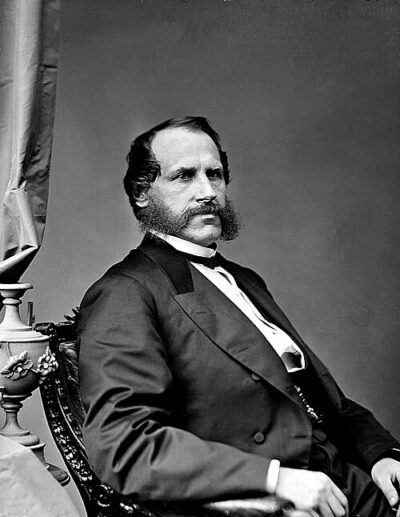
George Henry Williams
George Henry Williams was an American Lawyer, judge and politician, Oregon. Born March 26, 1823, in New Lebanon. Died April 4, 1910, in Portland. Positions held include United States Attorney General (1871–1875) and United States senator (1865–1871).
Facts
13 facts · 2 confirmed by two sources · 1 cited · 10 from one source
Where this comes from
Papalocal keeps its own record. It started from these sources; what each one said is kept here as it was copied, so a change on their side never changes this page by itself. Tap one to read its version.
What Wikidata says · copied November 18, 2026 · revision 2519172117
- Described as
- American Lawyer, judge and politician, Oregon (1823-1910)
- Born
- March 26, 1823 · 2 references
- Died
- April 4, 1910 · 2 references
- Born in
- New Lebanon
- Died in
- Portland
- Buried in
- River View Cemetery
- Citizen of
- United States
- Occupation
- politician; lawyer; judge
- Positions held
- United States Attorney General (1871–1875); United States senator (1865–1871) · 1 reference
- Political party
- Democratic Party; Republican Party
- Wikipedias with a page
- 18
Wikidata item Q725008 (wikidata.org/wiki/Q725008), public domain (CC0). Copied November 18, 2026.
What Wikipedia says · copied November 18, 2026 · revision 1382348378
George Henry Williams (March 26, 1823 – April 4, 1910) was an American judge and politician. He served as chief justice of the Oregon Supreme Court, was the 32nd attorney general of the United States, and was elected Oregon's U.S. senator, and served one term. Williams, as U.S. senator, authored and supported legislation that allowed the U.S. military to be deployed in Reconstruction of the southern states to allow for an orderly process of re-admittance into the United States. Williams was the first presidential Cabinet member to be appointed from the Pacific Coast. As attorney general under President Ulysses S. Grant, Williams continued the prosecutions that shut down the Ku Klux Klan. He had to contend with controversial election disputes in Reconstructed southern states. President Grant and Williams legally recognized P. B. S. Pinchback as the first African American state governor. Williams ruled that the Virginius, a gun-running ship delivering men and munitions to Cuban revolutionaries, which was captured by Spain during the Virginius Affair, did not have the right to bear the U.S. flag. However, he also argued that Spain did not have the right to execute American crew members. Nominated for Supreme Court Chief Justice by President Grant, Williams failed to be confirmed by the U.S. Senate primarily due to Williams's opposition to U.S. Attorney A. C. Gibbs, his former law partner, who refused to stop investigating Republican fraud in the special congressional election that resulted in a victory for Democrat James Nesmith.
In 1875, Williams resigned as U.S. Attorney General after his wife was accused of taking bribes from the custom house firm Pratt & Boyd, which attempted to persuade the U.S. Justice Department to drop litigation against the company. After his resignation, Williams took part in the effort to count Florida ballots for Rutherford B. Hayes during the controversial presidential election of 1876. Williams returned to Oregon, resumed private law practice, and was elected Portland's mayor, serving two terms from 1902 to 1905. Williams, at the age of 83, was indicted for not enforcing restrictions on gambling; he was acquitted and served out the rest of his term as mayor.
- Born, in its opening lines
- March 26, 1823
- Died, in its opening lines
- April 4, 1910
From the Wikipedia article “George Henry Williams” (en.wikipedia.org/wiki/George_Henry_Williams), by its contributors, under CC BY-SA 4.0 (creativecommons.org/licenses/by-sa/4.0/). Copied November 18, 2026; not changed.
Confirmed Two sources agree. Cited One source, and it names where it got it. One source One source, without a reference of its own. Sources disagree The sources disagree. We show the best-supported value and keep theirs below.
