
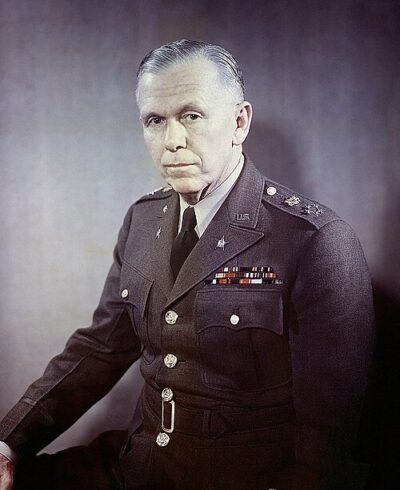
George Marshall
George Marshall was an American army officer and statesman. Born December 31, 1880, in Uniontown. Died October 16, 1959, in Washington, D.C.. Positions held include United States Secretary of State (1947–1949), United States Secretary of Defense (1950–1951) and Chief of Staff of the United States Army (1939–1945). Educated at Virginia Military Institute and United States Army Command and General Staff College. Awards include Charlemagne Prize, Nobel Peace Prize and Knight Grand Cross of the Order of the Bath.
Facts
48 facts · 2 confirmed by two sources · 16 cited · 30 from one source
Where this comes from
Papalocal keeps its own record. It started from these sources; what each one said is kept here as it was copied, so a change on their side never changes this page by itself. Tap one to read its version.
What Wikidata says · copied November 13, 2026 · revision 2568249782
- Described as
- American army officer and statesman (1880–1959)
- Other names
- George Catlett Marshall, Jr., George Catlett Marshall, George C. Marshall
- Born
- December 31, 1880 · 11 references
- Died
- October 16, 1959 · 13 references
- Born in
- Uniontown
- Died in
- Washington, D.C. · 4 references
- Buried in
- Arlington National Cemetery (1959) · 2 references
- Name at birth
- George Catlett Marshall
- Citizen of
- United States
- Occupation
- politician · 2 references; diplomat · 1 reference; army officer; American football player; foreign minister · 1 reference
- Positions held
- United States Secretary of State (1947–1949); United States Secretary of Defense (1950–1951) · 1 reference; Chief of Staff of the United States Army (1939–1945) · 1 reference; United States Ambassador to the Republic of China (1912-1949); defence minister · 1 reference
- Education
- Virginia Military Institute; United States Army Command and General Staff College
- Member of
- American Philosophical Society (1946–)
- Teams
- VMI Keydets football · 1 reference
- Sport
- American football
- Awards
- Charlemagne Prize (1959) · 1 reference; Nobel Peace Prize (1953) · 2 references; Knight Grand Cross of the Order of the Bath; Grand Cross of the Order of Wissam Alaouite; Silver Star; Order of Suvorov, 1st class; Distinguished Service Medal; American Defense Service Medal; American Campaign Medal; World War II Victory Medal; National Defense Service Medal; Grand Cross of the Legion of Honour; Grand Cross of the Order of George I; Grand Officer of the Order of Saints Maurice and Lazarus; grand officer of the Order of the Crown of Italy
- Field
- politics · 1 reference; military affairs · 1 reference; diplomacy · 1 reference
- Spouse
- Elizabeth Carter Coles Marshall; Katherine Boyce Tupper Brown Marshall (1930–) · 2 references
- Father
- George Catlett Marshall, Sr. · 1 reference
- Religion
- Episcopal Church
- Military branch
- United States Army
- Military rank
- General of the Army; general · 2 references
- Lived in
- Dodona Manor (1941–1959) · 1 reference
- Wikipedias with a page
- 105
Wikidata item Q151414 (wikidata.org/wiki/Q151414), public domain (CC0). Copied November 13, 2026.
What Wikipedia says · copied November 13, 2026 · revision 1384564631
General of the Army George Catlett Marshall Jr. (31 December 1880 – 16 October 1959) was an American military officer and diplomat. He rose through the United States Army to become Chief of Staff of the U.S. Army under presidents Franklin D. Roosevelt and Harry S. Truman, then served as Secretary of State and Secretary of Defense under Truman. Winston Churchill lauded Marshall as the "organizer of victory" for his leadership of the Allied victory in World War II. During the subsequent year, he unsuccessfully tried to prevent the continuation of the Chinese Civil War. As Secretary of State, Marshall advocated for a U.S. economic and political commitment to post-war European recovery, including the Marshall Plan that bore his name. In recognition of this work, he was awarded the Nobel Peace Prize in 1953, the only Army general ever to receive the honor.
Born in Uniontown, Pennsylvania, Marshall graduated from the Virginia Military Institute (VMI) in 1901. He received his commission as a second lieutenant of Infantry in February 1902 and immediately went to the Philippines. He served in the United States and overseas in positions of increasing rank, including platoon leader and company commander in the Philippines during the Philippine–American War. He was the top-ranked of the five Honor Graduates of his Infantry-Cavalry School Course in 1907 and graduated first in his 1908 Army Staff College class. In 1916 Marshall was assigned as aide-de-camp to J. Franklin Bell, the commander of the Western Department. After the nation entered the First World War in 1917, Marshall served with Bell, who commanded the Department of the East. He was assigned to the staff of the 1st Division; he assisted with the organization's mobilization and training in the United States, as well as planning of its combat operations in France. Subsequently assigned to the staff of the American Expeditionary Forces headquarters, he was a key planner of American operations, including the Meuse-Argonne Offensive.
Following his service in World War I, Marshall became an aide-de-camp to Army chief of staff John J. Pershing. Marshall later served on the Army staff, was the executive officer of the 15th Infantry Regiment in China and was an instructor at the Army War College. In 1927, he became assistant commandant of the Army's Infantry School, where he modernized command and staff processes, which proved to be of major benefit during World War II. In 1932 and 1933, he commanded the 8th Infantry Regiment and Fort Screven, Georgia. Marshall commanded 5th Brigade, 3rd Infantry Division and Vancouver Barracks from 1936 to 1938; he received promotion to brigadier general. During this command, Marshall was also responsible for 35 Civilian Conservation Corps (CCC) camps in Oregon and Southern Washington. In July 1938, Marshall was assigned to the War Plans Division on the War Department staff; he later became the Army's deputy chief of staff. When Chief of Staff Malin Craig retired in 1939, Marshall assumed the role of Chief of Staff in an acting capacity before his appointment to the position, which he held until the war's end in 1945.
As the U.S. Army's chief of staff, Marshall worked closely with Secretary of War Henry L. Stimson to organize the largest military expansion in U.S. history, and was ultimately promoted to five-star rank as General of the Army. Marshall coordinated Allied operations in Europe and the Pacific until the end of the war. In addition to accolades from Winston Churchill and other Allied leaders, Time magazine named Marshall its Man of the Year for 1943 and 1947. Marshall retired from active service in 1945, but remained on active duty, as required for holders of five-star rank. From 15 December 1945 to January 1947, Marshall served as a special envoy to China in an unsuccessful effort to negotiate a coalition government between the Nationalists of Chiang Kai-shek and the Communists of Mao Zedong.
As Secretary of State from 1947 to 1949, Marshall advocated rebuilding Europe, a program that became known as the Marshall Plan, and which led to his being awarded the 1953 Nobel Peace Prize. After resigning as Secretary of State, Marshall served as chairman of the American Battle Monuments Commission and president of the American National Red Cross. As Secretary of Defense after the start of the Korean War, Marshall worked to restore the military's confidence and morale after the end of its post-World War II demobilization and then its initial buildup for combat in Korea and operations during the Cold War. Resigning as Defense Secretary, Marshall retired to his home in Virginia. He died in 1959 and was buried with honors at Arlington National Cemetery.
- Born, in its opening lines
- December 31, 1880
- Died, in its opening lines
- October 16, 1959
From the Wikipedia article “George C. Marshall” (en.wikipedia.org/wiki/George_C._Marshall), by its contributors, under CC BY-SA 4.0 (creativecommons.org/licenses/by-sa/4.0/). Copied November 13, 2026; not changed.
Confirmed Two sources agree. Cited One source, and it names where it got it. One source One source, without a reference of its own. Sources disagree The sources disagree. We show the best-supported value and keep theirs below.
