
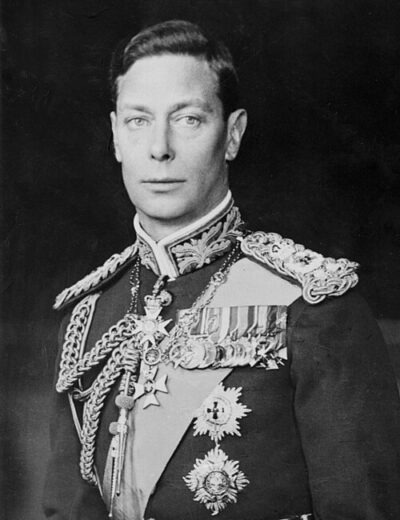
George VI
George VI was a King of the United Kingdom from 1936 to 1952. Born December 14, 1895, in York Cottage. Died February 6, 1952, in Sandringham House. Positions held include monarch of Australia (1942–1952), monarch of New Zealand (1947–1952) and monarch of the Dominion of Ceylon (1948–1952). Educated at Trinity College. Awards include Grand Cross of the Legion of Honour, Companion of the Liberation and Knight Grand Cross of the Royal Victorian Order.
Facts
63 facts · 2 confirmed by two sources · 10 cited · 51 from one source
Where this comes from
Papalocal keeps its own record. It started from these sources; what each one said is kept here as it was copied, so a change on their side never changes this page by itself. Tap one to read its version.
What Wikidata says · copied November 16, 2026 · revision 2567828411
- Described as
- King of the United Kingdom from 1936 to 1952
- Other names
- Prince Albert, Duke of York, The Prince Albert of the United Kingdom, George Windsor, The Prince Albert Frederick Arthur George of the United Kingdom, Bertie, Prince Albert Frederick Arthur George of Cornwall and York, The Prince Albert Frederick Arthur George, Duke of York, Albert Frederick Arthur George, Prince Albert Frederick Arthur George, Duke of York, Prince Albert of York, Prince Albert of Wales, Prince Albert Frederick Arthur George of Wales
- Born
- December 14, 1895 · 13 references
- Died
- February 6, 1952 · 13 references
- Born in
- York Cottage
- Died in
- Sandringham House · 1 reference
- Buried in
- King George VI Memorial Chapel · 1 reference
- Cause of death
- lung cancer
- Name at birth
- Prince Albert Frederick Arthur George of York
- Citizen of
- United Kingdom; United Kingdom of Great Britain and Ireland (–1927)
- Occupation
- monarch; aristocrat; military officer; tennis player · 1 reference
- Positions held
- monarch of Australia (1942–1952); monarch of New Zealand (1947–1952); monarch of the Dominion of Ceylon (1948–1952); Emperor of India (1936–1948); King of India (1947–1950); emperor (1936–1937); Monarch of the United Kingdom (1936–1952); monarch of the Dominion of Pakistan (1947–1952); monarch of Canada (1936–1952); monarch of the Union of South Africa (1936–1952); Duke of York (1920–1936) · 1 reference
- Education
- Trinity College (–1920)
- Member of
- Royal Society of London (1932–); The Work Foundation; George VI and Queen Elizabeth
- Sport
- tennis
- Awards
- Grand Cross of the Legion of Honour; Companion of the Liberation; Knight Grand Cross of the Royal Victorian Order; Chief Commander of the Legion of Merit; Knight Grand Cross of the Order of the White Eagle; Knight Grand Cross of the Order of St Michael and St George; Grand Cordon of the Supreme Order of the Chrysanthemum; Legionnaire of Legion of Merit; Order of St. Vladimir, 4th class with Swords (1917); War Cross; Royal Victorian Chain (1927); Knight Grand Cross of the Military Order of William (1946); Albert Medal (1951); Collar of the Supreme Order of the Chrysanthemum; Grand Cross of the Sash of the Three Orders · 1 reference
- Spouse
- Queen Elizabeth the Queen Mother (1923–1952) · 3 references
- Children
- Elizabeth II · 1 reference; Princess Margaret, Countess of Snowdon · 1 reference
- Father
- George V · 1 reference
- Mother
- Mary of Teck · 1 reference
- Siblings
- Edward VIII · 1 reference; Mary, Princess Royal and Countess of Harewood; Prince Henry, Duke of Gloucester; Prince George, Duke of Kent; Prince John of the United Kingdom
- Religion
- Church of England; Christianity · 1 reference
- Military branch
- Royal Navy; Royal Air Force; British Army
- Military rank
- commander-in-chief; Captain General Royal Marines (1936–1952) · 1 reference
- Lived in
- Buckingham Palace
- Nickname
- Bertie
- Wikipedias with a page
- 121
Wikidata item Q280856 (wikidata.org/wiki/Q280856), public domain (CC0). Copied November 16, 2026.
What Wikipedia says · copied November 16, 2026 · revision 1385096978
George VI (Albert Frederick Arthur George; 14 December 1895 – 6 February 1952) was King of the United Kingdom and the Dominions of the British Commonwealth from 11 December 1936 until his death in 1952. He was also the last Emperor of India from 1936 until the British Raj was dissolved in August 1947, though the title was only formally relinquished in June 1948. Following the London Declaration of 1949, he was the first Head of the Commonwealth.
The future George VI was born during the reign of his great-grandmother Queen Victoria; he was named Albert at birth after his late great-grandfather Prince Albert of Saxe-Coburg and Gotha and was known as "Bertie" to his family and close friends. His father ascended the throne as George V in 1910. As the second son of the king, Albert was not expected to inherit the throne. He spent his early life in the shadow of his elder brother, Edward, the heir apparent. Albert attended naval college as a teenager and served in the Royal Navy and Royal Air Force during the First World War. In 1920, he was made Duke of York. He married Lady Elizabeth Bowes-Lyon in 1923, and they had two daughters, Elizabeth and Margaret. In the mid-1920s, he engaged speech therapist Lionel Logue to treat his stutter, which he learned to manage to some degree. His elder brother ascended the throne as Edward VIII after their father died in 1936, but Edward abdicated later that year to marry the twice-divorced American socialite Wallis Simpson. As heir presumptive to Edward VIII, Albert became king, taking the regnal name George VI. His coronation took place in 1937.
In September 1939, the British Empire and most Commonwealth countries – but not Ireland – declared war on Nazi Germany, following the invasion of Poland. War with the Kingdom of Italy and the Empire of Japan followed in 1940 and 1941, respectively. George VI was seen as sharing the hardships of the common people and his popularity soared. Buckingham Palace was bombed during the Blitz while the King and Queen were there, and his younger brother the Duke of Kent was killed in a plane crash while on active service. George VI became known as a symbol of British determination to win the war. Britain and its allies were victorious in 1945, but the British Empire declined. Ireland had largely broken away, followed by the independence of India and Pakistan in 1947. The King relinquished the title of Emperor of India in June 1948 and instead adopted the new title of Head of the Commonwealth. He was beset by smoking-related health problems in the later years of his reign and died at Sandringham House, aged 56, of a coronary thrombosis. He was succeeded by his elder daughter, Elizabeth II.
- Born, in its opening lines
- December 14, 1895
- Died, in its opening lines
- February 6, 1952
From the Wikipedia article “George VI” (en.wikipedia.org/wiki/George_VI), by its contributors, under CC BY-SA 4.0 (creativecommons.org/licenses/by-sa/4.0/). Copied November 16, 2026; not changed.
Confirmed Two sources agree. Cited One source, and it names where it got it. One source One source, without a reference of its own. Sources disagree The sources disagree. We show the best-supported value and keep theirs below.
