
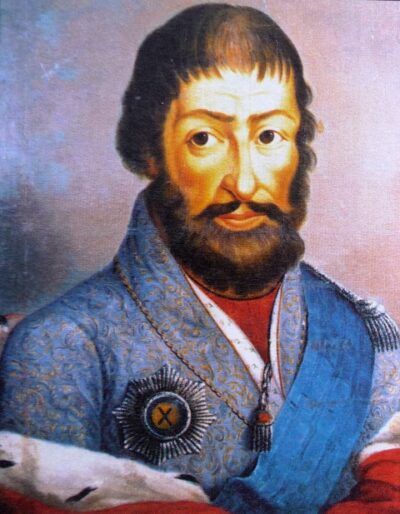
George XII of Georgia
George XII of Georgia was a king of Georgia (Kingdom of Kartli and Kakheti). Born November 10, 1746, in Telavi. Died December 28, 1800, in Tbilisi. Positions held include king of Kartli and Kakheti. Awards include Order of Saint Alexander Nevsky and Order of St. Andrew.
Facts
33 facts · 2 confirmed by two sources · 7 cited · 24 from one source
Where this comes from
Papalocal keeps its own record. It started from these sources; what each one said is kept here as it was copied, so a change on their side never changes this page by itself. Tap one to read its version.
What Wikidata says · copied November 16, 2026 · revision 2526848517
- Described as
- king of Georgia (Kingdom of Kartli and Kakheti)
- Other names
- George XII
- Born
- November 10, 1746 · 1 reference
- Died
- December 28, 1800 · 4 references
- Born in
- Telavi · 3 references
- Died in
- Tbilisi · 3 references
- Buried in
- Svetitskhoveli Cathedral · 1 reference
- Occupation
- monarch · 2 references; ruler · 1 reference; royalty · 1 reference
- Positions held
- king of Kartli and Kakheti · 4 references
- Awards
- Order of Saint Alexander Nevsky; Order of St. Andrew
- Spouse
- Mariam Tsitsishvili · 1 reference; Ketevan Andronikashvili · 1 reference
- Children
- Prince David of Georgia; Prince Ioane of Georgia · 1 reference; Ilia of Georgia; Prince Teimuraz of Georgia; Bagrat of Georgia; Prince Mikheil of Georgia; Prince Jibrael of Georgia; Okropir, son of George XII of Georgia; Nino of Mingrelia · 1 reference
- Father
- Heraclius II of Georgia · 4 references
- Mother
- Anna Abashidze · 3 references
- Siblings
- Princess Elene of Georgia; Prince Alexander of Georgia; Anton II of Georgia; Prince Mirian of Georgia; Prince Vakhtang-Almaskhan of Georgia; Prince Iulon of Georgia; Prince Parnaoz of Georgia; Princess Tekle of Georgia · 1 reference
- Religion
- Georgian Orthodox Church · 3 references
- Wikipedias with a page
- 29
Wikidata item Q668957 (wikidata.org/wiki/Q668957), public domain (CC0). Copied November 16, 2026.
What Wikipedia says · copied November 16, 2026 · revision 1369536055
George XII (Georgian: გიორგი XII, romanized: giorgi XII; 10 November 1746 – 28 December 1800), contemporaneously known as George XIII, of the Bagrationi dynasty, was the second and last king (mepe) of the Kingdom of Kartli-Kakheti in eastern Georgia from 1798 until his death in 1800.
The second son of King Heraclius II, George was raised in a country at war, facing regular attacks from the Persian and Ottoman empires in its south, and constant Lezgin raids from its northeast, and became heir to the throne after the early death of his older brother. As prince, he was a diligent governor of royal domains, seeking to repopulate devastated regions in Georgian Armenia, while seating on his father's royal council, assisting him in leading Georgian forces against Ottoman incursions, and representing him in diplomatic negotiations to bring peace to Western Georgia. However, he had to face the ambitions of his step-mother Queen Darejan and her sons, ambitions that would grow into open tensions and a 1794 deal in which King Heraclius changed the law of succession to make George's younger brothers next in line after George.
Taking over after his father's death in 1798, George sought closer relations with Russian Empire as a guarantee to secure his succession, especially after reverting the 1794 deal and appointing his son David as crown prince. This led to a civil war, with the king's younger brothers rebelling, and Russia dispatching troops in 1799 to restore peace in Kartli-Kakheti. An astute diplomat, he also sought alliances with Persia and the Ottoman Empire and was proposed a military partnership by Napoleon, but was forced to use Russia's power to prevent further devastations of his kingdom by his southern neighbors.
Weakened by illness, he was considered a failed monarch, paralyzed by paranoia, who could not put an end to the constant rebellions of his brothers. The poor economic state of the country led to a collapse in bureaucracy and a rise in crime, while he failed to implement any of the major public, financial, and educational reforms his son Ioane proposed. Supporting his kingdom's integration into the Russian Empire, he trusted Russian diplomats without realizing their own role in dividing Georgian nobility. In 1800, George secured from Emperor Paul I an approval of what his "Petitionary Articles", which provided for Eastern Georgia's integration into Russia as an autonomous kingdom, although he died without knowing about its ratification. His death opened the doors for Russia to break its agreements and fully annex Georgia.
- Born, in its opening lines
- November 10, 1746
- Died, in its opening lines
- December 28, 1800
From the Wikipedia article “George XII” (en.wikipedia.org/wiki/George_XII), by its contributors, under CC BY-SA 4.0 (creativecommons.org/licenses/by-sa/4.0/). Copied November 16, 2026; not changed.
Confirmed Two sources agree. Cited One source, and it names where it got it. One source One source, without a reference of its own. Sources disagree The sources disagree. We show the best-supported value and keep theirs below.
