
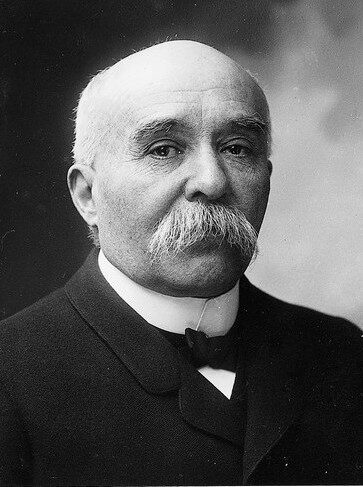
Georges Clemenceau
Georges Clemenceau was a Prime Minister of France, 1906–1909 and 1917–1920. Born September 28, 1841, in Mouilleron-en-Pareds. Died November 24, 1929, in Paris. Positions held include arrondissement mayor (1870–1871), member of the French National Assembly (2 times) (1871–1885) and Minister of War (1917–1920). Educated at University of Paris. Awards include Grand Cross of the Legion of Honour, Order of the White Eagle (Second Polish Republic) and Cross of Liberty.
Facts
44 facts · 2 confirmed by two sources · 18 cited · 24 from one source
Where this comes from
Papalocal keeps its own record. It started from these sources; what each one said is kept here as it was copied, so a change on their side never changes this page by itself. Tap one to read its version.
What Wikidata says · copied November 16, 2026 · revision 2562738715
- Described as
- Prime Minister of France, 1906–1909 and 1917–1920 (1841–1929)
- Other names
- Georges Benjamin Clemenceau, Clemenceau
- Born
- September 28, 1841 · 17 references
- Died
- November 24, 1929 · 18 references
- Born in
- Mouilleron-en-Pareds · 1 reference
- Died in
- Paris · 3 references
- Buried in
- Mouchamps · 1 reference
- Name at birth
- Georges Benjamin Clemenceau
- Citizen of
- France · 1 reference
- Occupation
- politician · 4 references; journalist · 3 references; physician · 2 references; screenwriter; novelist; head of government · 1 reference; mayor · 1 reference; teacher · 1 reference
- Positions held
- arrondissement mayor (1870–1871); member of the French National Assembly (2 times) (1871–1885); Minister of War (1917–1920); President of the Council (2 times) (1906–1920) · 1 reference; senator of the French Third Republic (1902–1920) · 1 reference; Member of the Académie française (1918–1929) · 1 reference; Deputy of the French Third Republic (1889–1893) · 1 reference
- Political party
- Radical Party; Radical-Socialist and Radical Republican Party
- Education
- University of Paris
- Member of
- Académie Française (1918–1929) · 2 references; Hellenic Philological Society of Constantinople (1907–); Académie Nationale de Médecine
- Awards
- Grand Cross of the Legion of Honour; Order of the White Eagle (Second Polish Republic) (1922); Cross of Liberty · 1 reference; Honorary doctor of the University of Liège (1919) · 1 reference; Cross of Valour (1920) · 1 reference
- Spouse
- Mary Plummer (1869–1891) · 1 reference
- Children
- Michel Clemenceau · 1 reference; Madeleine Clemenceau-Jacquemaire; Thérèse Clemenceau · 1 reference
- Father
- Paul Benjamin Clemenceau
- Mother
- Emma Gautreau
- Siblings
- Sophie Clemenceau; Albert Clemenceau; Paul Clemenceau
- Religion
- Protestantism · 1 reference; atheism
- Wikipedias with a page
- 102
Wikidata item Q171730 (wikidata.org/wiki/Q171730), public domain (CC0). Copied November 16, 2026.
What Wikipedia says · copied November 16, 2026 · revision 1385789296
Georges Benjamin Clemenceau (28 September 1841 – 24 November 1929) was a French statesman who was prime minister of France from 1906 to 1909 and again from 1917 until 1920. A physician turned journalist, he played a central role in the politics of the Third Republic, particularly amid the end of the First World War. He was a key figure of the Independent Radicals, advocating for the separation of church and state, as well as the amnesty of the Communards exiled to New Caledonia.
After about 1,400,000 French soldiers were killed between the German invasion and Armistice, he demanded a total victory over the German Empire. Clemenceau stood for reparations, a transfer of colonies, strict rules to prevent a rearming process, as well as the restitution of Alsace–Lorraine, which had been annexed to Germany in 1871. He achieved these goals through the Treaty of Versailles signed at the Paris Peace Conference (1919–1920). Nicknamed Père la Victoire ("Father Victory") or Le Tigre ("The Tiger"), he continued his harsh position against Germany in the 1920s, although not quite so much as President Raymond Poincaré or former Supreme Allied Commander Ferdinand Foch, both of whom thought the treaty was too lenient on Germany. Clemenceau obtained mutual defence treaties with the United Kingdom and the United States against possible future German aggression, but these never took effect due to the U.S. Senate's failure to ratify the treaty, which in turn released Britain from its obligation.
- Born, in its opening lines
- September 28, 1841
- Died, in its opening lines
- November 24, 1929
From the Wikipedia article “Georges Clemenceau” (en.wikipedia.org/wiki/Georges_Clemenceau), by its contributors, under CC BY-SA 4.0 (creativecommons.org/licenses/by-sa/4.0/). Copied November 16, 2026; not changed.
Confirmed Two sources agree. Cited One source, and it names where it got it. One source One source, without a reference of its own. Sources disagree The sources disagree. We show the best-supported value and keep theirs below.
