
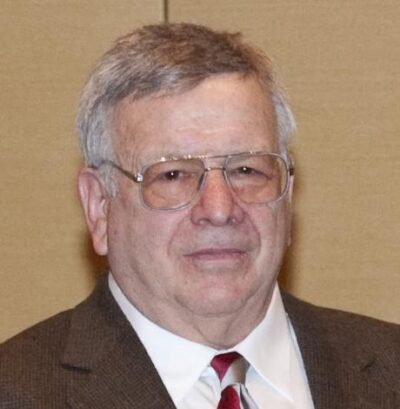
Gerald Guralnik
Gerald Guralnik was an American physicist. Born September 17, 1936, in Cedar Falls. Died April 26, 2014, in Providence. Educated at Harvard University and Massachusetts Institute of Technology. Awards include Fellow of the American Physical Society and Sakurai Prize.
Facts
13 facts · 2 confirmed by two sources · 3 cited · 8 from one source
Where this comes from
Papalocal keeps its own record. It started from these sources; what each one said is kept here as it was copied, so a change on their side never changes this page by itself. Tap one to read its version.
What Wikidata says · copied November 18, 2026 · revision 2540968535
- Described as
- American physicist
- Other names
- Gerald Stanford Guralnik
- Born
- September 17, 1936
- Died
- April 26, 2014
- Born in
- Cedar Falls
- Died in
- Providence · 1 reference
- Citizen of
- United States
- Occupation
- physicist; university teacher; theoretical physicist
- Worked for
- Brown University
- Education
- Harvard University · 1 reference; Massachusetts Institute of Technology
- Awards
- Fellow of the American Physical Society; Sakurai Prize (2010) · 2 references
- Wikipedias with a page
- 16
Wikidata item Q1509906 (wikidata.org/wiki/Q1509906), public domain (CC0). Copied November 18, 2026.
What Wikipedia says · copied November 18, 2026 · revision 1371999320
Gerald Stanford "Gerry" Guralnik (; September 17, 1936 – April 26, 2014) was the Chancellor’s Professor of Physics at Brown University. In 1964, he co-discovered the Higgs mechanism and Higgs boson with C. R. Hagen and Tom Kibble (GHK). As part of Physical Review Letters' 50th anniversary celebration, the journal recognized this discovery as one of the milestone papers in PRL history. While widely considered to have authored the most complete of the early papers on the Higgs theory, GHK were controversially not included in the 2013 Nobel Prize in Physics.
In 2010, Guralnik was awarded the American Physical Society's J. J. Sakurai Prize for Theoretical Particle Physics for the "elucidation of the properties of spontaneous symmetry breaking in four-dimensional relativistic gauge theory and of the mechanism for the consistent generation of vector boson masses".
Guralnik received his B.S. degree from the Massachusetts Institute of Technology in 1958 and his Ph.D. degree from Harvard University in 1964. He went to Imperial College London as a postdoctoral fellow supported by the National Science Foundation and then became a postdoctoral fellow at the University of Rochester. In the fall of 1967 Guralnik went to Brown University and frequently visited Imperial College and Los Alamos National Laboratory where he was a staff member from 1985 to 1987. While at Los Alamos, he did extensive work on the development and application of computational methods for lattice QCD.
Guralnik died of a heart attack at age 77 in 2014.
- Born, in its opening lines
- September 17, 1936
- Died, in its opening lines
- April 26, 2014
From the Wikipedia article “Gerald Guralnik” (en.wikipedia.org/wiki/Gerald_Guralnik), by its contributors, under CC BY-SA 4.0 (creativecommons.org/licenses/by-sa/4.0/). Copied November 18, 2026; not changed.
Confirmed Two sources agree. Cited One source, and it names where it got it. One source One source, without a reference of its own. Sources disagree The sources disagree. We show the best-supported value and keep theirs below.
