
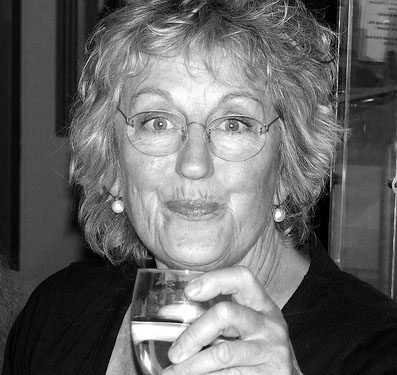
Germaine Greer
Germaine Greer is an Australian writer and public intellectual. Born January 29, 1939, in Melbourne. Known for The Female Eunuch and The Beautiful Boy. Educated at University of Sydney and University of Melbourne. Awards include Victorian Honour Roll of Women, Australian National Living Treasure and honorary doctor of the University of Sydney.
Facts
31 facts · 1 confirmed by two sources · 19 cited · 11 from one source
Where this comes from
Papalocal keeps its own record. It started from these sources; what each one said is kept here as it was copied, so a change on their side never changes this page by itself. Tap one to read its version.
What Wikidata says · copied November 16, 2026 · revision 2558022767
- Described as
- Australian writer and public intellectual (born 1939)
- Other names
- Rose Blight, Dr. G Terf
- Born
- January 29, 1939 · 3 references
- Born in
- Melbourne · 4 references
- Citizen of
- Australia · 1 reference
- Occupation
- essayist · 1 reference; journalist · 1 reference; professor · 3 references; screenwriter · 2 references; actor · 2 references; women's rights activist; critic · 1 reference; broadcaster · 1 reference
- Worked for
- University of Warwick
- Education
- University of Sydney · 1 reference; University of Melbourne · 1 reference; Newnham College; University of Cambridge (–1967) · 1 reference; University of Warwick
- Known for
- The Female Eunuch · 1 reference; The Beautiful Boy
- Awards
- Victorian Honour Roll of Women (2001) · 1 reference; Australian National Living Treasure; honorary doctor of the University of Sydney; Ackerley Prize; Fellow of the Royal Society of Literature (2016) · 1 reference
- Field
- gender studies; English-language literature · 1 reference; feminism
- Spouse
- Paul du Feu (1968–) · 1 reference
- Father
- Reg Greer · 1 reference
- Mother
- Peggy Lafrank · 1 reference
- Religion
- atheism
- Wikipedias with a page
- 82
Wikidata item Q103591 (wikidata.org/wiki/Q103591), public domain (CC0). Copied November 16, 2026.
What Wikipedia says · copied November 16, 2026 · revision 1385769377
Germaine Greer (; born 29 January 1939) is an Australian writer and public intellectual, regarded as one of the major voices of the second-wave feminism movement in the latter half of the 20th century.
Specialising in English and women's literature, Greer has held academic positions in England at the University of Warwick and Newnham College, Cambridge, and in the United States at the University of Tulsa. She started living in the UK in 1964, and from the 1990s until her later years, divided her time between Queensland, Australia, and her home in Essex, England.
Greer's ideas have created controversy ever since her first book, The Female Eunuch (1970), made her a household name. An international bestseller and a watershed text in the feminist movement, it offered a systematic deconstruction of ideas such as womanhood and femininity, arguing that women were forced to assume submissive roles in society to fulfil male fantasies of what being a woman entailed.
Greer's subsequent work has focused on literature, feminism, and the environment. She has written over 20 books, including Sex and Destiny (1984), The Change (1991), The Whole Woman (1999), and The Boy (2003). Her 2013 book White Beech: The Rainforest Years describes her efforts to restore an area of rainforest in the Numinbah Valley in Australia. In addition to her academic work and activism, she has been a prolific columnist for The Sunday Times, The Guardian, The Daily Telegraph, The Spectator, The Independent, and The Oldie, among others.
Greer is a liberation (or radical) rather than equality feminist. Her goal is not equality with men, which she sees as assimilation and "agreeing to live the lives of unfree men". "Women's liberation", she wrote in The Whole Woman (1999), "did not see the female's potential in terms of the male's actual." She argues instead that liberation is about asserting difference and "insisting on it as a condition of self-definition and self-determination". It is a struggle for the freedom of women to "define their own values, order their own priorities and decide their own fate".
- Born, in its opening lines
- January 29, 1939
From the Wikipedia article “Germaine Greer” (en.wikipedia.org/wiki/Germaine_Greer), by its contributors, under CC BY-SA 4.0 (creativecommons.org/licenses/by-sa/4.0/). Copied November 16, 2026; not changed.
Confirmed Two sources agree. Cited One source, and it names where it got it. One source One source, without a reference of its own. Sources disagree The sources disagree. We show the best-supported value and keep theirs below.
