
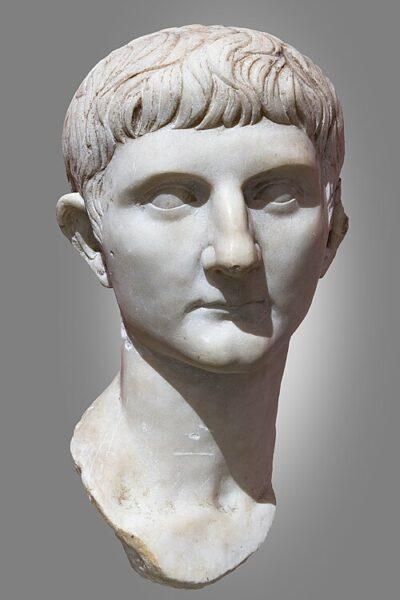
Germanicus
Germanicus was a nephew and adopted son of emperor Tiberius, heir apparent of the Roman Empire, and father of emperor Caligula. Born May 24, 15 BC, in Rome. Died October 10, 19, in Antioch. Positions held include ancient Roman senator, quaestor and Roman consul. Known for Aratea. Awards include Olympic victor, tethrippon (4-horse chariot) and Roman triumph.
Facts
32 facts · 0 confirmed by two sources · 10 cited · 21 from one source · 1 where the sources disagree
What’s different
- Father: we show Nero Claudius Drusus (Sources disagree). Wikidata also lists Tiberius
Where this comes from
Papalocal keeps its own record. It started from these sources; what each one said is kept here as it was copied, so a change on their side never changes this page by itself. Tap one to read its version.
What Wikidata says · copied November 16, 2026 · revision 2569633571
- Described as
- nephew and adopted son of emperor Tiberius, heir apparent of the Roman Empire, and father of emperor Caligula
- Other names
- Germanicus Julius Caesar, Nero Claudius Drusus, Germanicus Caesar, Cæsar Germanicus, Caesar Germanicus, Germanicus Iulius Caesar
- Born
- May 24, 15 BC · 2 references
- Died
- October 10, 19 · 2 references
- Born in
- Rome
- Died in
- Antioch
- Buried in
- Mausoleum of Augustus
- Name at birth
- Nero Claudius Drusus
- Citizen of
- Ancient Rome
- Occupation
- politician; writer · 1 reference; poet; military leader · 1 reference
- Positions held
- ancient Roman senator; quaestor; Roman consul
- Known for
- Aratea
- Awards
- Olympic victor, tethrippon (4-horse chariot) (17); Roman triumph (17)
- Spouse
- Agrippina the Elder · 1 reference
- Children
- Caligula · 1 reference; Nero Caesar · 1 reference; Julia Drusilla; Julia Livilla; Drusus Caesar · 1 reference; Agrippina the Younger · 1 reference; Gaius Julius Caesar Germanicus Major; Tiberius Caesar; Ignotus Julius Caesar Germanicus
- Father
- Nero Claudius Drusus · 2 references; Tiberius
- Mother
- Antonia Minor · 1 reference
- Siblings
- Livilla; Claudius
- Military branch
- Roman army · 1 reference
- Wikipedias with a page
- 62
Wikidata item Q191039 (wikidata.org/wiki/Q191039), public domain (CC0). Copied November 16, 2026.
What Wikipedia says · copied November 16, 2026 · revision 1384659727
Germanicus Julius Caesar (24 May 15 BC – 10 October AD 19) was a Roman general and politician most famously known for his campaigns against Arminius in Germania. The son of Nero Claudius Drusus and Antonia the Younger, Germanicus was born into an influential branch of the patrician gens Claudia. The agnomen Germanicus was added to his full name in 9 BC when it was posthumously awarded to his father in honor of his victories in Germania. In AD 4 he was adopted by his paternal uncle Tiberius, himself the stepson and heir of Germanicus' great-uncle Augustus; ten years later, Tiberius succeeded Augustus as Roman emperor. As a result of his adoption, Germanicus became an official member of the gens Julia, another prominent family, to which he was related on his mother's side. His connection to the Julii Caesares was further consolidated through a marriage between him and Agrippina the Elder, a granddaughter of Augustus. He was also the father of Caligula, the maternal grandfather of Nero, and the older brother of Claudius.
During the reign of Augustus, Germanicus enjoyed an accelerated political career, entering the office of quaestor five years before the legal age in AD 7. He held that office until AD 9 where he was made praetor after the Pannonian war, and was elected consul for the first time in AD 12. The year after, he was made proconsul of Germania Inferior, Germania Superior, and all of Gaul. From there he commanded eight legions, about one-third of the entire Roman army at the time, which he led against the Germanic tribes in his campaigns from AD 14 to 16. He avenged the Roman Empire's defeat in the Teutoburg Forest and retrieved two of the three legionary eagles that had been lost during the battle. In AD 17, he returned to Rome, where he received a triumph before leaving to reorganize the provinces of Asia Minor, whereby he incorporated the provinces of Cappadocia and Commagene in AD 18.
While in the eastern provinces, Germanicus came into conflict with the governor of Syria, Gnaeus Calpurnius Piso. During their feud, Germanicus became ill in Antioch and died on 10 October AD 19. His death has been attributed to poison by ancient sources, but that was never proven. As a famous general, he was widely popular and regarded as the ideal Roman long after his death. According to Roman historian Tacitus, some of the populace saw Germanicus as the Roman equivalent of Alexander the Great.
From the Wikipedia article “Germanicus” (en.wikipedia.org/wiki/Germanicus), by its contributors, under CC BY-SA 4.0 (creativecommons.org/licenses/by-sa/4.0/). Copied November 16, 2026; not changed.
Confirmed Two sources agree. Cited One source, and it names where it got it. One source One source, without a reference of its own. Sources disagree The sources disagree. We show the best-supported value and keep theirs below.
