
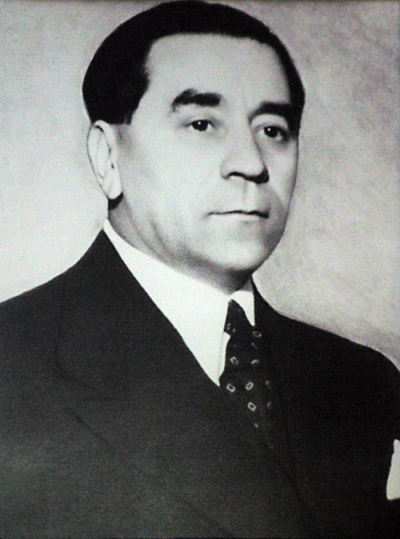
Gheorghe Tătărescu
Gheorghe Tătărescu was a Romanian politician. Born November 2, 1886, in Târgu Jiu. Died March 28, 1957, in Bucharest. Positions held include member of the Chamber of Deputies of Romania, Prime Minister of Romania (2 times) (1934–1940) and Minister of Foreign Affairs of Romania. Educated at University of Paris.
Facts
24 facts · 2 confirmed by two sources · 7 cited · 15 from one source
What’s different
- Born: we show November 2, 1886 (Confirmed). Wikidata also lists December 22, 1892
Where this comes from
Papalocal keeps its own record. It started from these sources; what each one said is kept here as it was copied, so a change on their side never changes this page by itself. Tap one to read its version.
What Wikidata says · copied November 17, 2026 · revision 2562766150
- Described as
- Romanian politician (1886–1957)
- Other names
- Guță Tătărescu, Gheorghe Tatarescu
- Born
- November 2, 1886; December 22, 1892 · 2 references
- Died
- March 28, 1957 · 5 references
- Born in
- Târgu Jiu · 1 reference
- Died in
- Bucharest · 1 reference
- Buried in
- Bellu Cemetery · 1 reference
- Cause of death
- tuberculosis
- Citizen of
- Romania · 1 reference
- Occupation
- politician; diplomat; lawyer
- Positions held
- member of the Chamber of Deputies of Romania; Prime Minister of Romania (2 times) (1934–1940) · 1 reference; Minister of Foreign Affairs of Romania; Member of the Crown Council of Romania
- Political party
- National Liberal Party
- Education
- University of Paris
- Member of
- Romanian Academy
- Spouse
- Arethia Tătărescu
- Children
- Sanda Tătărescu-Negropontes
- Father
- Nicolae Tătărăscu · 1 reference
- Siblings
- Emanoil Tătărescu · 1 reference; Alexandru Tătărescu · 1 reference; Ștefan Tătărescu
- Religion
- Romanian Orthodox Church
- Wikipedias with a page
- 27
Wikidata item Q1842040 (wikidata.org/wiki/Q1842040), public domain (CC0). Copied November 17, 2026.
What Wikipedia says · copied November 17, 2026 · revision 1368746917
Gheorghe I. Tătărescu (also known as Guță Tătărescu, with a slightly antiquated pet form of his given name; 2 November 1886 – 28 March 1957) was a Romanian politician who served twice as Prime Minister of Romania (1934–1937; 1939–1940), three times as Minister of Foreign Affairs (interim in 1934 and 1938, appointed to the office in 1945–1947) and once as Minister of War (1934). Representing the "young liberals" faction inside the National Liberal Party (PNL), Tătărescu began his political career as a collaborator of Ion G. Duca, becoming noted for his anticommunism and, in time, for his conflicts with the PNL's leader Dinu Brătianu and the Foreign Minister Nicolae Titulescu. During his first time in office, he moved closer to King Carol II and led an ambivalent policy toward the fascist Iron Guard and ultimately becoming instrumental in establishing the authoritarian and corporatist regime around the National Renaissance Front. In 1940, he accepted the cession of Bessarabia and Northern Bukovina to the Soviet Union and had to resign.
After the start of World War II, Gheorghe Tătărescu initiated a move to rally political forces in opposition to Ion Antonescu's dictatorship, and sought an alliance with the Romanian Communist Party (PCR). He was twice expelled from the PNL, in 1938 and 1944, creating instead his own group, the National Liberal Party-Tătărescu, and representing it inside the communist-endorsed Petru Groza cabinet. In 1946–1947, he was also the President of the Romanian Delegation to the Peace Conference in Paris. Then, relations between Tătărescu and the PCR began to sour, and he was replaced from the leadership of both his own party and the Foreign Ministry when his name was implicated in the Tămădău Affair. Following the Communist takeover, he was arrested and held as a political prisoner while being called to testify in the trial of Lucrețiu Pătrășcanu. He died soon after his release from prison.
Elected an honorary member of the Romanian Academy in 1937, he was removed from his seat by the communist authorities in 1948. One of his brothers, Colonel Ștefan Tătărescu, was at some point the leader of a minor Nazi group, the National Socialist Party.
- Born, in its opening lines
- November 2, 1886
- Died, in its opening lines
- March 28, 1957
From the Wikipedia article “Gheorghe Tătărescu” (en.wikipedia.org/wiki/Gheorghe_Tătărescu), by its contributors, under CC BY-SA 4.0 (creativecommons.org/licenses/by-sa/4.0/). Copied November 17, 2026; not changed.
Confirmed Two sources agree. Cited One source, and it names where it got it. One source One source, without a reference of its own. Sources disagree The sources disagree. We show the best-supported value and keep theirs below.
