
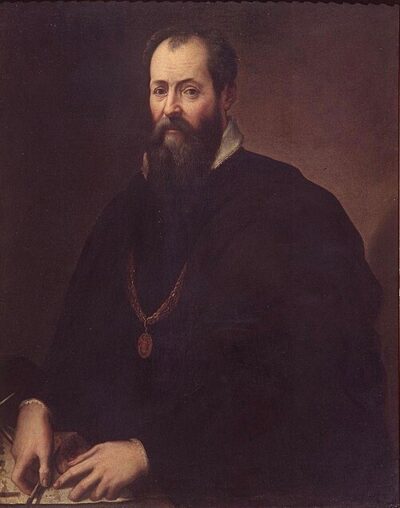
Giorgio Vasari
Giorgio Vasari was an Italian painter, architect, writer and historian. Born July 30, 1511, in Arezzo. Died June 27, 1574, in Florence. Positions held include court painter. Known for Uffizi Gallery, Lives of the Most Excellent Painters, Sculptors, and Architects and Allegory of Patience. Awards include Order of the Golden Spur.
Facts
40 facts · 2 confirmed by two sources · 17 cited · 21 from one source
Where this comes from
Papalocal keeps its own record. It started from these sources; what each one said is kept here as it was copied, so a change on their side never changes this page by itself. Tap one to read its version.
What Wikidata says · copied November 16, 2026 · revision 2569031547
- Described as
- Italian painter, architect, writer and historian (1511-1574)
- Other names
- Aretino, Giorgio Laretino, Giorg. Vasari, Giorgio Vaccari, vasari, G. Vasari, Giorgio, II Vasari, Giorgino di Rezzo, Giorgio Vattani, Georgio Vasari, Giorgio Vasaio, Giorgio Vasarri
- Born
- July 30, 1511 · 5 references
- Died
- June 27, 1574 · 4 references
- Born in
- Arezzo · 3 references
- Died in
- Florence · 3 references
- Name at birth
- Giorgio II Vasari
- Citizen of
- Republic of Florence · 1 reference; Grand Duchy of Tuscany
- Occupation
- painter · 4 references; architect · 5 references; art historian · 2 references; writer · 3 references; biographer; art theorist · 1 reference; aesthetician · 1 reference; architectural drafter · 1 reference
- Positions held
- court painter
- Member of
- Accademia delle Arti del Disegno
- Genre
- history painting · 1 reference; religious painting · 1 reference; portrait · 1 reference
- Known for
- Uffizi Gallery; Lives of the Most Excellent Painters, Sculptors, and Architects; Allegory of Patience · 1 reference; Annunciation to Zacharias · 1 reference; Feast of Esther · 1 reference; Gathering of the Manna · 1 reference; Murate Last Supper · 1 reference; Nativity and Adoration of the Shepherds · 1 reference; Graffiti in the facade of Palazzo Ramirez de Montalvo · 1 reference; Hall of Cosimo il Vecchio · 1 reference
- Awards
- Order of the Golden Spur
- Field
- Renaissance painting; architecture; painting · 1 reference; art history · 1 reference; art theory · 1 reference; biographistics · 1 reference
- Spouse
- Niccolosa Bacci
- Father
- Antonio Vasari
- Mother
- Maddalena Tacci
- Wikipedias with a page
- 89
Wikidata item Q128027 (wikidata.org/wiki/Q128027), public domain (CC0). Copied November 16, 2026.
What Wikipedia says · copied November 16, 2026 · revision 1373385809
Giorgio Vasari (30 July 1511 – 27 June 1574) was an Italian Renaissance painter, architect, art historian, and biographer known for his work Lives of the Most Excellent Painters, Sculptors, and Architects, considered the ideological foundation of Western art-historical writing, and still much cited in modern biographies of the many Italian Renaissance artists he covers, including Leonardo da Vinci and Michelangelo, although he is since regarded as including many factual errors, especially when covering artists from before he was born.
Vasari was a Mannerist painter highly regarded both as a painter and architect in his day, but rather less so in later centuries. He was effectively what would later be called the minister of culture to the Medici court in Florence, and the Lives promoted, with enduring success, the idea of Florentine superiority in the visual arts.
Vasari designed the Tomb of Michelangelo, his hero, in the Basilica of Santa Croce, Florence, which was completed in 1578. Based on Vasari's text in print about Giotto's new manner of painting as a rinascita (rebirth), author Jules Michelet, in his Histoire de France (1835), suggested the adoption of Vasari's concept, using the term Renaissance (from French) to distinguish the cultural change. The term was adopted thereafter in historiography and remains in use.
- Born, in its opening lines
- July 30, 1511
- Died, in its opening lines
- June 27, 1574
From the Wikipedia article “Giorgio Vasari” (en.wikipedia.org/wiki/Giorgio_Vasari), by its contributors, under CC BY-SA 4.0 (creativecommons.org/licenses/by-sa/4.0/). Copied November 16, 2026; not changed.
Confirmed Two sources agree. Cited One source, and it names where it got it. One source One source, without a reference of its own. Sources disagree The sources disagree. We show the best-supported value and keep theirs below.
