
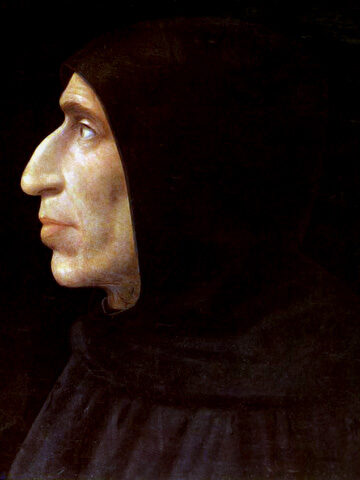
Girolamo Savonarola
Girolamo Savonarola was an Italian Dominican friar and preacher. Born September 21, 1452, in Ferrara. Died May 23, 1498, in piazza della Signoria. Known for De doctrina Aristotelis, Sermons and Trattato sul governo di Firenze. Educated at University of Ferrara.
Facts
32 facts · 2 confirmed by two sources · 11 cited · 19 from one source
Where this comes from
Papalocal keeps its own record. It started from these sources; what each one said is kept here as it was copied, so a change on their side never changes this page by itself. Tap one to read its version.
What Wikidata says · copied November 16, 2026 · revision 2568740819
- Described as
- Italian Dominican friar and preacher (1452-1498)
- Other names
- Jerome Savonarole, Hieronimo Savonarola, Gerolamo Savonarola, Ieróm Savonarola, Hieronymus Savonarola, Savonarola, Girolamo, 1452-1498, Girolamo Maria Francesco Matteo Savonarola, Ierom Savonarola, Jérome Savonarole, Hieronymo da Ferrara, Hierome Savanorola, Savonarola, Girolamo Maria Francesco Matteo, 1452-1498
- Born
- September 21, 1452 · 3 references
- Died
- May 23, 1498 · 3 references
- Born in
- Ferrara · 3 references
- Died in
- piazza della Signoria · 2 references
- Cause of death
- hanging to death · 1 reference
- Citizen of
- Duchy of Ferrara; Republic of Florence
- Occupation
- politician; philosopher; religious · 1 reference; writer · 2 references; preacher · 1 reference; theologian · 1 reference; social reformer · 1 reference; reformer · 1 reference
- Worked for
- University of Ferrara
- Education
- University of Ferrara
- Known for
- De doctrina Aristotelis; Sermons; Trattato sul governo di Firenze; In psalmum "Miserere"; In psalmum "In te, Domine, speravi"; Breviario; Rime; Letters; De veritate prophetica dyalogus; Apologeticus de ratione poeticae artis
- Field
- philosophy; theology · 1 reference; homiletics · 1 reference; politics · 1 reference
- Religion
- Catholic Church
- Wikipedias with a page
- 86
Wikidata item Q164823 (wikidata.org/wiki/Q164823), public domain (CC0). Copied November 16, 2026.
What Wikipedia says · copied November 16, 2026 · revision 1385573179
Girolamo Savonarola, OP (UK: , US: ; Italian: [dʒiˈrɔːlamo savonaˈrɔːla]; 21 September 1452 – 23 May 1498), also referred to as Jerome Savonarola, was an Italian ascetic Dominican friar from Ferrara and a preacher active in Renaissance Florence. He became known for his prophecies of civic glory, his advocacy of the destruction of secular art and culture, and his calls for Christian renewal. He denounced clerical corruption, despotic rule, and the exploitation of the poor.
In September 1494, when King Charles VIII of France invaded Italy and threatened Florence, Savonarola's prophecies seemed on the verge of fulfillment. While the friar intervened with the French king, the Florentines expelled the ruling Medicis and at Savonarola's urging established a "well received" republic, effectively under Savonarola's control. Declaring that Florence would be the New Jerusalem, the world centre of Christianity and "richer, more powerful, more glorious than ever", he instituted an extreme moralistic campaign, enlisting the active help of Florentine youth.
In 1495, when Florence refused to join Pope Alexander VI's Holy League against the French, the Vatican summoned Savonarola to Rome. He disobeyed, and further defied the pope by preaching under a ban, highlighting his campaign for reform with processions, bonfires of the vanities, and pious theatricals. In retaliation, Pope Alexander excommunicated Savonarola in May 1497 and threatened to place Florence under an interdict. A trial by fire proposed by a rival Florentine preacher in April 1498 to test Savonarola's divine mandate turned into a fiasco, and popular opinion turned against him. Savonarola and two of his supporting friars were imprisoned. On 23 May 1498, Church and civil authorities condemned, hanged, and burned the bodies of the three friars in the main square of Florence.
Savonarola's devotees, the Piagnoni, kept his cause of republican freedom and religious reform alive well into the following century. Pope Julius II allegedly considered his canonization. The Medici—restored to power in Florence in 1512 with the help of the papacy—eventually fatally weakened the Piagnoni movement. Some early Protestants, including Martin Luther himself, have regarded Savonarola as a vital precursor to the Protestant Reformation.
- Born, in its opening lines
- September 21, 1452
- Died, in its opening lines
- May 23, 1498
From the Wikipedia article “Girolamo Savonarola” (en.wikipedia.org/wiki/Girolamo_Savonarola), by its contributors, under CC BY-SA 4.0 (creativecommons.org/licenses/by-sa/4.0/). Copied November 16, 2026; not changed.
Confirmed Two sources agree. Cited One source, and it names where it got it. One source One source, without a reference of its own. Sources disagree The sources disagree. We show the best-supported value and keep theirs below.
