
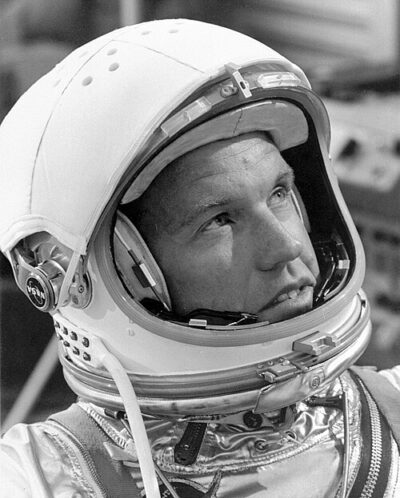
Gordon Cooper
Gordon Cooper was an American astronaut. Born March 6, 1927, in Shawnee. Died October 4, 2004, in Ventura. Educated at U.S. Air Force Test Pilot School and University of Hawaiʻi System. Awards include Distinguished Flying Cross, Legionnaire of Legion of Merit and Harmon Trophy.
Facts
29 facts · 2 confirmed by two sources · 4 cited · 23 from one source
Where this comes from
Papalocal keeps its own record. It started from these sources; what each one said is kept here as it was copied, so a change on their side never changes this page by itself. Tap one to read its version.
What Wikidata says · copied November 13, 2026 · revision 2541267283
- Described as
- American astronaut (1927–2004)
- Other names
- Leroy Gordon "Gordo" Cooper, Jr., Leroy Gordon Cooper
- Born
- March 6, 1927 · 7 references
- Died
- October 4, 2004 · 7 references
- Born in
- Shawnee
- Died in
- Ventura
- Cause of death
- Parkinson's disease
- Citizen of
- United States
- Occupation
- military officer; astronaut (1959–1970) · 1 reference; test pilot; military flight engineer; engineer; aircraft pilot; racing automobile driver · 1 reference
- Worked for
- National Aeronautics and Space Administration
- Education
- U.S. Air Force Test Pilot School; University of Hawaiʻi System; Murray High School
- Member of
- Mercury Seven · 1 reference
- Sport
- auto racing
- Awards
- Distinguished Flying Cross; Legionnaire of Legion of Merit; Harmon Trophy; United States Astronaut Hall of Fame; NASA Distinguished Service Medal (1963) · 1 reference; International Space Hall of Fame (1981) · 2 references
- Spouse
- Trudy Olson (1947–1971)
- Military branch
- United States Air Force; United States Marine Corps
- Military rank
- colonel
- Wikipedias with a page
- 43
Wikidata item Q312833 (wikidata.org/wiki/Q312833), public domain (CC0). Copied November 13, 2026.
What Wikipedia says · copied November 13, 2026 · revision 1378499323
Leroy Gordon Cooper Jr. (March 6, 1927 – October 4, 2004) was an American aerospace engineer, test pilot, United States Air Force pilot, and the youngest of the seven original astronauts in Project Mercury, the first human space program of the United States. Cooper learned to fly as a child, and after service in the United States Marine Corps during World War II, he was commissioned into the United States Air Force in 1949. After serving as a fighter pilot, he qualified as a test pilot in 1956 and was selected as an astronaut in 1959.
In 1963, Cooper piloted the longest and last Mercury spaceflight, Mercury-Atlas 9. During that 34-hour mission, he became the first American to spend an entire day in space, the first to sleep in space, and the last American launched on an entirely solo orbital mission. Despite a series of severe equipment failures, he completed the mission under manual control, guiding his spacecraft, which he named Faith 7, to a splashdown just 6.4 kilometres (4 mi) ahead of the recovery ship. Cooper became the first person to make a second orbital flight when he flew as command pilot of Gemini 5 in 1965. Along with pilot Pete Conrad, he set a new space endurance record by traveling 5,331,745 kilometres (3,312,993 mi) in 190 hours and 56 minutes—just short of eight days—showing that astronauts could survive in space for the length of time necessary to go from the Earth to the Moon and back.
Cooper liked to race cars and boats, and entered the $28,000 Salton City 500 miles (800 km) boat race, the Southwest Championship Drag Boat races in 1965, and the 1967 Orange Bowl Regatta with firefighter Red Adair. In 1968, he entered the 24 Hours of Daytona, but NASA management ordered him to withdraw due to the dangers involved. After serving as backup commander of the Apollo 10 mission, he was superseded by Alan Shepard. He retired from NASA and the Air Force with the rank of colonel in 1970.
- Born, in its opening lines
- March 6, 1927
- Died, in its opening lines
- October 4, 2004
From the Wikipedia article “Gordon Cooper” (en.wikipedia.org/wiki/Gordon_Cooper), by its contributors, under CC BY-SA 4.0 (creativecommons.org/licenses/by-sa/4.0/). Copied November 13, 2026; not changed.
Confirmed Two sources agree. Cited One source, and it names where it got it. One source One source, without a reference of its own. Sources disagree The sources disagree. We show the best-supported value and keep theirs below.
