

Mercury Seven
Mercury Seven is a group of seven Mercury astronauts.
All 4 facts, and where they come from
Facts
4 facts · 0 confirmed by two sources · 0 cited · 4 from one source
Where this comes from
Papalocal keeps its own record. It started from these sources; what each one said is kept here as it was copied, so a change on their side never changes this page by itself. Tap one to read its version.
What Wikidata says · copied November 16, 2026 · revision 2532439870
- Described as
- group of seven Mercury astronauts
- What it is
- group of humans; heptad; human spaceflight program
- Followed by
- NASA Astronaut Group 2
- Wikipedias with a page
- 28
Wikidata item Q597154 (wikidata.org/wiki/Q597154), public domain (CC0). Copied 2026-11-16.
What Wikipedia says · copied November 16, 2026 · revision 1385793756
The Mercury Seven were the group of seven astronauts selected to fly spacecraft for Project Mercury. They are also referred to as the "Original Seven" and Astronaut Group 1. Their names were publicly announced by NASA on April 9, 1959: M. Scott Carpenter, L. Gordon Cooper, John H. Glenn, Jr., Virgil I. Grissom, Walter M. Schirra, Jr., Alan B. Shepard, Jr., and Donald K. Slayton. The Mercury Seven created a new profession in the United States, and established the image of the American astronaut for decades to come.
All of the Mercury Seven eventually flew in space. They piloted the six spaceflights of the Mercury program that had an astronaut on board from May 1961 to May 1963, and members of the group flew on all of the NASA human spaceflight programs of the 20th century – Mercury, Gemini, Apollo, and the Space Shuttle.
Shepard became the first American to enter space in 1961, and walked on the Moon on Apollo 14 in 1971. Grissom flew the first crewed Gemini mission in 1965, but died in 1967 in the Apollo 1 fire; the others all survived past retirement from service. Schirra flew Apollo 7 in 1968, the first crewed Apollo mission, in Grissom's place, and became the only astronaut to fly Mercury, Gemini and Apollo missions. Cooper piloted the last Mercury spaceflight, Mercury-Atlas 9, in 1963, and in 1965 became the first astronaut to make a second orbital flight when he flew as command pilot of Gemini 5. Carpenter flew Mercury-Atlas 7 in 1962. He later took leave of absence to join the U.S. Navy SEALAB project as an aquanaut, but in training suffered injuries that made him unavailable for further spaceflights.
Slayton, grounded with an atrial fibrillation, ultimately flew on the Apollo–Soyuz Test Project in 1975. The first American in orbit in 1962, Glenn flew on the Space Shuttle Discovery in 1998 to become, at age 77, the oldest person to fly in space at the time. He was the oldest member of the Mercury Seven, and the last living member of the group when he died in 2016 at age 95.
From the Wikipedia article “Mercury Seven” (en.wikipedia.org/wiki/Mercury_Seven), by its contributors, under CC BY-SA 4.0 (creativecommons.org/licenses/by-sa/4.0/). Copied 2026-11-16; not changed.
Confirmed Two sources agree. Cited One source, and it names where it got it. One source One source, without a reference of its own. Sources disagree The sources disagree. We show the best-supported value and keep theirs below.
Picture: Wikimedia Commons: Original 7 Astronauts in Spacesuits - GPN-2000-001293.jpg · See Commons file page
People connected 7
Members
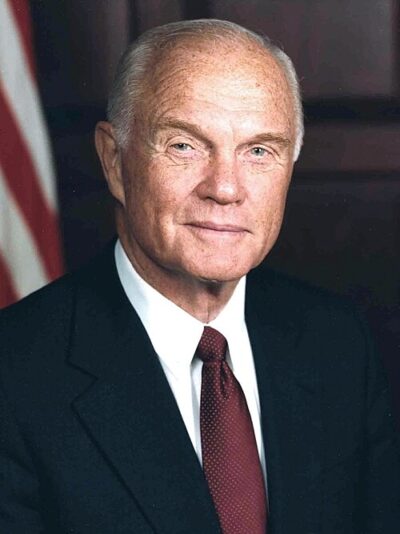 John GlennAmerican astronaut and politician (1921–2016)
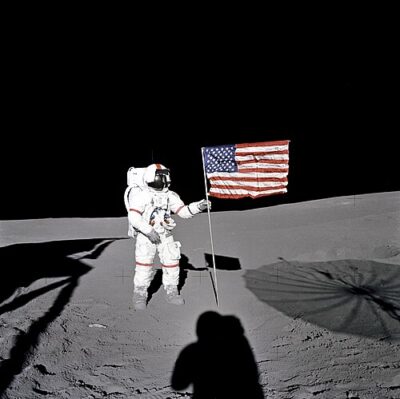 Alan ShepardAmerican astronaut, first American in space, lunar explorer (1923–1998)
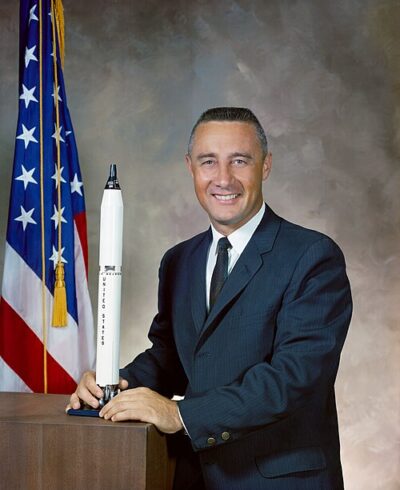 Gus GrissomAmerican astronaut (1926–1967)
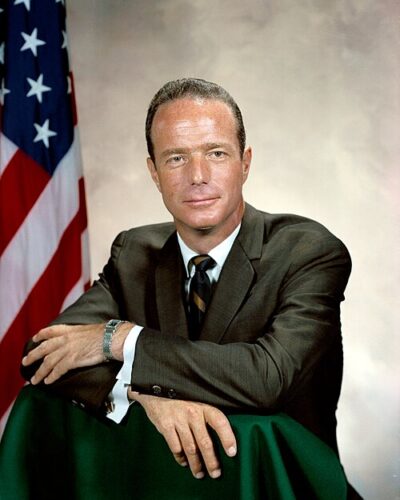 Scott CarpenterAmerican test pilot, astronaut and aquanaut (1925–2013)
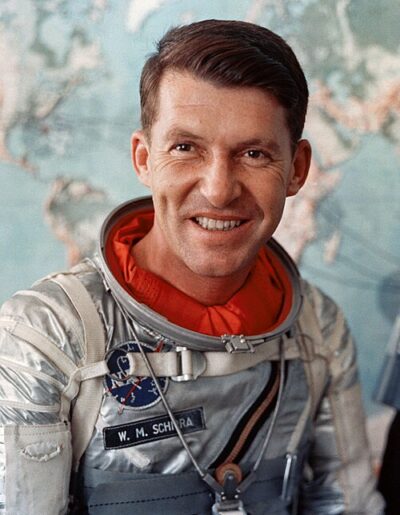 Wally SchirraAmerican astronaut (1923–2007)
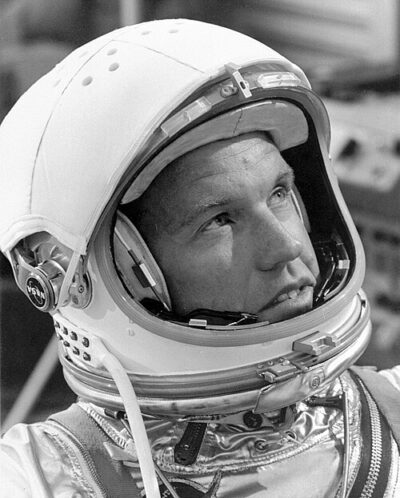 Gordon CooperAmerican astronaut (1927–2004)
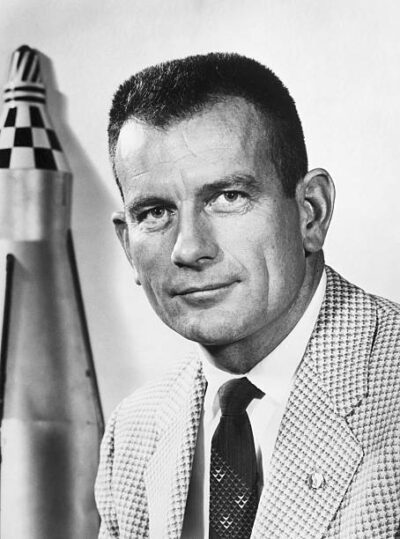 Deke SlaytonAmerican astronaut (1924–1993)
