
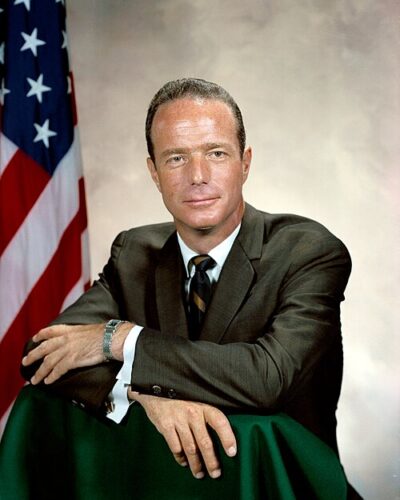
Scott Carpenter
Scott Carpenter was an American test pilot, astronaut and aquanaut. Born May 1, 1925, in Boulder. Died October 10, 2013, in Denver. Educated at University of Colorado Boulder and University of Colorado. Awards include Distinguished Flying Cross, Legionnaire of Legion of Merit and National Aviation Hall of Fame.
Facts
30 facts · 2 confirmed by two sources · 6 cited · 22 from one source
Where this comes from
Papalocal keeps its own record. It started from these sources; what each one said is kept here as it was copied, so a change on their side never changes this page by itself. Tap one to read its version.
What Wikidata says · copied November 13, 2026 · revision 2539532516
- Described as
- American test pilot, astronaut and aquanaut (1925–2013)
- Other names
- Malcolm Scott Carpenter, Malcolm Carpenter
- Born
- May 1, 1925 · 7 references
- Died
- October 10, 2013 · 7 references
- Born in
- Boulder · 1 reference
- Died in
- Denver
- Cause of death
- stroke
- Citizen of
- United States
- Occupation
- test pilot; hydronaut; astronaut (1959–1967) · 1 reference; autobiographer; aircraft pilot; writer; military flight engineer
- Worked for
- National Aeronautics and Space Administration
- Education
- University of Colorado Boulder; University of Colorado; United States Naval Test Pilot School; United States Naval Academy · 1 reference; Boulder High School · 1 reference
- Member of
- Mercury Seven · 1 reference
- Awards
- Distinguished Flying Cross; Legionnaire of Legion of Merit; National Aviation Hall of Fame (2017) · 1 reference; United States Astronaut Hall of Fame; NASA Distinguished Service Medal (1962) · 1 reference; International Space Hall of Fame (1981) · 2 references
- Father
- Marion Scott Carpenter · 1 reference
- Military branch
- United States Navy
- Military rank
- commander
- Website
- http://www.scottcarpenter.com/
- Wikipedias with a page
- 48
Wikidata item Q335503 (wikidata.org/wiki/Q335503), public domain (CC0). Copied November 13, 2026.
What Wikipedia says · copied November 13, 2026 · revision 1381667786
Malcolm Scott Carpenter (May 1, 1925 – October 10, 2013) was an American naval officer and aviator, test pilot, aeronautical engineer, astronaut, and aquanaut. He was one of the Mercury Seven astronauts selected for NASA's Project Mercury in April 1959. Carpenter was the second American (after John Glenn) to orbit the Earth and the fourth American in space, after Alan Shepard, Gus Grissom, and Glenn.
Commissioned into the U.S. Navy in 1949, Carpenter became a naval aviator, flying a Lockheed P-2 Neptune with Patrol Squadron 6 (VP-6) on reconnaissance and anti-submarine warfare missions along the coasts of the Soviet Union and China during the Korean War and the Cold War. In 1954, he attended the U.S. Naval Test Pilot School at NAS Patuxent River in Maryland and became a test pilot. In 1958, he was named Air Intelligence Officer of USS Hornet, which was then in dry dock at the Bremerton Navy Yard.
The following year, Carpenter was selected as one of the Mercury Seven astronauts. He was backup to Glenn during the latter's Mercury Atlas 6 orbital mission. Carpenter flew the next mission, Mercury Atlas 7, in the spacecraft he named Aurora 7. Due to a series of malfunctions, the spacecraft landed 250 miles (400 km) downrange from its intended splashdown point, but both pilot and spacecraft were retrieved.
In 1964, Carpenter obtained permission from NASA to take a leave of absence to join the U.S. Navy SEALAB project as an aquanaut. During training he suffered injuries that grounded him, making him unavailable for further spaceflights. In 1965, he spent 28 days living on the ocean floor off the coast of California as part of SEALAB II. He returned to NASA as Executive Assistant to the Director of the Manned Spacecraft Center, then joined the Navy's Deep Submergence Systems Project in 1967 as Director of Aquanaut Operations for SEALAB III. He retired from NASA in 1967 and the Navy in 1969, with the rank of commander.
Carpenter became a consultant to sport and diving manufacturers, and to the film industry on space flight and oceanography. He gave talks and appeared in television documentaries. He was involved in projects related to biological pest control and waste disposal, and for the production of energy from industrial and agricultural wastes. He appeared in television commercials and wrote a pair of technothrillers and an autobiography, For Spacious Skies: The Uncommon Journey of a Mercury Astronaut, co-written with his daughter, Kristen Stoever.
- Born, in its opening lines
- May 1, 1925
- Died, in its opening lines
- October 10, 2013
From the Wikipedia article “Scott Carpenter” (en.wikipedia.org/wiki/Scott_Carpenter), by its contributors, under CC BY-SA 4.0 (creativecommons.org/licenses/by-sa/4.0/). Copied November 13, 2026; not changed.
Confirmed Two sources agree. Cited One source, and it names where it got it. One source One source, without a reference of its own. Sources disagree The sources disagree. We show the best-supported value and keep theirs below.
