
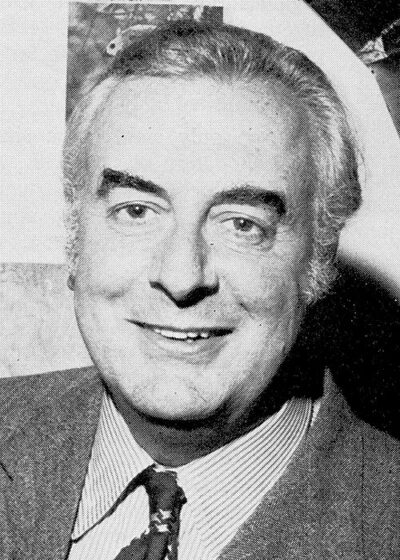
Gough Whitlam
Gough Whitlam was an Australian politician, 21st Prime Minister of Australia. Born July 11, 1916, in Gough Whitlam's birthplace. Died October 21, 2014, in Sydney. Positions held include Prime Minister of Australia (1972–1975), Attorney-General for Australia (1972) and member of the Australian House of Representatives (1952–1978). Educated at University of Sydney and Telopea Park School. Awards include Centenary Medal, Honorary Grand Companion of the Order of Logohu and Australian National Living Treasure.
Facts
39 facts · 2 confirmed by two sources · 10 cited · 27 from one source
Where this comes from
Papalocal keeps its own record. It started from these sources; what each one said is kept here as it was copied, so a change on their side never changes this page by itself. Tap one to read its version.
What Wikidata says · copied November 16, 2026 · revision 2566356312
- Described as
- Australian politician, 21st Prime Minister of Australia (1916–2014)
- Other names
- Edward Gough Whitlam, E. G. Whitlam
- Born
- July 11, 1916 · 5 references
- Died
- October 21, 2014 · 4 references
- Born in
- Gough Whitlam's birthplace · 1 reference
- Died in
- Sydney
- Name at birth
- Edward Gough Whitlam · 1 reference
- Citizen of
- Australia
- Occupation
- politician · 1 reference; diplomat; barrister; minister · 1 reference; jurist · 1 reference; head of government · 1 reference
- Positions held
- Prime Minister of Australia (1972–1975); Attorney-General for Australia (1972); member of the Australian House of Representatives (1952–1978); Minister for Justice (1972–1973); ambassador; Minister for Foreign Affairs (Australia) (1972–1973) · 1 reference; Treasurer of Australia (1972)
- Political party
- Australian Labor Party (1945–) · 3 references
- Education
- University of Sydney; Telopea Park School; Canberra Grammar School; Mowbray House
- Member of
- Australian Academy of the Humanities · 1 reference
- Awards
- Centenary Medal; Honorary Grand Companion of the Order of Logohu; Australian National Living Treasure; Companion of the Order of Australia (1978) · 1 reference; Grand Cordon of the Order of the Rising Sun
- Spouse
- Margaret Whitlam (1942–2012) · 1 reference
- Children
- Nicholas Whitlam; Tony Whitlam
- Father
- Fred Whitlam · 1 reference
- Mother
- Martha Maddocks · 1 reference
- Siblings
- Freda Whitlam
- Military branch
- Royal Australian Air Force (1942–1945) · 2 references
- Military rank
- flight lieutenant
- Height
- 1.94 m (6 ft 4 in)
- Wikipedias with a page
- 61
Wikidata item Q23333 (wikidata.org/wiki/Q23333), public domain (CC0). Copied November 16, 2026.
What Wikipedia says · copied November 16, 2026 · revision 1385919084
Edward Gough Whitlam (11 July 1916 – 21 October 2014) was the 21st prime minister of Australia, serving from December 1972 to November 1975. To date the longest-serving federal leader of the Australian Labor Party (ALP), he was notable for being the head of a reformist and socially progressive government that ended with his controversial dismissal by the then governor-general of Australia, Sir John Kerr, at the climax of the 1975 constitutional crisis. Whitlam remains the only Australian prime minister to have been removed from office by a governor-general.
Whitlam was an air navigator in the Royal Australian Air Force for four years during World War II, and worked as a barrister following the war. He was first elected to the Australian House of Representatives in 1952, becoming a member of parliament (MP) for the division of Werriwa. Whitlam became deputy leader of the Labor Party in 1960, and in 1967, after the retirement of Arthur Calwell, was elected leader of the party and became the Leader of the Opposition. After narrowly losing the 1969 federal election to John Gorton, Whitlam led Labor to victory at the 1972 election, after 23 years of Coalition government.
In its first term, the Whitlam government introduced numerous socially progressive and reformist policies and initiatives, including the termination of military conscription and the end of Australian involvement in the Vietnam War, institution of universal health care and free university education, and the implementation of legal aid programs. With the opposition-controlled Australian Senate delaying passage of bills, Whitlam called a snap double dissolution election in May 1974, in which he won a slightly reduced majority in the House of Representatives, and picked up three Senate seats to hold equal Senate numbers to the opposition. The Whitlam government then instituted the first and only joint sitting enabled under section 57 of the Australian constitution as part of the double dissolution process. His government's second term was dominated by a declining economy suffering from the 1973 oil crisis and the 1970s global recession, as well as a political scandal known as the Loans affair, which led to the removal of two government ministers. The opposition continued to obstruct Whitlam's agenda in the Senate.
In late 1975, the opposition senators refused to allow a vote on the government's appropriation bills, returning them to the House of Representatives with a demand that the government go to an election. Whitlam argued that his government, which held a clear majority in the House of Representatives, was being held to ransom by the Senate. The crisis ended in mid-November, when governor-general Sir John Kerr dismissed him from office and commissioned the opposition leader, Malcolm Fraser, as caretaker prime minister. Labor lost the subsequent election by a landslide. Whitlam stepped down as leader of the party after losing again at the 1977 election, and retired from parliament the following year. Upon the election of the Hawke government in 1983, he was appointed as ambassador to UNESCO; he was later elected a member of the UNESCO executive board. He remained active into his nineties. The propriety and circumstances of his dismissal and the legacy of his government have been frequently debated in the decades since he left office. Whitlam is often ranked in the upper tier of Australian prime ministers by political experts and academics, with political journalist Paul Kelly writing in 1994 that "there is no doubt that in three years his government was responsible for more reforms and innovations than any other government in Australian history".
- Born, in its opening lines
- July 11, 1916
- Died, in its opening lines
- October 21, 2014
From the Wikipedia article “Gough Whitlam” (en.wikipedia.org/wiki/Gough_Whitlam), by its contributors, under CC BY-SA 4.0 (creativecommons.org/licenses/by-sa/4.0/). Copied November 16, 2026; not changed.
Confirmed Two sources agree. Cited One source, and it names where it got it. One source One source, without a reference of its own. Sources disagree The sources disagree. We show the best-supported value and keep theirs below.
