
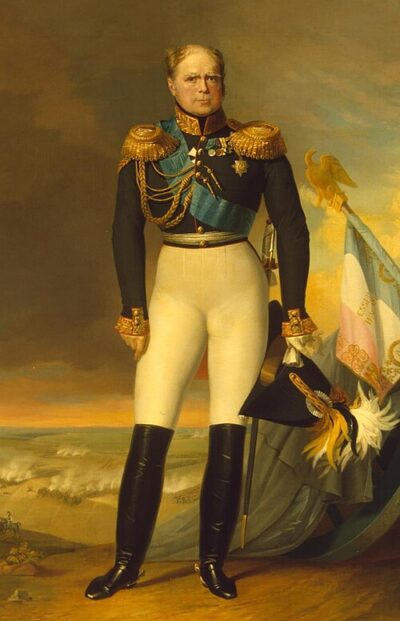
Grand Duke Konstantin Pavlovich of Russia
Grand Duke Konstantin Pavlovich of Russia was a Russian grand duke. Born May 8, 1779, in Tsarskoye Selo. Died June 27, 1831, in Vitebsk. Awards include Grand Cross of the Legion of Honour, Knight of the Order of the Holy Spirit and Knight of the Order of Saint Michael.
Facts
41 facts · 2 confirmed by two sources · 8 cited · 31 from one source
Where this comes from
Papalocal keeps its own record. It started from these sources; what each one said is kept here as it was copied, so a change on their side never changes this page by itself. Tap one to read its version.
What Wikidata says · copied November 16, 2026 · revision 2558094965
- Described as
- Russian grand duke (1779–1831)
- Other names
- Grand Duke Constantine Pavlovich of Russia, Konstantin Pavlovich
- Born
- May 8, 1779 · 2 references
- Died
- June 27, 1831 · 3 references
- Born in
- Tsarskoye Selo · 2 references
- Died in
- Vitebsk · 3 references
- Buried in
- Peter and Paul Cathedral (1831) · 1 reference
- Cause of death
- cholera · 1 reference
- Citizen of
- Russian Empire · 1 reference
- Occupation
- military personnel · 2 references; politician · 1 reference
- Awards
- Grand Cross of the Legion of Honour (1807); Knight of the Order of the Holy Spirit; Knight of the Order of Saint Michael; Knight of the Order of the Golden Fleece (1817); Knight of the Order of St. Alexander Nevsky (1779); Order of the White Eagle (1815); Order of the Black Eagle (1805); Order of St. Vladimir, 1st class (1807); Order of St. Andrew (1779); Gold Sword for Bravery (1813); Order of St. George, 3rd class (1806); Knight Grand Cross of the Military Order of William (1818); Order of St. George, 2nd class (1813); Order of Saint John of Jerusalem (1798); Order of Saint Anna (1779)
- Spouse
- Princess Juliane of Saxe-Coburg and Gotha (1796–1820) · 4 references; Joanna Grudzińska (1820–1831) · 4 references
- Children
- Konstantin Konstantinov; Pavel Alexandrov · 1 reference
- Father
- Paul I of Russia · 2 references
- Mother
- Sophie Dorothee of Württemberg · 1 reference
- Siblings
- Anna Pavlovna of Russia; Grand Duchess Maria Pavlovna of Russia; Grand Duchess Alexandra Pavlovna of Russia; Catherine Pavlovna of Russia; Grand Duchess Elena Pavlovna of Russia; Grand Duchess Olga Pavlovna of Russia; Alexander I of Russia · 1 reference; Grand Duke Michael Pavlovich of Russia; Nicholas I of Russia
- Military rank
- adjutant general (1819); soldier · 1 reference
- Wikipedias with a page
- 44
Wikidata item Q161106 (wikidata.org/wiki/Q161106), public domain (CC0). Copied November 16, 2026.
What Wikipedia says · copied November 16, 2026 · revision 1383696988
Konstantin Pavlovich (Russian: Константи́н Па́влович; 8 May [O.S. 27 April] 1779 – 27 June [O.S. 15 June] 1831) was a grand duke of Russia and the second son of Emperor Paul I and Sophie Dorothea of Württemberg. He was the heir presumptive for most of his elder brother Alexander I's reign, but had secretly renounced his claim to the throne in 1823. For 25 days after the death of Alexander I; from 19 November (O.S.)/1 December to 14 December (O.S.)/26 December 1825, he was known as His Imperial Majesty Konstantin I Emperor and Sovereign of Russia, although he never reigned and never acceded to the throne. His younger brother Nicholas became tsar in 1825. The succession controversy became the pretext of the Decembrist revolt.
Konstantin was known to eschew court etiquette and to take frequent stands against the wishes of his brother Alexander I, for which he is remembered fondly in Russia, but in his capacity as the governor of Poland he is remembered as a hated ruler.
- Born, in its opening lines
- May 8, 1779
- Died, in its opening lines
- June 27, 1831
From the Wikipedia article “Grand Duke Konstantin Pavlovich of Russia” (en.wikipedia.org/wiki/Grand_Duke_Konstantin_Pavlovich_of_Russia), by its contributors, under CC BY-SA 4.0 (creativecommons.org/licenses/by-sa/4.0/). Copied November 16, 2026; not changed.
Confirmed Two sources agree. Cited One source, and it names where it got it. One source One source, without a reference of its own. Sources disagree The sources disagree. We show the best-supported value and keep theirs below.
