
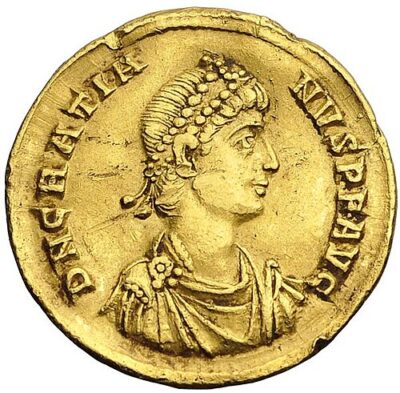
Gratian
Gratian was a Roman emperor from 367 to 383. Born April 18, 359, in Sirmium. Died August 25, 383, in Lugdunum. Positions held include Roman emperor (367–383), ancient Roman senator and Roman consul.
Facts
18 facts · 2 confirmed by two sources · 2 cited · 14 from one source
Where this comes from
Papalocal keeps its own record. It started from these sources; what each one said is kept here as it was copied, so a change on their side never changes this page by itself. Tap one to read its version.
What Wikidata says · copied November 16, 2026 · revision 2557898941
- Described as
- Roman emperor from 367 to 383
- Other names
- Flavius Gratianus Augustus, Emperor of Rome Flavius Gratianus, Emperor of Rome Flavius Gratian, Emperor of Rome Gratianus, Emperor of Rome Gratian, Emperor of Rome Flavius Gratianus Augustus, Gratianus, Augustus Gratianus
- Born
- April 18, 359
- Died
- August 25, 383 · 1 reference
- Born in
- Sirmium
- Died in
- Lugdunum · 1 reference
- Buried in
- Basilica of San Lorenzo · 1 reference
- Citizen of
- Ancient Rome
- Occupation
- politician; military personnel
- Positions held
- Roman emperor (367–383); ancient Roman senator; Roman consul
- Spouse
- Constantia; Laeta
- Father
- Valentinian I
- Mother
- Marina Severa
- Siblings
- Valentinian II; Galla; Grata
- Wikipedias with a page
- 61
Wikidata item Q189108 (wikidata.org/wiki/Q189108), public domain (CC0). Copied November 16, 2026.
What Wikipedia says · copied November 16, 2026 · revision 1385109599
Gratian (; Latin: Gratianus; 18 April 359 – 25 August 383) was emperor of the Western Roman Empire from 367 to 383. The eldest son of Valentinian I, Gratian was raised to the rank of Augustus as a child and inherited the West after his father's death in 375. He nominally shared the government with his infant half-brother Valentinian II, who was also acclaimed emperor in Pannonia on Valentinian's death. The East was ruled by his uncle Valens, who was later succeeded by Theodosius I.
Gratian subsequently led a campaign across the Rhine, attacked the Lentienses, and forced the tribe to surrender. That same year, the eastern emperor Valens was killed fighting the Goths at the Battle of Adrianople, which led to Gratian elevating Theodosius to replace him in 379. Gratian favoured Catholicism over traditional Roman religion, issuing the Edict of Thessalonica, refusing the office of pontifex maximus, and removing the Altar of Victory from the Roman Senate's Curia Julia. The city of Cularo on the Isère river in Roman Gaul was renamed Gratianopolis after him, which later evolved to Grenoble. By 383 Gratian had become unpopular with his army, which abandoned him during a confrontation with the usurper Magnus Maximus near Lutetia (Paris). Gratian fled to Lugdunum and was later murdered.
- Born, in its opening lines
- April 18, 359
- Died, in its opening lines
- August 25, 383
From the Wikipedia article “Gratian” (en.wikipedia.org/wiki/Gratian), by its contributors, under CC BY-SA 4.0 (creativecommons.org/licenses/by-sa/4.0/). Copied November 16, 2026; not changed.
Confirmed Two sources agree. Cited One source, and it names where it got it. One source One source, without a reference of its own. Sources disagree The sources disagree. We show the best-supported value and keep theirs below.
