
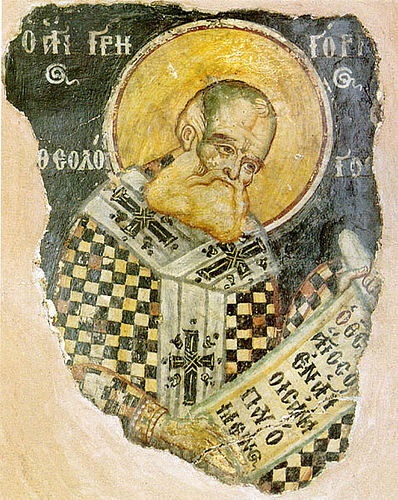
Gregory of Nazianzus
Gregory of Nazianzus was a Christian saint and theologian (c. 329 – 390). Born 329, in Arianzos. Died 390, in Arianzos. Positions held include Ecumenical Patriarch of Constantinople (379–381) and diocesan bishop (372). Known for The Spirit and the Resurrection. Educated at Platonic Academy.
Facts
23 facts · 2 confirmed by two sources · 7 cited · 12 from one source · 2 where the sources disagree
What’s different
- Born: we show 329 (Confirmed). Wikidata also lists 330
- Died: we show 390 (Confirmed). Wikidata also lists January 25, 389
- Born in: we show Arianzos (Sources disagree). Wikidata also lists Nazianzus
- Died in: we show Arianzos (Sources disagree). Wikidata also lists Nazianzus
Where this comes from
Papalocal keeps its own record. It started from these sources; what each one said is kept here as it was copied, so a change on their side never changes this page by itself. Tap one to read its version.
What Wikidata says · copied November 16, 2026 · revision 2568996594
- Described as
- Christian saint and theologian (c. 329 – 390)
- Other names
- St. Gregory of Nazianzus, Gregory Nazianzen, St. Gregory Nazianzen, Gregory the Theologian, Grigorios Nazianzenos, Gregorius Nazianzenus
- Born
- 329 · 2 references; 330 · 2 references
- Died
- January 25, 389; 390 · 3 references
- Born in
- Arianzos; Nazianzus
- Died in
- Arianzos; Nazianzus
- Buried in
- Constantinople
- Citizen of
- Ancient Rome
- Occupation
- priest (361–) · 1 reference; bishop (372–) · 2 references; preacher · 1 reference; theologian · 2 references; poet; epigrammatist; religious leader · 1 reference; Doctor of the Church · 1 reference
- Positions held
- Ecumenical Patriarch of Constantinople (379–381); diocesan bishop (372) · 1 reference
- Education
- Platonic Academy · 1 reference
- Known for
- The Spirit and the Resurrection
- Father
- Gregory of Nazianzus the Elder
- Mother
- Nonna of Nazianzus · 2 references
- Siblings
- Caesarius of Nazianzus · 1 reference; Gorgonia
- Religion
- Christianity · 1 reference
- Wikipedias with a page
- 88
Wikidata item Q44011 (wikidata.org/wiki/Q44011), public domain (CC0). Copied November 16, 2026.
What Wikipedia says · copied November 16, 2026 · revision 1374383349
Gregory of Nazianzus (Koine Greek: Γρηγόριος ὁ Ναζιανζηνός, romanized: Grēgórios ho Nazianzēnós, IPA: [ɣriˈɣori.os o nazi.anziˈnos]; c. 329 – 25 January 390), also known as Saint Gregory the Theologian or Gregory Nazianzen, was an early Roman Christian theologian and prelate who served as Archbishop of Constantinople from 380 to 381. He is widely considered the most accomplished rhetorical stylist of the patristic age. As a classically trained orator and philosopher, he infused Hellenism into the early Church, establishing the paradigm of Byzantine theologians and church officials.
Gregory made a significant impact on the shape of Trinitarian theology among both Greek and Latin-speaking theologians, and he is remembered as the "Trinitarian Theologian". Much of his theological work continues to influence modern theologians, especially in regard to the relationship among the three Persons of the Trinity. Along with the brothers Basil of Caesarea and Gregory of Nyssa, he is known as one of the Cappadocian Fathers.
Gregory of Nazianzus is a saint in both Eastern and Western Christianity. In the Catholic Church he is numbered among the Doctors of the Church; in the Eastern Orthodox Church and the Eastern Catholic Churches he is revered as one of the Three Holy Hierarchs, along with Basil of Caesarea and John Chrysostom. Along with them and Athanasius of Alexandria he is also regarded by the Catholic Church as one of the four Great Greek Church Fathers.
He is also one of only three men in the life of the Orthodox Church who have been officially designated "Theologian" by epithet, the other two being John the Apostle, and Symeon the New Theologian.
- Born, in its opening lines
- c. 329
- Died, in its opening lines
- January 25, 390
From the Wikipedia article “Gregory of Nazianzus” (en.wikipedia.org/wiki/Gregory_of_Nazianzus), by its contributors, under CC BY-SA 4.0 (creativecommons.org/licenses/by-sa/4.0/). Copied November 16, 2026; not changed.
Confirmed Two sources agree. Cited One source, and it names where it got it. One source One source, without a reference of its own. Sources disagree The sources disagree. We show the best-supported value and keep theirs below.
