
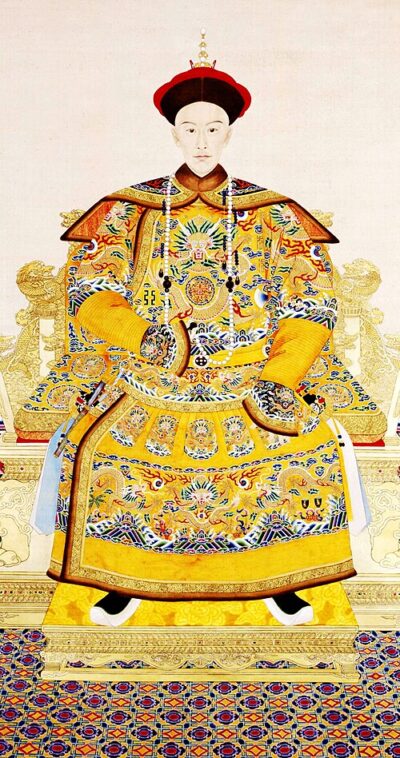
Guangxu Emperor
Guangxu Emperor was a Chinese emperor. Born August 14, 1871, in Prince Chun Mansion. Died November 14, 1908, in Zhongnanhai. Positions held include Emperor of China (1875–1908) and emperor Mañjuśrī (1875–1908). Awards include Order of St. Andrew and Collar of the Supreme Order of the Chrysanthemum.
Facts
21 facts · 2 confirmed by two sources · 2 cited · 16 from one source · 1 where the sources disagree
What’s different
- Name at birth: we show ᡯᠠᡳ ᡨᡳᠶᠠᠨ (Sources disagree). Wikidata also lists 載湉
Where this comes from
Papalocal keeps its own record. It started from these sources; what each one said is kept here as it was copied, so a change on their side never changes this page by itself. Tap one to read its version.
What Wikidata says · copied November 16, 2026 · revision 2568284360
- Described as
- Chinese emperor (1871-1908)
- Other names
- Emperor Guangxu, Dezong, Aixinjueluo Zaitian, Kuang-hsü Emperor, Emperor Kuang-hsü
- Born
- August 14, 1871 · 1 reference
- Died
- November 14, 1908 · 2 references
- Born in
- Prince Chun Mansion
- Died in
- Zhongnanhai
- Buried in
- Chongling Mausoleum (Qing dynasty)
- Cause of death
- arsenic poisoning · 2 references
- Name at birth
- ᡯᠠᡳ ᡨᡳᠶᠠᠨ; 載湉
- Citizen of
- Qing dynasty · 1 reference
- Occupation
- head of state
- Positions held
- Emperor of China (1875–1908); emperor Mañjuśrī (1875–1908)
- Awards
- Order of St. Andrew; Collar of the Supreme Order of the Chrysanthemum
- Spouse
- Empress Dowager Longyu; Consort Jin; Consort Zhen
- Father
- Yixuan, Prince Chun · 1 reference
- Mother
- Yehenara Wanzhen
- Siblings
- Zaifeng, Prince Chun; Zaitao; Zaixun, Prince Rui
- Wikipedias with a page
- 60
Wikidata item Q299710 (wikidata.org/wiki/Q299710), public domain (CC0). Copied November 16, 2026.
What Wikipedia says · copied November 16, 2026 · revision 1385886718
The Guangxu Emperor (14 August 1871 – 14 November 1908), also known by his temple name Emperor Dezong of Qing, personal name Zaitian, was the tenth and penultimate emperor of the Qing dynasty, and the ninth Qing emperor to rule over China proper. His succession was endorsed by dowager empresses Ci'an and Cixi for political reasons, after the Tongzhi Emperor died without an heir. Cixi held political power for much of Guangxu's reign as regent, except for the period between his assumption of ruling powers in 1889 and the Hundred Days' Reform in 1898.
The Qing Empire's prestige and sovereignty continued to erode during Guangxu's reign with defeats in the Sino-French War, the First Sino-Japanese War, and the Boxer Rebellion. Guangxu engaged intellectuals like Kang Youwei and Liang Qichao to develop the Hundred Days' Reform program of 1898 to reverse the decline. Among the goals was removing Cixi from power; however, the program was too radical for the conservative ruling elite, and it failed to secure the support of the army. Cixi rallied the program's opponents to launch a coup in late 1898 that suppressed the reforms and secured her power. Guangxu lost ruling powers and was placed under virtual house arrest at the Yingtai Pavilion of Zhongnanhai until his death.
Guangxu died without children in 1908 of arsenic poisoning. He was buried in the Chongling at the Western Qing tombs.
- Born, in its opening lines
- August 14, 1871
- Died, in its opening lines
- November 14, 1908
From the Wikipedia article “Guangxu Emperor” (en.wikipedia.org/wiki/Guangxu_Emperor), by its contributors, under CC BY-SA 4.0 (creativecommons.org/licenses/by-sa/4.0/). Copied November 16, 2026; not changed.
Confirmed Two sources agree. Cited One source, and it names where it got it. One source One source, without a reference of its own. Sources disagree The sources disagree. We show the best-supported value and keep theirs below.
