
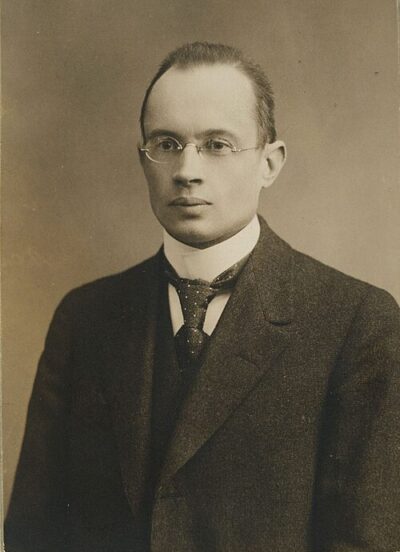
Gunnar Nordström
Gunnar Nordström was a Finnish physicist. Born March 12, 1881, in Helsinki. Died December 24, 1923, in Helsinki. Educated at Helsinki University of Technology and University of Helsinki.
Facts
20 facts · 2 confirmed by two sources · 1 cited · 17 from one source
Where this comes from
Papalocal keeps its own record. It started from these sources; what each one said is kept here as it was copied, so a change on their side never changes this page by itself. Tap one to read its version.
What Wikidata says · copied November 18, 2026 · revision 2538824303
- Described as
- Finnish physicist (1881–1923)
- Born
- March 12, 1881
- Died
- December 24, 1923
- Born in
- Helsinki
- Died in
- Helsinki
- Cause of death
- pernicious anemia
- Citizen of
- Finland; Russian Empire · 1 reference
- Occupation
- physicist · 1 reference; university teacher; theoretical physicist
- Worked for
- Helsinki University of Technology; University of Helsinki · 1 reference; University of Göttingen · 1 reference; Leiden University · 1 reference
- Education
- Helsinki University of Technology; University of Helsinki; Läroverket för gossar och flickor
- Field
- physics; mechanics · 1 reference
- Father
- Ernst Nordström
- Wikipedias with a page
- 23
Wikidata item Q726175 (wikidata.org/wiki/Q726175), public domain (CC0). Copied November 18, 2026.
What Wikipedia says · copied November 18, 2026 · revision 1372540785
Gunnar Nordström (12 March 1881 – 24 December 1923) was a Finnish theoretical physicist best remembered for his theory of gravitation, which was an early competitor of general relativity. Nordström is often designated by modern writers as The Einstein of Finland due to his novel work in similar fields with similar methods to Einstein.
- Born, in its opening lines
- March 12, 1881
- Died, in its opening lines
- December 24, 1923
From the Wikipedia article “Gunnar Nordström” (en.wikipedia.org/wiki/Gunnar_Nordström), by its contributors, under CC BY-SA 4.0 (creativecommons.org/licenses/by-sa/4.0/). Copied November 18, 2026; not changed.
Confirmed Two sources agree. Cited One source, and it names where it got it. One source One source, without a reference of its own. Sources disagree The sources disagree. We show the best-supported value and keep theirs below.
