
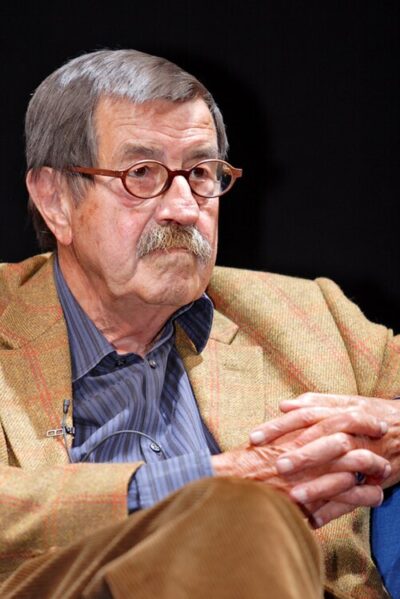
Günter Grass
Günter Grass was a German novelist, poet, playwright, illustrator, graphic artist, and sculptor. Born October 16, 1927, in Free City of Danzig. Died April 13, 2015, in Lübeck. Known for The Tin Drum, Cat and Mouse and Dog Years. Educated at Kunstakademie Düsseldorf and Berlin University of the Arts. Awards include Nobel Prize in Literature, Georg Büchner Prize and Hermann Kesten Prize.
Facts
62 facts · 2 confirmed by two sources · 15 cited · 45 from one source
Where this comes from
Papalocal keeps its own record. It started from these sources; what each one said is kept here as it was copied, so a change on their side never changes this page by itself. Tap one to read its version.
What Wikidata says · copied November 16, 2026 · revision 2564037933
- Described as
- German novelist, poet, playwright, illustrator, graphic artist, and sculptor (1927–2015)
- Other names
- Günter Graß, Günter Wilhelm Graß, Gunter Grass, Günter Wilhelm Grass
- Born
- October 16, 1927 · 18 references
- Died
- April 13, 2015 · 13 references
- Born in
- Free City of Danzig
- Died in
- Lübeck · 3 references
- Buried in
- Village church Behlendorf
- Cause of death
- infection
- Name at birth
- Günter Wilhelm Grass; Günter Wilhelm Grass
- Citizen of
- Free City of Danzig (–1939) · 2 references; Germany (1949–) · 2 references
- Occupation
- lyricist; screenwriter; poet · 1 reference; sculptor · 3 references; novelist · 1 reference; playwright · 3 references; essayist; autobiographer
- Political party
- Social Democratic Party of Germany (1982–1992)
- Education
- Kunstakademie Düsseldorf (1948–1952); Berlin University of the Arts (1953–1956); Pestalozzischule · 1 reference
- Member of
- PEN Germany (1968–); Academy of Arts, Berlin; Royal Society of Literature; American Academy of Arts and Sciences (1970–); Group 47 (1957–)
- Known for
- The Tin Drum; Cat and Mouse; Dog Years; Crabwalk; What Must Be Said; The Rat; Last dances; The Call of the Toad
- Awards
- Nobel Prize in Literature (1999) · 2 references; Georg Büchner Prize (1965); Hermann Kesten Prize (1995); Princess of Asturias Literary Prize (1999); Hans Fallada Prize (1996); Samuel Bogumil Linde Prize (1996); Fontane-Preis (1968); Ernst-Toller-Preis (2007); Literature Award of the Bavarian Academy of the Fine Arts (1994); Honorary doctor of the Free University of Berlin (2005); honorary doctor of Harvard University (1976); Honorary doctor of the University of Gdańsk (1993); Carl von Ossietzky Medal (1967) · 1 reference; Thomas Mann Prize (1996); honorary doctor of the Adam Mickiewicz University in Poznań (1990) · 1 reference
- Field
- fiction · 1 reference
- Spouse
- Anna Schwarz (1954–1978) · 1 reference; Ute Grass (1979–); Anna Grass · 1 reference
- Children
- Helene Grass
- Siblings
- Waltraud Grass
- Religion
- Catholic Church
- Lived in
- Paris (1956–1959) · 1 reference; Friedenau (1960–1972); Wewelsfleth (1972–1987); Behlendorf; Gdańsk (1927–) · 1 reference
- Website
- https://www.grass-stiftung.de/
- Wikipedias with a page
- 137
Wikidata item Q6538 (wikidata.org/wiki/Q6538), public domain (CC0). Copied November 16, 2026.
What Wikipedia says · copied November 16, 2026 · revision 1383051294
Günter Wilhelm Grass (German: [ˈɡʏntɐ ˈɡʁas] ; 16 October 1927 – 13 April 2015) was a German novelist, poet, playwright, illustrator, graphic artist, sculptor, and recipient of the 1999 Nobel Prize in Literature.
He was born in the Free City of Danzig (now Gdańsk, Poland). At age 17, he was drafted into the military and served from late 1944 in the Waffen-SS. He was taken as a prisoner of war by US forces at the end of the war in May 1945. He was released in April 1946. Trained as a stonemason and sculptor, Grass began writing in the 1950s. In his fiction, he frequently returned to the Danzig of his childhood.
Grass is best known for his first novel, The Tin Drum (1959), a key text in European magic realism. It was the first book of his Danzig Trilogy, the other two being Cat and Mouse and Dog Years. His works are frequently considered to have a left-wing political dimension, and Grass was an active supporter of the Social Democratic Party of Germany (SPD).
The Tin Drum was adapted as a film of the same name, which won both the 1979 Palme d'Or and the Academy Award for Best Foreign Language Film. In 1999, the Swedish Academy awarded Grass the Nobel Prize in Literature, praising him as a writer "whose frolicsome black fables portray the forgotten face of history".
- Born, in its opening lines
- October 16, 1927
- Died, in its opening lines
- April 13, 2015
From the Wikipedia article “Günter Grass” (en.wikipedia.org/wiki/Günter_Grass), by its contributors, under CC BY-SA 4.0 (creativecommons.org/licenses/by-sa/4.0/). Copied November 16, 2026; not changed.
Confirmed Two sources agree. Cited One source, and it names where it got it. One source One source, without a reference of its own. Sources disagree The sources disagree. We show the best-supported value and keep theirs below.
