
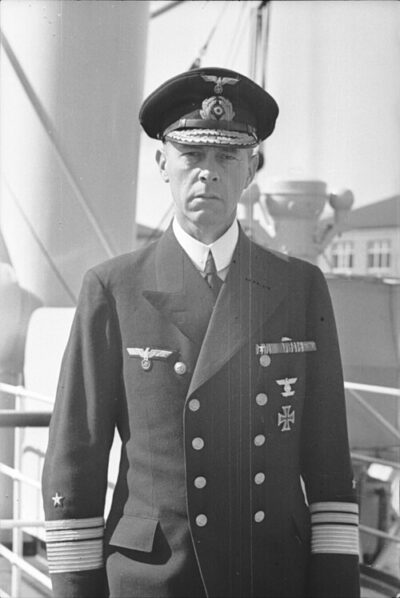
Günther Lütjens
Günther Lütjens was a German admiral. Born May 25, 1889, in Wiesbaden. Died May 27, 1941, in Atlantic Ocean. Awards include Knight's Cross of the Iron Cross.
Facts
11 facts · 2 confirmed by two sources · 3 cited · 6 from one source
Where this comes from
Papalocal keeps its own record. It started from these sources; what each one said is kept here as it was copied, so a change on their side never changes this page by itself. Tap one to read its version.
What Wikidata says · copied November 16, 2026 · revision 2569133355
- Described as
- German admiral (1889–1941)
- Born
- May 25, 1889 · 2 references
- Died
- May 27, 1941 · 2 references
- Born in
- Wiesbaden · 1 reference
- Died in
- Atlantic Ocean
- Citizen of
- Nazi Germany
- Occupation
- naval officer · 1 reference; admiral · 1 reference
- Awards
- Knight's Cross of the Iron Cross
- Siblings
- Helmuth Lütjens
- Military branch
- German Navy
- Military rank
- admiral
- Wikipedias with a page
- 32
Wikidata item Q57646 (wikidata.org/wiki/Q57646), public domain (CC0). Copied November 16, 2026.
What Wikipedia says · copied November 16, 2026 · revision 1379937649
Johann Günther Lütjens (German pronunciation: [ˈjoːhan ˈɡʏntɐ ˈlʏtjəns]; 25 May 1889 – 27 May 1941) was a German admiral whose military service spanned more than 30 years and two world wars. Lütjens is best known for his actions during World War II and his command of the battleship Bismarck during her foray into the Atlantic Ocean in 1941. He was killed in action during the last battle of the battleship Bismarck.
Born in 1889, Lütjens entered into the Imperial German Navy in 1907 and saw service during World War I against the British Royal Navy, achieving the rank of Kapitänleutnant (Lieutenant). After the war he remained in the navy, now renamed the Reichsmarine. In the Weimar Republic era, Lütjens built a reputation as an excellent staff officer. In 1935, after the Nazi regime came to power in 1933, the navy was remodelled again and renamed the Kriegsmarine. Lütjens soon became acquainted with Erich Raeder and Karl Dönitz, the two commanders-in-chief of the Kriegsmarine in World War II. His capability and friendship led to rapid promotions and a command of the cruiser Karlsruhe. By 1937, he had risen to the rank of Konteradmiral (rear admiral).
During the German invasion of Poland in September 1939, Lütjens commanded destroyer operations in the North Sea. In April 1940, now a Vizeadmiral (vice admiral), he was given temporary command of the entire German surface fleet during the initial landing phase of Operation Weserübung, the invasions of Denmark and Norway. In the aftermath of the campaign he was appointed the fleet commander of the Kriegsmarine and promoted to Admiral on 1 September 1940. In January 1941, Lütjens planned and executed Operation Berlin, an Atlantic raid to support U-boats in the Battle of the Atlantic by attacking British merchant shipping lanes. The operation was a tactical victory. It came to a close in March 1941, when the ships docked in German-occupied France after sailing some 18,000 miles, a record for a German battle group at the time.
In May 1941, Lütjens commanded a German task force, consisting of the battleship Bismarck and the heavy cruiser Prinz Eugen, during Operation Rheinübung. In a repetition of Berlin, Lütjens was required to break out of their naval base in occupied Poland, sail via occupied Norway, and attack merchant shipping. The operation went awry and the task force was soon spotted and engaged near Iceland. In the ensuing Battle of the Denmark Strait, HMS Hood was sunk and three other British warships were forced to retreat. The two German ships then separated. Three days later, on 27 May, Lütjens and most of the ship's crew drowned when Bismarck was caught and sunk. In the post-war navy of West Germany, the Bundesmarine, the destroyer Lütjens, launched in 1967, was named after Lütjens.
- Born, in its opening lines
- May 25, 1889
- Died, in its opening lines
- May 27, 1941
From the Wikipedia article “Günther Lütjens” (en.wikipedia.org/wiki/Günther_Lütjens), by its contributors, under CC BY-SA 4.0 (creativecommons.org/licenses/by-sa/4.0/). Copied November 16, 2026; not changed.
Confirmed Two sources agree. Cited One source, and it names where it got it. One source One source, without a reference of its own. Sources disagree The sources disagree. We show the best-supported value and keep theirs below.
