
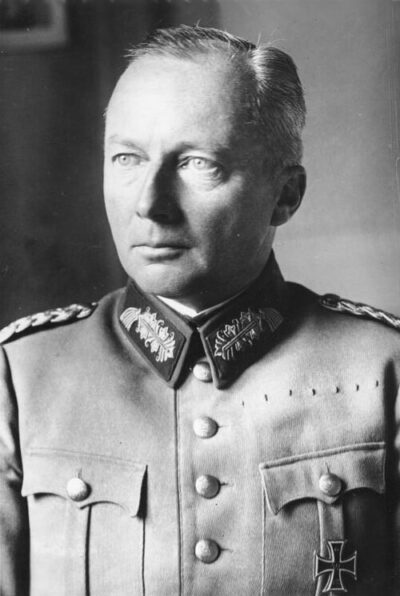
Günther von Kluge
Günther von Kluge was a German general. Born October 30, 1882, in Poznań. Died August 19, 1944, in Dombasle-en-Argonne. Awards include Military Merit Cross III. Class, Knight's Cross of the Iron Cross with Oak Leaves and Swords and Eastern Medal.
Facts
27 facts · 2 confirmed by two sources · 3 cited · 22 from one source
What’s different
- Died: we show August 19, 1944 (Confirmed). Wikidata also lists August 17, 1944
Where this comes from
Papalocal keeps its own record. It started from these sources; what each one said is kept here as it was copied, so a change on their side never changes this page by itself. Tap one to read its version.
What Wikidata says · copied November 16, 2026 · revision 2569028592
- Described as
- German general (1882-1944)
- Born
- October 30, 1882 · 5 references
- Died
- August 17, 1944; August 19, 1944 · 2 references
- Born in
- Poznań
- Died in
- Dombasle-en-Argonne
- Cause of death
- shot to the head
- Name at birth
- Günther Adolf Ferdinand von Kluge
- Citizen of
- Kingdom of Prussia; Weimar Republic; Nazi Germany
- Occupation
- military officer; soldier · 1 reference; Generalfeldmarschall · 1 reference
- Awards
- Military Merit Cross III. Class; Knight's Cross of the Iron Cross with Oak Leaves and Swords; Eastern Medal; Anschluss Medal; Sudetenland Medal; Wound Badge (1918) in Black · 1 reference; Military Merit Cross (Mecklenburg-Schwerin); Military Merit Order (Bavaria); House Order of Hohenzollern · 1 reference; Order of the Iron Crown (Austria) · 1 reference
- Father
- Max von Kluge
- Siblings
- Wolfgang von Kluge
- Military branch
- German Army · 1 reference
- Military rank
- general; Generalfeldmarschall · 1 reference
- Wikipedias with a page
- 48
Wikidata item Q57141 (wikidata.org/wiki/Q57141), public domain (CC0). Copied November 16, 2026.
What Wikipedia says · copied November 16, 2026 · revision 1379821235
Günther Adolf Ferdinand von Kluge (30 October 1882 – 19 August 1944) was a German Generalfeldmarschall (Field Marshal) during World War II. Kluge held commands on the Eastern and Western Fronts, until his suicide in connection with the 20 July plot.
He commanded the 4th Army of the Wehrmacht during the invasion of Poland in 1939 and the Battle of France in 1940, earning a promotion to Generalfeldmarschall. Kluge went on to command the 4th Army in Operation Barbarossa (the invasion of the Soviet Union) and the Battle for Moscow in 1941. Amid the crisis of the Soviet counter-offensive in December 1941, Kluge was promoted to command Army Group Centre replacing Field Marshal Fedor von Bock. Several members of the German military resistance to Adolf Hitler served on his staff, including Henning von Tresckow. Kluge was aware of the plotters' activities but refused to offer his support unless Hitler was killed. His command on the Eastern Front lasted until October 1943 when Kluge was badly injured in a car accident.
Following a lengthy recuperation, Kluge was appointed OB West (Supreme Commander West) in occupied France in July 1944, after his predecessor, Field Marshal Gerd von Rundstedt, was dismissed for defeatism. Kluge's forces were unable to stop the momentum of the Allied invasion of Normandy, and he began to realise that the war in the West was lost. Although Kluge was not an active conspirator in the 20 July plot, in the aftermath of the failed coup he committed suicide on 19 August 1944, after having been recalled to Berlin for a meeting with Hitler. Kluge was replaced by Field Marshal Walter Model.
- Born, in its opening lines
- October 30, 1882
- Died, in its opening lines
- August 19, 1944
From the Wikipedia article “Günther von Kluge” (en.wikipedia.org/wiki/Günther_von_Kluge), by its contributors, under CC BY-SA 4.0 (creativecommons.org/licenses/by-sa/4.0/). Copied November 16, 2026; not changed.
Confirmed Two sources agree. Cited One source, and it names where it got it. One source One source, without a reference of its own. Sources disagree The sources disagree. We show the best-supported value and keep theirs below.
