
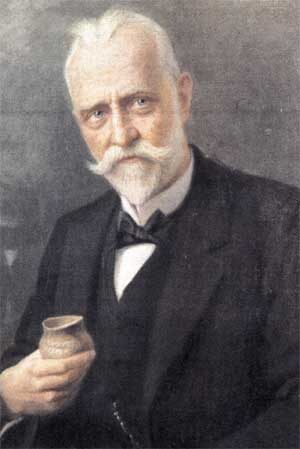
Gustaf Kossinna
Gustaf Kossinna was a German archaeologist. Born September 28, 1858, in Tilsit-Ragnit District. Died December 20, 1931, in Berlin. Educated at University of Göttingen and Leipzig University.
Facts
26 facts · 2 confirmed by two sources · 8 cited · 16 from one source
Where this comes from
Papalocal keeps its own record. It started from these sources; what each one said is kept here as it was copied, so a change on their side never changes this page by itself. Tap one to read its version.
What Wikidata says · copied November 18, 2026 · revision 2568947642
- Described as
- German archaeologist (1858–1931)
- Born
- September 28, 1858 · 3 references
- Died
- December 20, 1931 · 3 references
- Born in
- Tilsit-Ragnit District
- Died in
- Berlin · 2 references
- Buried in
- Lichterfelde cemetery
- Citizen of
- Kingdom of Prussia; German Reich
- Occupation
- anthropologist; librarian · 1 reference; writer; archaeologist · 1 reference; prehistorian · 1 reference; university teacher · 1 reference; Germanist · 1 reference
- Worked for
- Humboldt-Universität zu Berlin
- Education
- University of Göttingen; Leipzig University; Humboldt-Universität zu Berlin; University of Strasbourg; Königliche Litthauische Provinzialschule · 1 reference
- Member of
- Academy of Science for Public Utility; Militant League for German Culture; Royal Swedish Academy of Letters, History and Antiquities
- Field
- philology · 1 reference
- Children
- Erwin Kossina · 1 reference
- Father
- Hermann Kossinna · 1 reference
- Wikipedias with a page
- 23
Wikidata item Q63224 (wikidata.org/wiki/Q63224), public domain (CC0). Copied November 18, 2026.
What Wikipedia says · copied November 18, 2026 · revision 1351883752
Gustaf Kossinna (28 September 1858 – 20 December 1931) was a German philologist and archaeologist who was Professor of German Archaeology at the University of Berlin.
Along with Carl Schuchhardt he was the most influential German prehistorian of his day, and was creator of the techniques of settlement archaeology (German: Siedlungsarchaeologie). His nationalistic theories about the origins of the Germanic peoples and Indo-Europeans influenced aspects of National Socialist ideology. Though politically discredited after World War II, Kossinna's methodological approach has greatly influenced archaeology up to the present day.
In the years following World War II, Kossinna's theories of settlement archaeology were widely dismissed as pseudoscience. Recent discoveries in archaeogenetics have prompted a renewed discussion of Kossinna's legacy and the significance of migration in prehistory.
- Born, in its opening lines
- September 28, 1858
- Died, in its opening lines
- December 20, 1931
From the Wikipedia article “Gustaf Kossinna” (en.wikipedia.org/wiki/Gustaf_Kossinna), by its contributors, under CC BY-SA 4.0 (creativecommons.org/licenses/by-sa/4.0/). Copied November 18, 2026; not changed.
Confirmed Two sources agree. Cited One source, and it names where it got it. One source One source, without a reference of its own. Sources disagree The sources disagree. We show the best-supported value and keep theirs below.
