
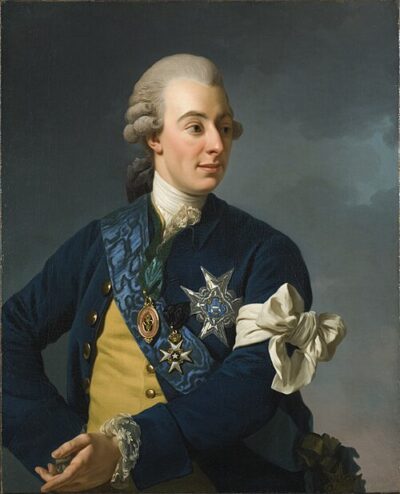
Gustav III of Sweden
Gustav III of Sweden was a King of Sweden from 1771 to 1792. Born January 24, 1746, in The Royal Court Parish. Died March 29, 1792, in The Royal Court Parish. Positions held include Monarch of Sweden (1771–1792). Awards include Royal Order of the Seraphim, Order of Saint Alexander Nevsky and Order of St. Andrew.
Facts
26 facts · 2 confirmed by two sources · 5 cited · 19 from one source
Where this comes from
Papalocal keeps its own record. It started from these sources; what each one said is kept here as it was copied, so a change on their side never changes this page by itself. Tap one to read its version.
What Wikidata says · copied November 16, 2026 · revision 2569004897
- Described as
- King of Sweden from 1771 to 1792 (1746–1792)
- Other names
- Gustav III, Gustavus III
- Born
- January 24, 1746 · 12 references
- Died
- March 29, 1792 · 13 references
- Born in
- The Royal Court Parish · 1 reference
- Died in
- The Royal Court Parish · 1 reference
- Buried in
- Riddarholm Church · 1 reference
- Cause of death
- sepsis
- Citizen of
- Sweden
- Occupation
- politician
- Positions held
- Monarch of Sweden (1771–1792)
- Member of
- Saint Petersburg Academy of Sciences
- Awards
- Royal Order of the Seraphim (1748); Order of Saint Alexander Nevsky; Order of St. Andrew; Royal Order of the Sword; Knight of the Order of the Elephant (1766)
- Spouse
- Sophia Magdalena of Denmark (1766–) · 1 reference
- Children
- Gustav IV Adolf of Sweden · 1 reference; Prince Carl Gustav, Duke of Småland · 1 reference
- Father
- Adolf Fredrik of Sweden
- Mother
- Louisa Ulrika of Prussia
- Siblings
- Sophia Albertina of Sweden; Fredrik Adolf of Sweden, Duke of Östergötland; Charles XIII of Sweden; Lolotte Forssberg; son of von Holstein-Gottorp; Adolf Fredriksson
- Wikipedias with a page
- 61
Wikidata item Q52930 (wikidata.org/wiki/Q52930), public domain (CC0). Copied November 16, 2026.
What Wikipedia says · copied November 16, 2026 · revision 1385538943
Gustav III (24 January [O.S. 13 January] 1746 – 29 March 1792), also called Gustavus III, was King of Sweden from 1771 until his assassination in 1792. He was the eldest son of King Adolf Frederick and Queen Louisa Ulrika of Sweden.
Gustav was a vocal opponent of what he saw as the abuse of political privileges seized by the nobility since the death of King Charles XII in the Great Northern War. Seizing power from the government in a coup d'état, called the Swedish Revolution, in 1772 that ended the Age of Liberty, he initiated a campaign to restore a measure of royal autocracy. This was completed by the Union and Security Act of 1789, which swept away most of the powers exercised by the Swedish Riksdag of the Estates during the Age of Liberty, but at the same time, it opened up the government for all citizens, thereby breaking the privileges of the nobility.
A believer in enlightened absolutism, Gustav spent considerable public funds on cultural ventures, which were controversial among his critics, as well as military attempts to seize Norway with Russian aid, then a series of attempts to re-capture the Swedish Baltic dominions lost during the Great Northern War through the failed war with Russia. Nonetheless, his successful leadership in the Battle of Svensksund averted a complete military defeat and signified that Swedish military might was to be countenanced after its major defeats earlier in the century.
An admirer of Voltaire, Gustav legalised Catholic and Jewish presence in Sweden, and enacted wide-ranging reforms aimed at economic liberalism, social reform and the restriction, in many cases, of torture and capital punishment. The much-praised Freedom of the Press Act of 1766 was severely curtailed, however, by amendments in 1774 and 1792, effectively extinguishing independent media.
Following the uprising against the French monarchy in 1789, Gustav pursued an alliance of princes aimed at crushing the insurrection and re-instating his French counterpart, King Louis XVI, offering Swedish military assistance as well as his leadership.
In 1792, he was mortally wounded by a gunshot in the lower back during a masquerade ball as part of an aristocratic-parliamentary coup attempt, but managed to assume command and quell the uprising before succumbing to sepsis 13 days later, a period during which he received apologies from many of his political enemies. Gustav's immense powers were placed in the hands of a regency under his brother Prince Carl and Gustaf Adolf Reuterholm until his son and successor Gustav IV Adolf reached adulthood in 1796. The Gustavian autocracy thus survived until 1809, when his son was ousted in another coup d'état, which definitively established parliament as the dominant political power; this has lasted until the modern day, where the Riksdag is Sweden's supreme legislature.
A patron of the arts and benefactor of arts and literature, Gustav founded the Swedish Academy, created a national costume and had the Royal Swedish Opera and Royal Dramatic Theatre built. In 1772, he founded the Royal Order of Vasa to acknowledge and reward those Swedes who had contributed to advances in the fields of agriculture, mining and commerce. He was also a patron of many cultural figures, including Alexander Roslin and Carl Michael Bellman, and is often considered one of the most important figures in the history of Swedish art, music and architecture. Gustav III was well liked by the Swedish population and was mourned upon his death.
In 1777, Gustav III was the first formally neutral head of state in the world to recognise the United States during its war for independence from Great Britain. Swedish military forces were engaged by the thousands on the side of the colonists, largely through the French expedition force. Through the acquisition of Saint Barthélemy in 1784, Gustav enabled the restoration, if symbolic, of Swedish overseas colonies in America, as well as great personal profits from the transatlantic slave trade.
- Born, in its opening lines
- January 24, 1746
- Died, in its opening lines
- March 29, 1792
From the Wikipedia article “Gustav III” (en.wikipedia.org/wiki/Gustav_III), by its contributors, under CC BY-SA 4.0 (creativecommons.org/licenses/by-sa/4.0/). Copied November 16, 2026; not changed.
Confirmed Two sources agree. Cited One source, and it names where it got it. One source One source, without a reference of its own. Sources disagree The sources disagree. We show the best-supported value and keep theirs below.
