
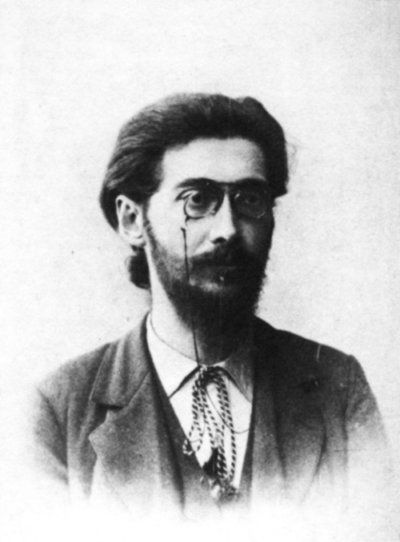
Gustav Landauer
Gustav Landauer was a German anarchist, editor. Born April 7, 1870, in Karlsruhe. Died May 2, 1919, in Munich Prison. Known for Skepticism and Mysticism, Revolution and For Socialism. Educated at Bismarck-Gymnasium Karlsruhe and Heidelberg University.
Facts
40 facts · 2 confirmed by two sources · 19 cited · 19 from one source
Where this comes from
Papalocal keeps its own record. It started from these sources; what each one said is kept here as it was copied, so a change on their side never changes this page by itself. Tap one to read its version.
What Wikidata says · copied November 16, 2026 · revision 2569129326
- Described as
- German anarchist, editor (1870-1919)
- Born
- April 7, 1870 · 8 references
- Died
- May 2, 1919 · 7 references
- Born in
- Karlsruhe · 2 references
- Died in
- Munich Prison
- Buried in
- Neuer Israelitischer Friedhof (1933–)
- Cause of death
- gunshot wound
- Citizen of
- Germany · 3 references
- Occupation
- politician · 2 references; translator · 2 references; writer · 2 references; journalist; editor · 3 references; philosopher · 2 references; book dealer · 3 references; publisher · 1 reference
- Education
- Bismarck-Gymnasium Karlsruhe; Heidelberg University; Humboldt-Universität zu Berlin; University of Strasbourg
- Known for
- Skepticism and Mysticism; Revolution; For Socialism; Preacher of Death; Friedrich Hölderlin in seinen Gedichten; Arnold Himmelheber; Shakespeare
- Field
- politics · 1 reference; literature · 1 reference; philosophy · 1 reference; journalism · 1 reference; drama · 1 reference; theatre criticism · 1 reference
- Spouse
- Hedwig Lachmann · 1 reference; Margarethe Landauer (1894–1903) · 1 reference
- Children
- Brigitte Landauer · 1 reference; Charlotte Landauer; Gudula Landauer · 1 reference
- Father
- Hermann Landauer · 1 reference
- Mother
- Roese (Rosa) Landauer · 1 reference
- Lived in
- Hermsdorf (1902–1908)
- Wikipedias with a page
- 33
Wikidata item Q61723 (wikidata.org/wiki/Q61723), public domain (CC0). Copied November 16, 2026.
What Wikipedia says · copied November 16, 2026 · revision 1372536288
Gustav Landauer (German: [ˈlandaʊɐ]; 7 April 1870 – 2 May 1919) was a German anarchist writer and revolutionary. As one of the leading theorists of anarchism in Germany at the turn of the 20th century, he advocated a form of libertarian socialism that rejected both capitalism and Marxist historical materialism. Landauer's philosophy synthesized anarchism with romanticism, mysticism, and a non-racist, communitarian interpretation of völkisch thought, emphasizing spiritual renewal and the creation of decentralized, autonomous communities.
Born into a middle-class Jewish family in Karlsruhe, Landauer's early thought was shaped by German Romanticism and the philosophies of Baruch Spinoza, Arthur Schopenhauer, and Friedrich Nietzsche. In Berlin during the 1890s, he became a prominent anarchist voice, breaking with the Social Democratic Party over its rigid Marxism. He argued that socialism was not an inevitable outcome of economic laws but an act of human will and ethical choice. His major works, including Skepsis und Mystik (Skepticism and Mysticism, 1903) and Aufruf zum Sozialismus (Call to Socialism, 1911), articulated his view that the state is not an institution to be violently overthrown but a social relationship that can be replaced by creating new, voluntary forms of community.
From the 1890s until the First World War, Landauer was the central figure behind the newspaper Der Sozialist. In 1908, he founded the Socialist Bund (Socialist League), an association of autonomous groups intended to prefigure a future libertarian society through cooperative settlements. A committed pacifist, Landauer opposed World War I and advocated for a general strike to prevent it. During this time, he developed a cosmopolitan cultural nationalism that defined nations as peaceful communities of spirit, distinct from the violent structures of states.
During the German Revolution of 1918–1919, Landauer was invited to Munich by Kurt Eisner. He participated in the proclamation of the Bavarian Soviet Republic in April 1919 and served in its first, short-lived council of people's deputies as Commissioner for Enlightenment and Public Instruction. When the republic was crushed by government troops, Landauer was arrested and murdered in Stadelheim Prison. His ideas influenced figures such as Martin Buber, Ernst Toller, and the German youth movement, and his work represents a significant communitarian and anti-authoritarian alternative to both capitalism and state socialism.
- Born, in its opening lines
- April 7, 1870
- Died, in its opening lines
- May 2, 1919
From the Wikipedia article “Gustav Landauer” (en.wikipedia.org/wiki/Gustav_Landauer), by its contributors, under CC BY-SA 4.0 (creativecommons.org/licenses/by-sa/4.0/). Copied November 16, 2026; not changed.
Confirmed Two sources agree. Cited One source, and it names where it got it. One source One source, without a reference of its own. Sources disagree The sources disagree. We show the best-supported value and keep theirs below.
