
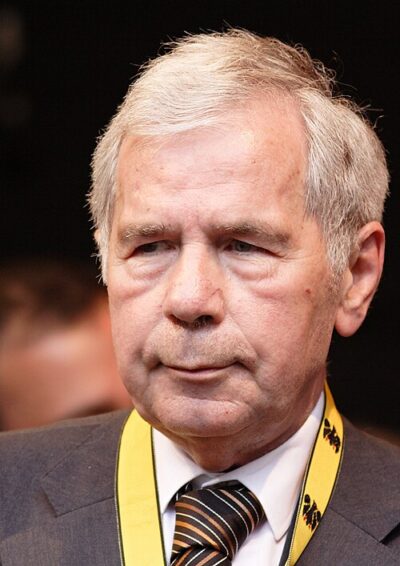
Gyula Horn
Gyula Horn was a Hungarian politician. Born July 5, 1932, in Budapest. Died June 19, 2013, in Budapest. Positions held include Prime Minister of Hungary (1994–1998), Minister of Foreign Affairs of Hungary (1989–1990) and member of the National Assembly of Hungary (1990–2010). Educated at Rostov State Economics University. Awards include Charlemagne Prize, Grand Cross 1st class of the Order of Merit of the Federal Republic of Germany and Memminger Freedom Prize 1525.
Facts
28 facts · 2 confirmed by two sources · 11 cited · 15 from one source
Where this comes from
Papalocal keeps its own record. It started from these sources; what each one said is kept here as it was copied, so a change on their side never changes this page by itself. Tap one to read its version.
What Wikidata says · copied November 16, 2026 · revision 2562763913
- Described as
- Hungarian politician (1932–2013)
- Other names
- Horn Gyula
- Born
- July 5, 1932 · 7 references
- Died
- June 19, 2013 · 6 references
- Born in
- Budapest · 1 reference
- Died in
- Budapest · 1 reference
- Buried in
- Fiume Road Graveyard · 2 references
- Name at birth
- Horn Gyula János
- Citizen of
- Hungary
- Occupation
- politician · 1 reference; diplomat; economist
- Positions held
- Prime Minister of Hungary (1994–1998) · 1 reference; Minister of Foreign Affairs of Hungary (1989–1990) · 1 reference; member of the National Assembly of Hungary (1990–2010) · 1 reference; secretary of state; member of Central Committee of the Hungarian Socialist Workers' Party (1985–1989) · 1 reference
- Political party
- Hungarian Socialist Party (1989–2013); Hungarian Socialist Workers' Party (1956–1989); Hungarian Working People's Party (1954–1956)
- Education
- Rostov State Economics University (–1954) · 1 reference
- Awards
- Charlemagne Prize (1990) · 1 reference; Grand Cross 1st class of the Order of Merit of the Federal Republic of Germany; Memminger Freedom Prize 1525; Grand Cross of Honor for Services to the Republic of Austria (2005) · 1 reference; The Glass of Reason; Schärfste Klinge; Commemorative Medal for Worker-Peasant Power (1957); Courage Award (2005)
- Field
- political activity · 1 reference
- Wikipedias with a page
- 52
Wikidata item Q155684 (wikidata.org/wiki/Q155684), public domain (CC0). Copied November 16, 2026.
What Wikipedia says · copied November 16, 2026 · revision 1383558064
Gyula János Horn (5 July 1932 – 19 June 2013) was a Hungarian politician who was the Prime Minister of Hungary from 1994 to 1998.
Horn was the last Communist Minister of Foreign Affairs of Hungary. He played a major role in demolishing the "Iron Curtain" for East Germans in 1989, contributing to the later unification of Germany. During his premiership, he launched the Bokros package, the biggest fiscal austerity programme in post-communist Hungary, in 1995.
- Born, in its opening lines
- July 5, 1932
- Died, in its opening lines
- June 19, 2013
From the Wikipedia article “Gyula Horn” (en.wikipedia.org/wiki/Gyula_Horn), by its contributors, under CC BY-SA 4.0 (creativecommons.org/licenses/by-sa/4.0/). Copied November 16, 2026; not changed.
Confirmed Two sources agree. Cited One source, and it names where it got it. One source One source, without a reference of its own. Sources disagree The sources disagree. We show the best-supported value and keep theirs below.
