
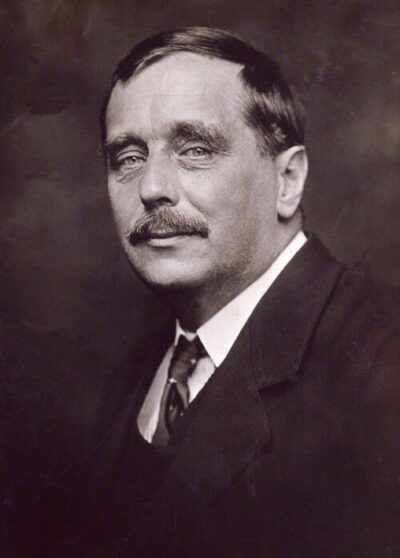
H. G. Wells
H. G. Wells was an English writer. Born September 21, 1866, in Bromley. Died August 13, 1946, in London. Positions held include president (1932–1935). Known for The Outline of History, The Time Machine and The Invisible Man. Educated at Royal College of Science and University of London. Awards include Science Fiction and Fantasy Hall of Fame.
Facts
47 facts · 2 confirmed by two sources · 13 cited · 32 from one source
Where this comes from
Papalocal keeps its own record. It started from these sources; what each one said is kept here as it was copied, so a change on their side never changes this page by itself. Tap one to read its version.
What Wikidata says · copied November 16, 2026 · revision 2565537538
- Described as
- English writer (1866–1946)
- Other names
- Wells, Herbert George, Herbert Wells, Herbert George Wells, Herbert G. Wells, H.G. Wells, HG Wells
- Born
- September 21, 1866 · 20 references
- Died
- August 13, 1946 · 20 references
- Born in
- Bromley · 2 references
- Died in
- London · 3 references
- Cause of death
- liver tumor
- Name at birth
- Herbert George Wells
- Citizen of
- United Kingdom of Great Britain and Ireland; United Kingdom
- Occupation
- writer · 4 references; historian · 1 reference; journalist; Idist; science fiction writer · 1 reference; novelist · 1 reference; sociologist · 1 reference; screenwriter
- Positions held
- president (1932–1935) · 1 reference
- Political party
- Labour Party
- Education
- Royal College of Science; University of London
- Member of
- Fabian Society
- Genre
- science fiction; biography · 1 reference; essay · 1 reference
- Known for
- The Outline of History; The Time Machine; The Invisible Man; The Island of Dr Moreau; The War of the Worlds; The First Men in the Moon; The Shape of Things to Come; Marriage; The Soul of a Bishop
- Awards
- Science Fiction and Fantasy Hall of Fame (1997)
- Field
- science fiction · 1 reference; creative and professional writing · 1 reference; non-fiction literature · 1 reference; science fiction literature · 1 reference
- Spouse
- Isabel Mary Wells (1891–1894); Catherine Wells (1895–1927) · 1 reference
- Children
- Anthony West · 1 reference; George Philip Wells · 1 reference; Frank Wells
- Father
- Joseph Wells
- Mother
- Sarah Neal · 1 reference
- Siblings
- Francis Charles Wells; Frederick Joseph Wells
- Wikipedias with a page
- 169
Wikidata item Q42511 (wikidata.org/wiki/Q42511), public domain (CC0). Copied November 16, 2026.
What Wikipedia says · copied November 16, 2026 · revision 1385725988
Herbert George Wells (21 September 1866 – 13 August 1946) was an English writer, prolific in many genres. He wrote more than forty novels and dozens of short stories. His non-fiction output included works of social commentary, politics, history, popular science, satire, biography, and autobiography. Wells is most known today for his groundbreaking science fiction novels; he has sometimes been called the "father of science fiction", a title that has also been given to Jules Verne and Hugo Gernsback.
In addition to his fame as a writer, he was prominent in his lifetime as a forward-looking, even prophetic social critic who devoted his literary talents to the development of a progressive vision on a global scale. As a futurist, he wrote a number of utopian works and foresaw the advent of aircraft, tanks, space travel, nuclear weapons, satellite television and something resembling the World Wide Web. His science fiction imagined time travel, alien invasion, invisibility, and biological engineering before these subjects were common in the genre. Brian Aldiss referred to Wells as the "Shakespeare of science fiction", while Charles Fort called him a "wild talent".
Wells rendered his works convincing by instilling commonplace detail alongside a single extraordinary assumption per work – dubbed "Wells's law" – leading Joseph Conrad to hail him in 1898 with "O Realist of the Fantastic!". His most notable science fiction works include The Time Machine (1895), which was his first novella, The Island of Doctor Moreau (1896), The Invisible Man (1897), The War of the Worlds (1898), the military science fiction The War in the Air (1907), and the dystopian When the Sleeper Wakes (1910). Novels of social realism such as Kipps (1905) and The History of Mr Polly (1910), which describe lower-middle-class English life, led to the suggestion that he was a worthy successor to Charles Dickens, but Wells described a range of social strata and even attempted, in Tono-Bungay (1909), a diagnosis of English society as a whole. Wells was nominated for the Nobel Prize in Literature four times.
Wells's earliest specialised training was in biology, and his thinking on ethical matters took place in a Darwinian context. He was also an outspoken socialist from a young age, often (but not always, as at the beginning of the First World War) sympathising with pacifist views. For much of his adult life he was a passionate advocate of eugenics and involuntary euthanasia, arguing in favour of the "sterilisation of failure" as a necessary condition for socialism to succeed, a view he had largely recanted by 1940. In his later years, he wrote less fiction and more works expounding his political and social views, sometimes giving his profession as that of journalist. Wells was a diabetic and co-founded the charity The Diabetic Association (Diabetes UK) in 1934.
- Born, in its opening lines
- September 21, 1866
- Died, in its opening lines
- August 13, 1946
From the Wikipedia article “H. G. Wells” (en.wikipedia.org/wiki/H._G._Wells), by its contributors, under CC BY-SA 4.0 (creativecommons.org/licenses/by-sa/4.0/). Copied November 16, 2026; not changed.
Confirmed Two sources agree. Cited One source, and it names where it got it. One source One source, without a reference of its own. Sources disagree The sources disagree. We show the best-supported value and keep theirs below.
