
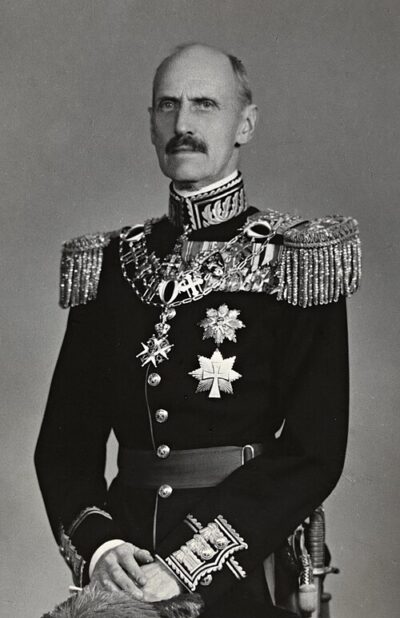
Haakon VII of Norway
Haakon VII of Norway was a King of Norway from 1905 to 1957. Born August 3, 1872, in Charlottenlund Palace. Died September 21, 1957, in Royal Palace, Oslo. Positions held include Monarch of Norway (1905–1957) and Prince of Denmark (1872–1905). Educated at Royal Danish Naval Academy. Awards include Grand Cross of the Legion of Honour, Knight of the Order of the Golden Fleece and Knight of the Order of St. Alexander Nevsky.
Facts
51 facts · 2 confirmed by two sources · 7 cited · 42 from one source
Where this comes from
Papalocal keeps its own record. It started from these sources; what each one said is kept here as it was copied, so a change on their side never changes this page by itself. Tap one to read its version.
What Wikidata says · copied November 16, 2026 · revision 2565932094
- Described as
- King of Norway from 1905 to 1957 (1872–1957)
- Other names
- Prince Carl of Denmark, Prince Christian Frederik Carl Georg Valdemar Axel of Denmark, Carl of Denmark, Christian Frederik Carl Georg Valdemar Axel of Denmark, Haakon VII
- Born
- August 3, 1872 · 13 references
- Died
- September 21, 1957 · 14 references
- Born in
- Charlottenlund Palace · 2 references
- Died in
- Royal Palace, Oslo · 2 references
- Buried in
- Royal Mausoleum · 1 reference
- Name at birth
- Prince Christian Frederik Carl Georg Valdemar Axel of Denmark
- Citizen of
- Norway (1905–); Kingdom of Denmark (1872–1905)
- Occupation
- monarch (1905–1957); royalty (1872–1957)
- Positions held
- Monarch of Norway (1905–1957); Prince of Denmark (1872–1905)
- Education
- Royal Danish Naval Academy
- Member of
- Haakon VII of Norway and Queen Maud · 1 reference; Norwegian royal family
- Awards
- Grand Cross of the Legion of Honour; Knight of the Order of the Golden Fleece; Knight of the Order of St. Alexander Nevsky; Order of the Black Eagle; Honorary Knight Grand Cross of the Order of the Bath (1896) · 1 reference; Order of the White Eagle; Holmenkollen Medal (1955); Order of Saint Anna, 1st class; Order of the White Eagle; Order of Saint Stanislaus, 1st class; War Medal; Order of St. Andrew; Croix de guerre 1939–1945; Royal Victorian Chain (1902); Order of the Elephant (1861)
- Spouse
- Maud of Wales (1896–1938) · 2 references
- Children
- Olav V of Norway · 1 reference
- Father
- Frederik VIII of Denmark · 1 reference
- Mother
- Louise of Sweden · 1 reference
- Siblings
- Christian X of Denmark; Princess Louise of Denmark; Prince Harald of Denmark; Princess Ingeborg of Denmark; Princess Thyra of Denmark; Prince Gustav of Denmark; Princess Dagmar of Denmark
- Religion
- Lutheranism
- Military branch
- Royal Danish Navy (1893–1905)
- Military rank
- first lieutenant (1894–1905); second lieutenant (1893–1894)
- Lived in
- Amalienborg; Charlottenlund Palace; Copenhagen; Appleton House; Bygdøy Royal Estate
- Website
- http://www.kongehuset.no/c27312/seksjonstekst_person/vis.html?tid=28677 · 1 reference
- Wikipedias with a page
- 72
Wikidata item Q154927 (wikidata.org/wiki/Q154927), public domain (CC0). Copied November 16, 2026.
What Wikipedia says · copied November 16, 2026 · revision 1385615281
Haakon VII (Norwegian: [ˈhôːkʊn]; born Prince Carl of Denmark; 3 August 1872 – 21 September 1957) was King of Norway from 1905 until his death in 1957.
Born in Copenhagen during the reign of his grandfather, King Christian IX of Denmark, he was named Carl at birth and was the second son of the Crown Prince and Crown Princess of Denmark (later King Frederick VIII and Queen Louise). Through his mother, Louise of Sweden, he was also a grandson of King Charles XV of Sweden, linking him lineally to both the Danish and Swedish royal houses.
Carl was educated at the Royal Danish Naval Academy and served in the Royal Danish Navy. After the 1905 dissolution of the union between Sweden and Norway, he was offered the Norwegian crown. Following a referendum on the monarchy, he accepted the offer and was formally elected King of Norway by the Storting and took the Old Norse name Haakon, thus ascended the throne as Haakon VII, the first independent Norwegian monarch since Olav IV in 1387.
As king, Haakon gained much sympathy from the Norwegian people. Although the Constitution of Norway vests the King with considerable executive powers, in practice, Haakon confined himself to a representative and ceremonial role while rarely interfering in politics, a practice continued by his successors. Norway was invaded by Nazi Germany in April 1940. Haakon rejected German demands to legitimise the Quisling regime's puppet government, vowing to abdicate rather than do so. He refused to abdicate after going into exile in Great Britain. As such, he played a pivotal role in uniting the Norwegian nation in its resistance to the invasion and the subsequent five-year-long occupation during the Second World War. He returned to Norway in June 1945 after the defeat of Germany.
Haakon became King of Norway when his grandfather Christian IX was still reigning in Denmark, and before his father and elder brother became kings of Denmark. During his reign he saw his father Frederick VIII, his elder brother Christian X, and his nephew Frederik IX ascend the throne of Denmark in 1906, 1912, and 1947 respectively. Haakon died at the age of 85 in September 1957. He was succeeded by his only child, a son, who ascended to the throne as Olav V.
- Born, in its opening lines
- August 3, 1872
- Died, in its opening lines
- September 21, 1957
From the Wikipedia article “Haakon VII” (en.wikipedia.org/wiki/Haakon_VII), by its contributors, under CC BY-SA 4.0 (creativecommons.org/licenses/by-sa/4.0/). Copied November 16, 2026; not changed.
Confirmed Two sources agree. Cited One source, and it names where it got it. One source One source, without a reference of its own. Sources disagree The sources disagree. We show the best-supported value and keep theirs below.
