
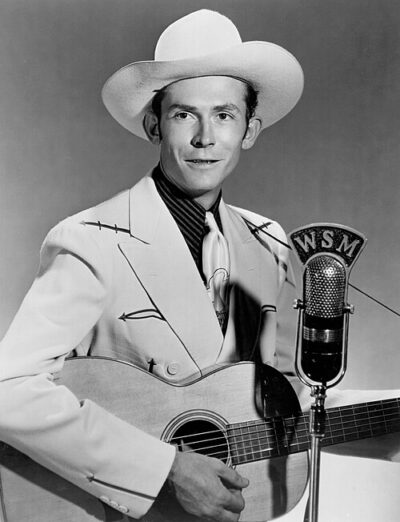
Hank Williams
Hank Williams was an American singer-songwriter. Born September 17, 1923, in Mount Olive. Died January 1, 1953, in Oak Hill. Educated at Sidney Lanier High School. Awards include Grammy Lifetime Achievement Award, Americana Music Association President's Award and star on Hollywood Walk of Fame.
Facts
38 facts · 2 confirmed by two sources · 9 cited · 26 from one source · 1 where the sources disagree
What’s different
- Cause of death: we show drug overdose (Sources disagree). Wikidata also lists heart failure
Where this comes from
Papalocal keeps its own record. It started from these sources; what each one said is kept here as it was copied, so a change on their side never changes this page by itself. Tap one to read its version.
What Wikidata says · copied November 13, 2026 · revision 2565558409
- Described as
- American singer-songwriter (1923–1953)
- Other names
- Luke the Drifter, Hank Senior, Luke The Drifter, Hank Williams, Sr., Hiram King Williams, Sr., Hiram King "Hank" Williams, Hiram King Williams
- Born
- September 17, 1923 · 9 references
- Died
- January 1, 1953 · 9 references
- Born in
- Mount Olive
- Died in
- Oak Hill · 1 reference
- Buried in
- Oakwood Annex Cemetery · 1 reference
- Cause of death
- drug overdose; heart failure
- Name at birth
- Hiriam Williams · 2 references
- Citizen of
- United States
- Occupation
- singer-songwriter; singer; street artist; country musician · 1 reference; yodeler; guitarist; recording artist; composer · 1 reference
- Political party
- Republican Party
- Education
- Sidney Lanier High School · 1 reference
- Member of
- Hank Williams With His Drifting Cowboys · 1 reference
- Genre
- country music; blues · 1 reference; honky tonk · 1 reference; honky-tonk · 1 reference
- Instrument
- guitar; voice
- Record label
- Sterling Records; MGM Records · 1 reference
- Awards
- Grammy Lifetime Achievement Award (1987); Americana Music Association President's Award (2013) · 1 reference; star on Hollywood Walk of Fame · 1 reference; Rock and Roll Hall of Fame (1987) · 1 reference; Pulitzer Prize Special Citations and Awards (2010) · 1 reference
- Spouse
- Audrey Williams (1944–1954); Billie Jean Jones (1952–1953)
- Children
- Hank Williams Jr. · 1 reference; Jett Williams (1953) · 1 reference
- Religion
- Baptists
- Website
- http://www.hankwilliams.com/
- Wikipedias with a page
- 71
Wikidata item Q206181 (wikidata.org/wiki/Q206181), public domain (CC0). Copied November 13, 2026.
What Wikipedia says · copied November 13, 2026 · revision 1385262751
Hiram "Hank" Williams (September 17, 1923 – January 1, 1953) was an American singer, songwriter, and musician. An early pioneer of country music, he is regarded as one of the most significant and influential musicians of the 20th century. Williams recorded 55 singles that reached the top 10 of the Billboard Country & Western Best Sellers chart, 5 of which were released posthumously, and 12 of which reached No. 1.
Born and raised in Alabama, Williams learned guitar from blues musician Rufus Payne. Both Payne and Roy Acuff significantly influenced his musical style. After winning an amateur talent contest, Williams began his professional career in Montgomery in the late 1930s playing on local radio stations and at area venues such as school houses, movie theaters, and bars. He formed the Drifting Cowboys backup band, which was managed by his mother, and dropped out of school to devote his time to his career. Because his alcoholism made him unreliable, he was fired and rehired several times by radio station WSFA. Williams also had trouble replacing several of his band members who were drafted during World War II.
In 1944, Williams married Audrey Sheppard, who competed with his mother to control his career. After recording "Never Again" and "Honky Tonkin'" with Sterling Records, he signed a contract with MGM Records. He released the hit single "Move It On Over" in 1947 and joined the Louisiana Hayride radio program. The next year he released a cover of "Lovesick Blues", which quickly reached number one on Billboard's Top Country & Western singles chart and propelled him to stardom on the Grand Ole Opry. Although unable to read or notate music to any significant degree, he wrote such iconic hits as "Your Cheatin' Heart", "Hey, Good Lookin'", and "I'm So Lonesome I Could Cry". During his final years, he struggled with back pain and substance abuse, exacerbating the strain on his relationships with Audrey and the Grand Ole Opry.
Williams died on New Year's Day 1953 at the age of 29, his heart failing in the back seat of a car near Oak Hill, West Virginia, en route to a concert in Canton, Ohio. Despite his relatively brief career, he is one of the most celebrated and influential musicians of the 20th century, especially in country music. Many artists have covered his songs and he has influenced Chuck Berry, Elvis Presley, Waylon Jennings, Johnny Cash, Bob Dylan, and the Rolling Stones, among others. He was inducted into the Country Music Hall of Fame in 1961, the Songwriters Hall of Fame in 1970, the Rock and Roll Hall of Fame in 1987, the Native American Music Awards Hall of Fame in 1999, and gained a star on the Hollywood Walk of Fame. In 2010, he was posthumously awarded a Pulitzer Prize Special Citation for his "craftsmanship as a songwriter who expressed universal feelings with poignant simplicity and played a pivotal role in transforming country music into a major musical and cultural force in American life." His life and career were dramatized in the 1964 biopic Your Cheatin' Heart and the 2015 biopic I Saw the Light.
- Born, in its opening lines
- September 17, 1923
- Died, in its opening lines
- January 1, 1953
From the Wikipedia article “Hank Williams” (en.wikipedia.org/wiki/Hank_Williams), by its contributors, under CC BY-SA 4.0 (creativecommons.org/licenses/by-sa/4.0/). Copied November 13, 2026; not changed.
Confirmed Two sources agree. Cited One source, and it names where it got it. One source One source, without a reference of its own. Sources disagree The sources disagree. We show the best-supported value and keep theirs below.
