
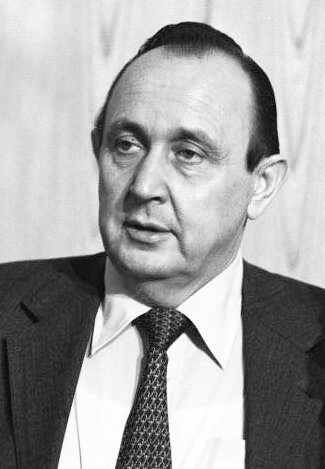
Hans-Dietrich Genscher
Hans-Dietrich Genscher was a German politician and member of the Free Democratic Party. Born March 21, 1927, in Reideburg. Died March 31, 2016, in Pech. Positions held include Vice-Chancellor of Germany (1974–1992), Federal Minister for Foreign Affairs (1974–1992) and member of the German Bundestag (1965–1998). Educated at Martin Luther University Halle-Wittenberg and Leipzig University. Awards include honorary citizen of Berlin, Order of Merit of North Rhine-Westphalia and Ring of Honour of the City of Wuppertal.
Facts
55 facts · 2 confirmed by two sources · 18 cited · 35 from one source
Where this comes from
Papalocal keeps its own record. It started from these sources; what each one said is kept here as it was copied, so a change on their side never changes this page by itself. Tap one to read its version.
What Wikidata says · copied November 16, 2026 · revision 2569183038
- Described as
- German politician and member of the Free Democratic Party (1927-2016)
- Other names
- Hans Dietrich Genscher
- Born
- March 21, 1927 · 14 references
- Died
- March 31, 2016 · 11 references
- Born in
- Reideburg · 1 reference
- Died in
- Pech · 1 reference
- Buried in
- Rheinhöhenfriedhof
- Cause of death
- cardiac arrest
- Citizen of
- Germany (1952–) · 2 references; East Germany (–1952) · 1 reference
- Occupation
- politician · 2 references; lawyer; assessor; university teacher · 1 reference; non-fiction writer; military personnel; foreign minister · 1 reference
- Positions held
- Vice-Chancellor of Germany (1974–1992); Federal Minister for Foreign Affairs (1974–1992) · 1 reference; member of the German Bundestag (1965–1998) · 1 reference; Chief Whip (1965–1969); Federal Minister of the Interior (1969–1974); interior minister · 1 reference
- Political party
- Free Democratic Party (1952–2016) · 1 reference; Nazi Party (1944–1945); Liberal Democratic Party of Germany (1946–1952)
- Worked for
- Freie Universität Berlin (1994–1995); FDP Bundestag fraction (1956–1959); Johannes Gutenberg University Mainz (2002)
- Education
- Martin Luther University Halle-Wittenberg (1946–); Leipzig University (–1949); University of Hamburg · 1 reference; Hans-Dietrich-Genscher-Gymnasium
- Member of
- German Council on Foreign Relations
- Awards
- honorary citizen of Berlin; Order of Merit of North Rhine-Westphalia (2007); Ring of Honour of the City of Wuppertal (1998); Orden wider den tierischen Ernst (1979) · 1 reference; Order of Merit of Saxony-Anhalt; Great Cross with Star and Sash of the Order of Merit of the Federal Republic of Germany (1975) · 1 reference; Princess of Asturias Award for International Cooperation (1990); Steiger Award; Order of the Three Stars, 2nd Class; Order of Freedom of the Republic of Slovenia; Grand Cross of the Order of Isabella the Catholic (1977) · 1 reference; Reinhold Maier Medal (1993); Leipzig International Mendelssohn Prize (2014) · 1 reference; Grand Cross of the Military Order of Christ · 1 reference; Grand Cross of the Military Order of Saint James of the Sword · 1 reference
- Field
- politics · 1 reference; foreign policy · 1 reference
- Spouse
- Barbara Genscher (1969–2016) · 1 reference
- Religion
- Protestantism · 1 reference
- Military branch
- 12th Army (1945–)
- Military rank
- Gefreiter
- Lived in
- Wachtberg
- Website
- http://www.genscher.de/
- Wikipedias with a page
- 63
Wikidata item Q106235 (wikidata.org/wiki/Q106235), public domain (CC0). Copied November 16, 2026.
What Wikipedia says · copied November 16, 2026 · revision 1379613838
Hans-Dietrich Genscher (German: [ˈɡɛnʃɐ]; 21 March 1927 – 31 March 2016) was a German statesman and a member of the liberal Free Democratic Party (FDP), who served as Federal Minister of the Interior from 1969 to 1974, and as Federal Minister for Foreign Affairs and Vice Chancellor of Germany from 1974 to 1992 (except for a two-week break in 1982, after the FDP had left the Third Schmidt cabinet), making him the longest-serving occupant of either post and the only person to have held one of these positions under two different Chancellors of the Federal Republic of Germany. In 1991 he was chairman of the Organization for Security and Co-operation in Europe (OSCE).
A proponent of Realpolitik, Genscher has been called "a master of diplomacy". He is widely regarded as having been a principal "architect of German reunification". In 1991, he played a pivotal role in international diplomacy surrounding the breakup of Yugoslavia by successfully pushing for international recognition of Croatia, Slovenia and other republics declaring independence, in an effort to halt "a trend towards a Greater Serbia". After leaving office, he worked as a lawyer and international consultant. He was President of the German Council on Foreign Relations and was involved with several international organisations, and with former Czech President Václav Havel, he called for a Cold War museum to be built in Berlin.
- Born, in its opening lines
- March 21, 1927
- Died, in its opening lines
- March 31, 2016
From the Wikipedia article “Hans-Dietrich Genscher” (en.wikipedia.org/wiki/Hans-Dietrich_Genscher), by its contributors, under CC BY-SA 4.0 (creativecommons.org/licenses/by-sa/4.0/). Copied November 16, 2026; not changed.
Confirmed Two sources agree. Cited One source, and it names where it got it. One source One source, without a reference of its own. Sources disagree The sources disagree. We show the best-supported value and keep theirs below.
