
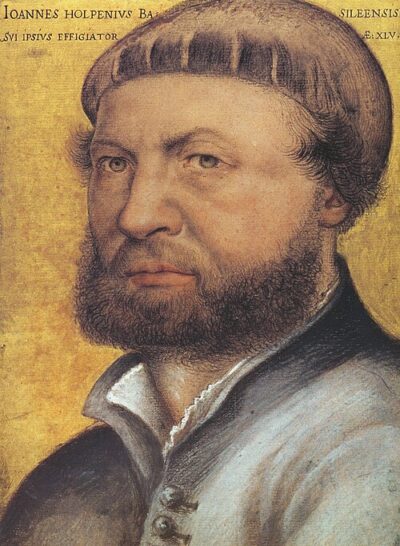
Hans Holbein the Younger
Hans Holbein the Younger was a German artist and printmaker. Born 1497, in Augsburg. Died November 29, 1543, in London. Positions held include court painter. Known for The Ambassadors, Madonna enthroned with child and two figures and Darmstadt Madonna.
Facts
31 facts · 0 confirmed by two sources · 21 cited · 10 from one source
Where this comes from
Papalocal keeps its own record. It started from these sources; what each one said is kept here as it was copied, so a change on their side never changes this page by itself. Tap one to read its version.
What Wikidata says · copied November 16, 2026 · revision 2569045601
- Described as
- German artist and printmaker (1497–1543)
- Other names
- Orbens, the younger Hans Holbein, Hans Ubeno, Hans II Holbein, Olvens, Holbin, Hanshulben, Hulbeine, Hans Olbeius, Hans Ulbens, Hol-bein, Olbens
- Born
- 1497 · 6 references
- Died
- November 29, 1543
- Born in
- Augsburg · 3 references
- Died in
- London · 1 reference
- Buried in
- Church of St Katharine Cree, London · 1 reference
- Cause of death
- plague
- Citizen of
- Holy Roman Empire; Switzerland · 2 references; France · 1 reference
- Occupation
- painter · 7 references; printmaker · 1 reference; illustrator · 1 reference; portraitist · 1 reference; draftsperson · 4 references; exlibrist; visual artist · 1 reference; artist · 2 references
- Positions held
- court painter · 1 reference
- Genre
- portrait painting · 1 reference; portrait · 1 reference; religious art · 1 reference
- Known for
- The Ambassadors; Madonna enthroned with child and two figures; Darmstadt Madonna; The Body of the Dead Christ in the Tomb
- Field
- painting · 1 reference; printmaking
- Children
- Philipp Holbein I
- Father
- Hans Holbein the Elder · 1 reference
- Siblings
- Ambrosius Holbein · 2 references
- Religion
- reformed · 1 reference
- Wikipedias with a page
- 72
Wikidata item Q48319 (wikidata.org/wiki/Q48319), public domain (CC0). Copied November 16, 2026.
What Wikipedia says · copied November 16, 2026 · revision 1384179306
Hans Holbein the Younger (UK: HOL-byne, US: HOHL-byne, HAWL-; German: Hans Holbein der Jüngere; c. 1497 – between 7 October and 29 November 1543) was a German painter and printmaker active in Switzerland and England. He worked in a Northern Renaissance style, and is considered one of the greatest portraitists of the 16th century. He also produced religious art, satire, and Reformation propaganda, and he made a significant contribution to the history of book design. He is called "the Younger" to distinguish him from his father Hans Holbein the Elder, an accomplished painter of the Late Gothic school.
Holbein was born in Augsburg to a family of Swiss descent but worked mainly in Basel as a young artist. At first, he painted murals and religious works, and designed stained glass windows and illustrations for books from the printer Johann Froben. He also painted an occasional portrait, making his international mark with portraits of humanist Desiderius Erasmus. When the Reformation reached Basel, Holbein worked for reformist clients while continuing to serve traditional religious patrons. His Late Gothic style was enriched by artistic trends in Italy, France, and the Netherlands, as well as by Renaissance humanism. The result was a combined aesthetic uniquely his own.
Holbein travelled to England in 1526 in search of work with a recommendation from Erasmus. He was welcomed into the humanist circle of Thomas More, where he quickly built a high reputation. He returned to Basel for four years, then resumed his career in England in 1532 under the patronage of Anne Boleyn and Thomas Cromwell. By 1535, he was King's Painter to Henry VIII. In this role, he produced portraits and festive decorations, as well as designs for jewellery, plate, and other precious objects. His portraits of the royal family and nobles are a record of the court in the years when Henry was asserting his supremacy over the Church of England.
Holbein's art was prized from early in his career. French poet and reformer Nicholas Bourbon (the elder) dubbed him "the Apelles of our time", a typical accolade at the time. Holbein has also been described as a great "one-off" in art history since he founded no school. Some of his work was lost after his death, but much was collected and he was recognized among the great portrait masters by the 19th century. Recent exhibitions have also highlighted his versatility. He created designs ranging from intricate jewellery to monumental frescoes.
Holbein's art has sometimes been called realist, since he drew and painted with a rare precision. His portraits were renowned in their time for their likeness, and it is through his eyes that many famous figures of his day are pictured today, such as Erasmus and More. He was never content with outward appearance, however; he embedded layers of symbolism, allusion, and paradox in his art, to the lasting fascination of scholars. In the view of art historian Ellis Waterhouse, his portraiture "remains unsurpassed for sureness and economy of statement, penetration into character, and a combined richness and purity of style."
From the Wikipedia article “Hans Holbein the Younger” (en.wikipedia.org/wiki/Hans_Holbein_the_Younger), by its contributors, under CC BY-SA 4.0 (creativecommons.org/licenses/by-sa/4.0/). Copied November 16, 2026; not changed.
Confirmed Two sources agree. Cited One source, and it names where it got it. One source One source, without a reference of its own. Sources disagree The sources disagree. We show the best-supported value and keep theirs below.
