
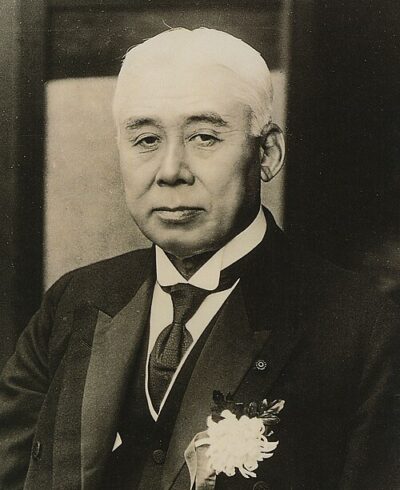
Hara Takashi
Hara Takashi was a Prime Minister of Japan from 1918 to 1921. Born March 15, 1856, in Morioka. Died November 4, 1921, in Tokyo Station. Positions held include member of the House of Representatives of Japan (1902–1921) and Prime Minister of Japan (1918–1921). Educated at Law School of the Ministry of Justice. Awards include Order of the Rising Sun, 1st class, Order of the Rising Sun with Paulownia Flowers, 1st class and Grand Cordon of the Supreme Order of the Chrysanthemum.
Facts
37 facts · 2 confirmed by two sources · 6 cited · 29 from one source
Where this comes from
Papalocal keeps its own record. It started from these sources; what each one said is kept here as it was copied, so a change on their side never changes this page by itself. Tap one to read its version.
What Wikidata says · copied November 16, 2026 · revision 2562815173
- Described as
- Prime Minister of Japan from 1918 to 1921
- Other names
- Hara Kei
- Born
- March 15, 1856 · 2 references
- Died
- November 4, 1921 · 3 references
- Born in
- Morioka · 1 reference
- Died in
- Tokyo Station
- Buried in
- Daiji-ji Temple (Morioka)
- Cause of death
- stab wound
- Citizen of
- Japan
- Occupation
- politician · 1 reference; writer; journalist · 1 reference; diplomat · 1 reference; head of government · 1 reference; member of parliament · 1 reference
- Positions held
- member of the House of Representatives of Japan (1902–1921); Prime Minister of Japan (1918–1921)
- Political party
- Rikken Seiyūkai
- Worked for
- Hōchi; Ministry of Foreign Affairs of Japan; Osaka Mainichi Shimbun
- Education
- Law School of the Ministry of Justice
- Awards
- Order of the Rising Sun, 1st class (1914); Order of the Rising Sun with Paulownia Flowers, 1st class (1920); Grand Cordon of the Supreme Order of the Chrysanthemum (1921); Order of the Rising Sun, 6th class (1885); Order of the Sacred Treasure, 5th Class (1893); Order of the Sacred Treasure, 4th class (1895); Order of the Rising Sun, 3rd class (1896); Order of the Sacred Treasure, 2nd Class (1906); Commander of the Order of Leopold (1888); Officer of the Legion of Honour (1889); Knight grand cross of the order of the crown of Italy (1896); Order of Saint Anna, 1st class (1896); Collar of the Order of Isabella the Catholic (1896); Knight Grand Officer of the Order of the Dannebrog (1897); 1st Class Order of the Crown (1897)
- Spouse
- Asako Hara · 1 reference
- Religion
- Catholic Church
- Wikipedias with a page
- 47
Wikidata item Q315553 (wikidata.org/wiki/Q315553), public domain (CC0). Copied November 16, 2026.
What Wikipedia says · copied November 16, 2026 · revision 1381486482
Hara Takashi (原 敬; 15 March 1856 – 4 November 1921), informally known as Hara Kei, was a Japanese politician who served as the Prime Minister of Japan from 1918 until his assassination. Hara was the first commoner and first Christian appointed to be Prime Minister of Japan, and was given the moniker of "commoner prime minister" (平民宰相, heimin saishō).
Hara held several minor ambassadorial roles before rising through the ranks of the Rikken Seiyūkai and being elected to the House of Representatives. Hara served as Home Minister in several cabinets under Saionji Kinmochi and Yamamoto Gonnohyōe between 1906 and 1913. Hara was appointed prime minister following the Rice Riots of 1918 and positioned himself as a moderate, participating in the Paris Peace Conference, founding the League of Nations, and relaxing oppressive policies in Japanese Korea. Hara's premiership oversaw the Siberian intervention and the suppression of the March 1st Movement in Japanese-occupied Korea. Hara was assassinated by Nakaoka Kon'ichi, a far-right nationalist, on 4 November 1921.
- Born, in its opening lines
- March 15, 1856
- Died, in its opening lines
- November 4, 1921
From the Wikipedia article “Hara Takashi” (en.wikipedia.org/wiki/Hara_Takashi), by its contributors, under CC BY-SA 4.0 (creativecommons.org/licenses/by-sa/4.0/). Copied November 16, 2026; not changed.
Confirmed Two sources agree. Cited One source, and it names where it got it. One source One source, without a reference of its own. Sources disagree The sources disagree. We show the best-supported value and keep theirs below.
