
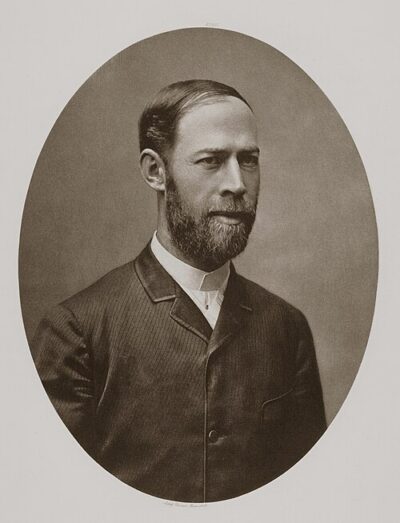
Heinrich Hertz
Heinrich Hertz was a German physicist. Born February 22, 1857, in Hamburg. Died January 1, 1894, in Bonn. Educated at LMU Munich and Frederick William University Berlin. Awards include Rumford Medal, Matteucci Medal and La Caze Prize of the Academy of Sciences.
Facts
39 facts · 2 confirmed by two sources · 21 cited · 16 from one source
Where this comes from
Papalocal keeps its own record. It started from these sources; what each one said is kept here as it was copied, so a change on their side never changes this page by itself. Tap one to read its version.
What Wikidata says · copied November 16, 2026 · revision 2568735227
- Described as
- German physicist (1857–1894)
- Other names
- Heinrich Rudolf Hertz
- Born
- February 22, 1857 · 12 references
- Died
- January 1, 1894 · 12 references
- Born in
- Hamburg · 3 references
- Died in
- Bonn · 3 references
- Buried in
- Ohlsdorf Cemetery · 1 reference
- Cause of death
- sepsis
- Citizen of
- Hamburg
- Occupation
- physicist · 1 reference; philosopher; inventor; university teacher · 1 reference
- Worked for
- University of Bonn (1889–1893) · 2 references; Kiel University (1883–1885) · 2 references; TH Karlsruhe (1885–1889) · 2 references; Humboldt-Universität zu Berlin Institut für Physik (1880–1883) · 1 reference
- Education
- LMU Munich (1877–1878) · 1 reference; Frederick William University Berlin (1878–1880) · 1 reference; TU Dresden (1876) · 2 references; Gelehrtenschule des Johanneums (1872–1875) · 1 reference
- Member of
- Maxwellians · 1 reference; Royal Prussian Academy of Sciences; Academy of Sciences of Turin (1893–) · 1 reference; Göttingen Academy of Sciences and Humanities in Lower Saxony; Accademia Nazionale dei Lincei (1892–) · 1 reference
- Awards
- Rumford Medal (1890) · 1 reference; Matteucci Medal (1888) · 1 reference; La Caze Prize of the Academy of Sciences (1889) · 1 reference; Bressa Prize (1887) · 1 reference; CQ Amateur Radio Hall of Fame (2001) · 1 reference; honorary member of the Physics Association (Frankfurt am Main, Germany) (1890)
- Field
- physics · 1 reference; electrical engineering; acoustics · 1 reference; electromagnetic wave · 1 reference
- Spouse
- Elisabeth Hertz · 1 reference
- Children
- Mathilde Carmen Hertz · 1 reference; Johanna Hertz · 1 reference
- Father
- Gustav Ferdinand Hertz
- Religion
- Lutheranism
- Wikipedias with a page
- 112
Wikidata item Q41257 (wikidata.org/wiki/Q41257), public domain (CC0). Copied November 16, 2026.
What Wikipedia says · copied November 16, 2026 · revision 1379369509
Heinrich Rudolf Hertz ( hurts; German: [hɛʁts] ; 22 February 1857 – 1 January 1894) was a German physicist who first conclusively proved the existence of the electromagnetic waves proposed by James Clerk Maxwell's equations of electromagnetism.
- Born, in its opening lines
- February 22, 1857
- Died, in its opening lines
- January 1, 1894
From the Wikipedia article “Heinrich Hertz” (en.wikipedia.org/wiki/Heinrich_Hertz), by its contributors, under CC BY-SA 4.0 (creativecommons.org/licenses/by-sa/4.0/). Copied November 16, 2026; not changed.
Confirmed Two sources agree. Cited One source, and it names where it got it. One source One source, without a reference of its own. Sources disagree The sources disagree. We show the best-supported value and keep theirs below.
