
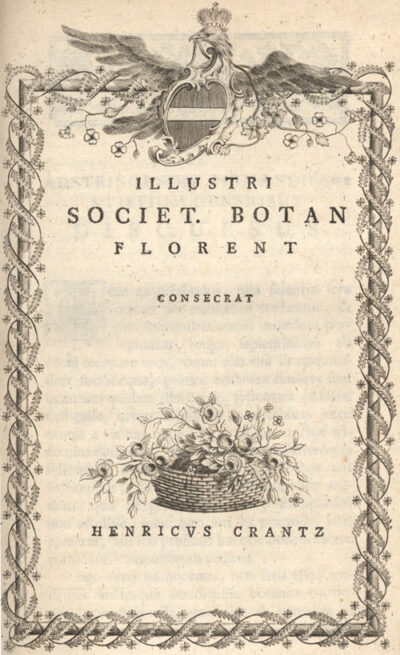
Heinrich Johann Nepomuk von Crantz
Heinrich Johann Nepomuk von Crantz was a Luxembourgish botanist. Born 1723. Died January 18, 1797, in Oberzeiring. Educated at University of Vienna and Athénée de Luxembourg.
Facts
14 facts · 0 confirmed by two sources · 3 cited · 9 from one source · 2 where the sources disagree
What’s different
- Born: we show 1723 (Sources disagree). Wikipedia says November 25, 1722
- Died: we show January 18, 1797 (Sources disagree). Wikipedia says January 18, 1799
Where this comes from
Papalocal keeps its own record. It started from these sources; what each one said is kept here as it was copied, so a change on their side never changes this page by itself. Tap one to read its version.
What Wikidata says · copied November 18, 2026 · revision 2569008337
- Described as
- Luxembourgish botanist (1723-1797)
- Other names
- Crantz
- Born
- 1723
- Died
- January 18, 1797
- Died in
- Oberzeiring · 1 reference
- Citizen of
- Habsburg monarchy
- Occupation
- botanist; gynecologist · 1 reference; university teacher; physician · 2 references
- Worked for
- University of Vienna
- Education
- University of Vienna; Athénée de Luxembourg
- Member of
- German Academy of Sciences Leopoldina
- Field
- botany; medicine
- Wikipedias with a page
- 24
Wikidata item Q112261 (wikidata.org/wiki/Q112261), public domain (CC0). Copied November 18, 2026.
What Wikipedia says · copied November 18, 2026 · revision 1372292315
Heinrich Johann Nepomuk von Crantz (Roodt-sur-Eisch, Luxembourg, 25 November 1722 – 18 January 1799, Judenburg, Austria) was a botanist and a physician.
In 1750 he obtained his doctorate of medicine in Vienna, where he was a pupil of Gerard van Swieten (1700–1772). He studied obstetrics in Paris and London. In Paris he was influenced by André Levret (1703–1780) and Nicolas Puzos (1686–1753).
He was first married to Anna Susanne Petrasch and then to Magda Lena de Tremon. He had two sons and one daughter.
He became a lecturer in obstetrics at St. Mary's Hospital in Vienna in 1754. From 1756 to 1774, he taught physiology and materia medica at the university in that city.
He was the author of:Einleitung in eine wahre und gegründete Hebammenkunst (1756).
Commentarius de rupto in partus doloribus a foetu utero (1756).
Commentatio de instrumentorum in arte obstetricia historia utilitate et recta ac praepostera applicatione (1757).
De systemate irritabilitatis (1761).
Materia medica et chirurgica (three volumes, 1762) (Vol. 1 - 3 1765 Digital edition by the University and State Library Düsseldorf)
De aquis medicatis principatus Transsylvaniae (1773).
Die Gesundbrunnen der Österreichischen Monarchie (1777).
He recommended better methods of hygiene for midwives. In addition to his work in medicine, he studied chemistry, botany, and the sources of mineral water.
The plant genus Crantzia (Gesneriaceae) was named for him by Thomas Nuttall.
- Born, in its opening lines
- November 25, 1722
- Died, in its opening lines
- January 18, 1799
From the Wikipedia article “Heinrich Johann Nepomuk von Crantz” (en.wikipedia.org/wiki/Heinrich_Johann_Nepomuk_von_Crantz), by its contributors, under CC BY-SA 4.0 (creativecommons.org/licenses/by-sa/4.0/). Copied November 18, 2026; not changed.
Confirmed Two sources agree. Cited One source, and it names where it got it. One source One source, without a reference of its own. Sources disagree The sources disagree. We show the best-supported value and keep theirs below.
