
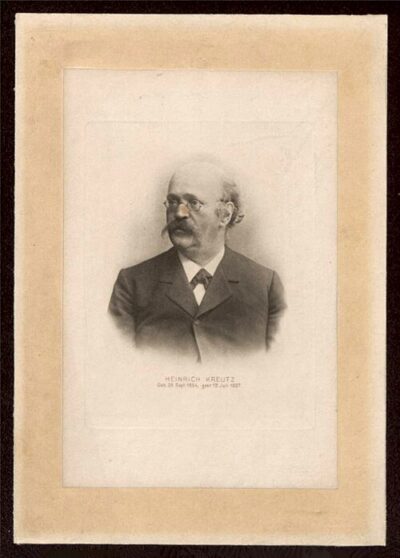
Heinrich Kreutz
Heinrich Kreutz was a German astronomer. Born September 8, 1854, in Siegen. Died July 13, 1907, in Kiel. Educated at University of Bonn.
Facts
11 facts · 2 confirmed by two sources · 3 cited · 6 from one source
What’s different
- Died: we show July 13, 1907 (Confirmed). Wikidata also lists July 3, 1907
Where this comes from
Papalocal keeps its own record. It started from these sources; what each one said is kept here as it was copied, so a change on their side never changes this page by itself. Tap one to read its version.
What Wikidata says · copied November 18, 2026 · revision 2569103975
- Described as
- German astronomer (1854–1907)
- Other names
- Heinrich Carl Friedrich Kreutz
- Born
- September 8, 1854 · 1 reference
- Died
- July 13, 1907; July 3, 1907 · 1 reference
- Born in
- Siegen · 1 reference
- Died in
- Kiel · 1 reference
- Citizen of
- Kingdom of Prussia
- Occupation
- astronomer · 1 reference; university teacher
- Worked for
- Kiel University
- Education
- University of Bonn
- Member of
- German Academy of Sciences Leopoldina
- Field
- astronomy
- Wikipedias with a page
- 20
Wikidata item Q66383 (wikidata.org/wiki/Q66383), public domain (CC0). Copied November 18, 2026.
What Wikipedia says · copied November 18, 2026 · revision 1364937187
Heinrich Carl Friedrich Kreutz (September 8, 1854 – July 13, 1907) was a German astronomer, most notable for his studies of the orbits of several sungrazing comets, which revealed that they were all related objects, produced when a very large Sun-grazing comet fragmented several hundred years previously. The group is now known as the Kreutz sungrazers, and has produced some of the brightest comets ever seen, including X/1106 C1 and Comet Ikeya–Seki. The source of the group may have been the Great Comet of 371 BC.
Kreutz was born in Siegen in 1854, and obtained his PhD at the University of Bonn in 1880 on the orbit of comet C/1861 J1, working under Eduard Schönfeld and Adalbert Krueger. In 1880, he spent some time in Vienna, working with Edmund Weiss and Theodor von Oppolzer. In 1882 started to work as a computer at Recheninstitut in Berlin. Next year he moved to Kiel, following his adviser Krueger, who became the director of Kiel Observatory, and started to work as a computer at the observatory. In 1889 he became an assistant professor, and two years later a associate professor of astronomy at the University of Kiel. After Krueger's death in 1896, Kreutz became the editor of the Astronomische Nachrichten, the leading astronomical journal of the time, and held the position until his death in 1907.
The minor planet 3635 Kreutz, discovered by Luboš Kohoutek in 1981, was named after him.
- Born, in its opening lines
- September 8, 1854
- Died, in its opening lines
- July 13, 1907
From the Wikipedia article “Heinrich Kreutz” (en.wikipedia.org/wiki/Heinrich_Kreutz), by its contributors, under CC BY-SA 4.0 (creativecommons.org/licenses/by-sa/4.0/). Copied November 18, 2026; not changed.
Confirmed Two sources agree. Cited One source, and it names where it got it. One source One source, without a reference of its own. Sources disagree The sources disagree. We show the best-supported value and keep theirs below.
