
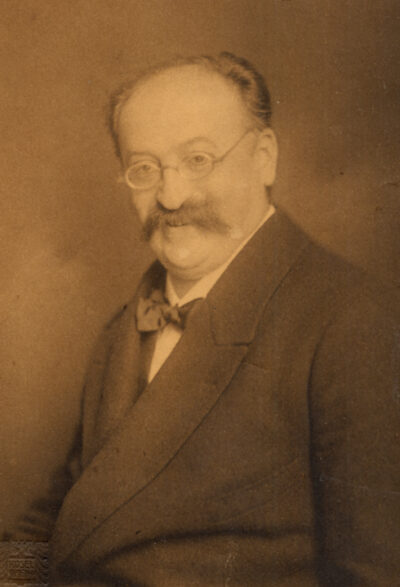
Heinrich Schenker
Heinrich Schenker was an Austrian music theorist. Born June 19, 1868, in Vyshnivchyk. Died January 14, 1935, in Vienna. Known for Free Composition and Schenkerian analysis. Educated at University of Music and Performing Arts Vienna.
Facts
19 facts · 2 confirmed by two sources · 6 cited · 10 from one source · 1 where the sources disagree
What’s different
- Died: we show January 14, 1935 (Confirmed). Wikidata also lists January 13, 1935
- Cause of death: we show diabetes (Sources disagree). Wikidata also lists arteriosclerosis
Where this comes from
Papalocal keeps its own record. It started from these sources; what each one said is kept here as it was copied, so a change on their side never changes this page by itself. Tap one to read its version.
What Wikidata says · copied November 18, 2026 · revision 2568740927
- Described as
- Austrian music theorist (1868-1935)
- Born
- June 19, 1868 · 7 references
- Died
- January 14, 1935 · 7 references; January 13, 1935 · 1 reference
- Born in
- Vyshnivchyk
- Died in
- Vienna · 1 reference
- Buried in
- New Jewish Cemetery
- Cause of death
- diabetes; arteriosclerosis
- Citizen of
- Austria
- Occupation
- composer · 1 reference; musicologist · 1 reference; music theorist; music educator; accompanist; editor · 1 reference; pianist · 1 reference
- Education
- University of Music and Performing Arts Vienna
- Instrument
- piano
- Known for
- Free Composition; Schenkerian analysis
- Spouse
- Jeanette Schenker · 1 reference
- Wikipedias with a page
- 23
Wikidata item Q531995 (wikidata.org/wiki/Q531995), public domain (CC0). Copied November 18, 2026.
What Wikipedia says · copied November 18, 2026 · revision 1382398297
Heinrich Schenker (19 June 1868 – 14 January 1935) was an Austrian music theorist whose writings have had a profound influence on subsequent musical analysis. His approach, now termed Schenkerian analysis, was most fully explained in a three-volume series, Neue musikalische Theorien und Phantasien (New Musical Theories and Phantasies), which included Harmony (1906), Counterpoint (1910; 1922), and Free Composition (1935).
Born in Wiśniowczyk, Austrian Galicia, he studied law at University of Vienna and music at what is now the University of Music and Performing Arts Vienna where his teachers included Franz Krenn, Ernst Ludwig, Anton Bruckner, and Johann Nepomuk Fuchs. Despite his law degree, he focused primarily on a musical career following graduation, finding minimal success as a composer, conductor, and accompanist. After 1900 Schenker increasingly directed his efforts toward music theory, developing a systemic approach to analyze the underlying melodic and harmonic material of tonal music. His theories proposed the presence of fundamental structures (Ursatz) occurring in the background (Hintergrund) of compositions, which he illustrated with a variety of new specialized terms and notational methods.
Schenker's view on race has come under scrutiny and criticism in the 21st century.
- Born, in its opening lines
- June 19, 1868
- Died, in its opening lines
- January 14, 1935
From the Wikipedia article “Heinrich Schenker” (en.wikipedia.org/wiki/Heinrich_Schenker), by its contributors, under CC BY-SA 4.0 (creativecommons.org/licenses/by-sa/4.0/). Copied November 18, 2026; not changed.
Confirmed Two sources agree. Cited One source, and it names where it got it. One source One source, without a reference of its own. Sources disagree The sources disagree. We show the best-supported value and keep theirs below.
