
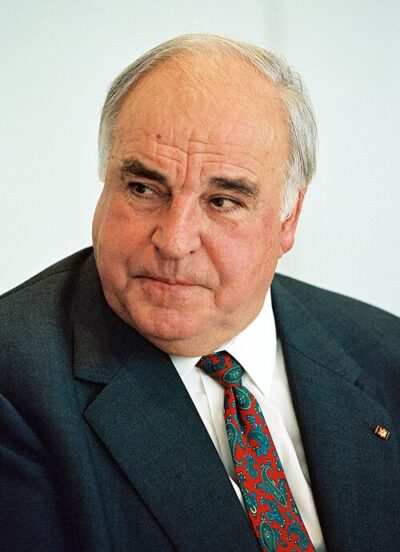
Helmut Kohl
Helmut Kohl was a Chancellor of West Germany and reunified Germany. Born April 3, 1930, in Friesenheim. Died June 16, 2017, in Ludwigshafen. Positions held include Federal Chancellor of Germany (1982–1998), Minister-President of Rhineland-Palatinate (1969–1976) and member of the German Bundestag (1976–2002). Educated at Goethe University Frankfurt and Heidelberg University. Awards include Grand Cross special issue of the Order of Merit of the Federal Republic of Germany, special issue, German Leo Baeck Award and Jawaharlal Nehru Award for International Understanding.
Facts
50 facts · 2 confirmed by two sources · 17 cited · 31 from one source
Where this comes from
Papalocal keeps its own record. It started from these sources; what each one said is kept here as it was copied, so a change on their side never changes this page by itself. Tap one to read its version.
What Wikidata says · copied November 16, 2026 · revision 2565822584
- Described as
- Chancellor of West Germany and reunified Germany (1982–1998)
- Other names
- Helmut Josef Michael Kohl, Kohl, Dr. Helmut Kohl
- Born
- April 3, 1930 · 14 references
- Died
- June 16, 2017 · 12 references
- Born in
- Friesenheim
- Died in
- Ludwigshafen · 1 reference
- Buried in
- Old Cemetery
- Name at birth
- Helmut Josef Michael Kohl
- Citizen of
- Weimar Republic (–1933); Nazi Germany (1933–1945); West Germany (1945–1990); Germany (1990–)
- Occupation
- politician · 2 references; historian; political scientist; Chancellor of Germany · 1 reference
- Positions held
- Federal Chancellor of Germany (1982–1998) · 1 reference; Minister-President of Rhineland-Palatinate (1969–1976) · 1 reference; member of the German Bundestag (1976–2002) · 1 reference; member of Landtag of Rhineland-Palatinate (1959–1976) · 1 reference; leader of the Christian Democratic Union (1973–1998) · 2 references; Chairman of the CDU/CSU Bundestag fraction (1976–1982) · 1 reference; substitute member of the Parliamentary Assembly of the Council of Europe (1977) · 1 reference
- Political party
- Christian Democratic Union
- Education
- Goethe University Frankfurt; Heidelberg University
- Member of
- Christian Democratic Union · 1 reference
- Awards
- Grand Cross special issue of the Order of Merit of the Federal Republic of Germany, special issue (1998) · 1 reference; German Leo Baeck Award (1997); Jawaharlal Nehru Award for International Understanding (1990) · 1 reference; Grand Cross of Honor for Services to the Republic of Austria (1973); Charlemagne Prize (1988) · 1 reference; honorary citizen of Berlin; Order of Merit of Baden-Württemberg (1999); Order of the White Eagle (Third Polish Republic) (1998); Eric M. Warburg Award (1996); Knight Grand Cross of the Order of St Michael and St George; Presidential Medal of Freedom (1999) · 1 reference; European handicraft prize (1992) · 1 reference; Princess of Asturias Award for International Cooperation (1996); Hanns Martin Schleyer Prize (2009); Robert Schuman Medal (1986)
- Spouse
- Maike Kohl-Richter (2008–2017) · 2 references; Hannelore Kohl (1960–2001) · 2 references
- Children
- Walter Kohl · 1 reference; Peter Kohl · 1 reference
- Father
- Hans Kohl · 1 reference
- Mother
- Cäcilie Kohl · 1 reference
- Religion
- Catholic Church · 1 reference
- Lived in
- Oggersheim (1971–2017) · 1 reference
- Height
- 1.95 m (6 ft 5 in)
- Website
- http://www.helmut-kohl.de/
- Wikipedias with a page
- 129
Wikidata item Q2518 (wikidata.org/wiki/Q2518), public domain (CC0). Copied November 16, 2026.
What Wikipedia says · copied November 16, 2026 · revision 1384582870
Helmut Josef Michael Kohl (3 April 1930 – 16 June 2017) was a German politician who served as chancellor of Germany from 1982 to 1998. He was leader of the Christian Democratic Union (CDU) from 1973 to 1998 and oversaw the end of the Cold War, German reunification, and the creation of the European Union (EU). Kohl's 16-year tenure is the longest in German post-war history, lasting just nine days longer than Angela Merkel's tenure, and is the longest for any elected chancellor of Germany.
Born in Ludwigshafen to a Catholic family, Kohl joined the CDU in 1946 at the age of 16. He earned a PhD in history at Heidelberg University in 1958 and worked as a business executive before becoming a full-time politician. He was elected as the youngest member of the Parliament of Rhineland-Palatinate in 1959 and from 1969 to 1976 was minister president of the Rhineland-Palatinate state. Viewed during the 1960s and the early 1970s as a progressive within the CDU, he was elected national chairman of the party in 1973. After he had become party leader, Kohl was increasingly seen as a more conservative figure. In the 1976 and 1980 federal elections, his party performed well, but the social-liberal government of social democrat Helmut Schmidt was able to remain in power. After Schmidt had lost the support of the liberal FDP in 1982, Kohl was elected Chancellor through a constructive vote of no confidence, forming a coalition government with the FDP. Kohl chaired the G7 in 1985 and 1992.
As Chancellor, Kohl was committed to European integration and especially to the Franco-German relationship; he was also a steadfast ally of the United States and supported Ronald Reagan's more aggressive policies to weaken the Soviet Union. Following the Revolutions of 1989, his government acted decisively, culminating in the German reunification in 1990. Kohl and French president François Mitterrand were the architects of the Maastricht Treaty, which established the European Union and the Euro currency. Kohl was also a central figure in the eastern enlargement of the EU, and his government led the effort to push for international recognition of Croatia, Slovenia, and Bosnia and Herzegovina when the states declared independence. He played a controversial role in resolving the Bosnian War. Domestically Kohl's policies from 1990 focused on integrating former East Germany into reunified Germany, and he moved the federal capital from the "provisional capital" Bonn back to Berlin, although he never resided there because the government offices were only relocated in 1999. Kohl also greatly increased federal spending on arts and culture. After his chancellorship, Kohl became honorary chairman of the CDU in 1998 but resigned from the position in 2000 in the wake of the CDU donations scandal, which damaged his reputation domestically.
Kohl received the 1988 Charlemagne Prize and was named Honorary Citizen of Europe by the European Council in 1998. Following his death, Kohl was honoured with the first-ever European act of state in Strasbourg. Kohl was described as "the greatest European leader of the second half of the 20th century" by US presidents George H. W. Bush and Bill Clinton.
- Born, in its opening lines
- April 3, 1930
- Died, in its opening lines
- June 16, 2017
From the Wikipedia article “Helmut Kohl” (en.wikipedia.org/wiki/Helmut_Kohl), by its contributors, under CC BY-SA 4.0 (creativecommons.org/licenses/by-sa/4.0/). Copied November 16, 2026; not changed.
Confirmed Two sources agree. Cited One source, and it names where it got it. One source One source, without a reference of its own. Sources disagree The sources disagree. We show the best-supported value and keep theirs below.
