
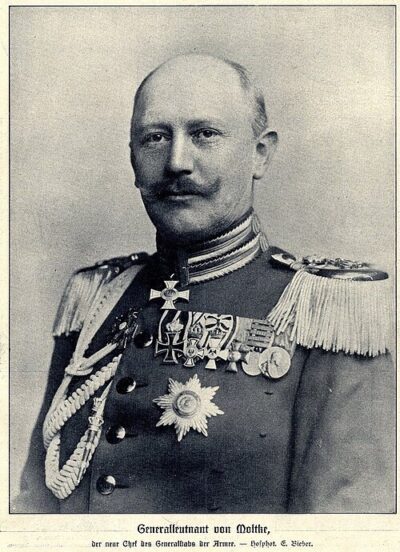
Helmuth von Moltke the Younger
Helmuth von Moltke the Younger was a Chief of the German General Staff. Born May 25, 1848, in Biendorf. Died June 18, 1916, in Berlin. Awards include Pour le Mérite, Knight Commander of the Royal Victorian Order and Order of the Black Eagle.
Facts
28 facts · 2 confirmed by two sources · 14 cited · 12 from one source
Where this comes from
Papalocal keeps its own record. It started from these sources; what each one said is kept here as it was copied, so a change on their side never changes this page by itself. Tap one to read its version.
What Wikidata says · copied November 16, 2026 · revision 2569028547
- Described as
- Chief of the German General Staff (1848–1916)
- Other names
- Moltke the Younger, Helmuth Johann Ludwig von Moltke, Helmuth Johannes Ludwig Graf von Moltke, Graf Helmuth Johannes Ludwig von Moltke, Helmuth von Moltke
- Born
- May 25, 1848 · 4 references
- Died
- June 18, 1916 · 5 references
- Born in
- Biendorf
- Died in
- Berlin · 2 references
- Buried in
- Invalids' Cemetery
- Cause of death
- stroke
- Citizen of
- Kingdom of Prussia
- Occupation
- military officer; soldier · 2 references; anthroposophist · 1 reference; Generaloberst · 1 reference; author · 1 reference
- Awards
- Pour le Mérite; Knight Commander of the Royal Victorian Order; Order of the Black Eagle; Commander 2nd Class of the Order of Philip the Magnanimous (1892) · 2 references; Grand Cross of the Order of the Dannebrog (1902) · 1 reference; Grand Cross of the Dannebrogorder with pectoral star in diamonds (1906) · 1 reference; Commander Cross of the Military Order of Maria Theresa (1914) · 1 reference
- Field
- armed forces · 1 reference; military · 1 reference; World War I · 1 reference; history of war · 1 reference
- Father
- Adolf von Moltke
- Siblings
- Friedrich von Moltke
- Military branch
- Prussian Army · 1 reference
- Military rank
- colonel general; general · 1 reference
- Wikipedias with a page
- 53
Wikidata item Q57130 (wikidata.org/wiki/Q57130), public domain (CC0). Copied November 16, 2026.
What Wikipedia says · copied November 16, 2026 · revision 1385748563
Graf Helmuth Johannes Ludwig von Moltke (German: [ˈhɛlmuːt fɔn ˈmɔltkə]; 25 May 1848 – 18 June 1916), also known as Moltke the Younger, was a German general and Chief of the Great German General Staff, a member of the House of Moltke. He was also the nephew of Generalfeldmarschall Graf Helmuth von Moltke the Elder, who is commonly called "Moltke the Elder" to differentiate the two.
Upon becoming the head of the General Staff, Moltke led the Imperial German Army from 1 January 1906 to 14 September 1914. When World War I broke out in July 1914, he served as the Army's commander-in-chief during the initial months of the conflict. Moltke the Younger's legacy remains controversial due to his involvement in Germany's decision to go to war in 1914 as well as his execution of the invasion of France and Belgium that culminated in the First Battle of the Marne.
- Born, in its opening lines
- May 25, 1848
- Died, in its opening lines
- June 18, 1916
From the Wikipedia article “Helmuth von Moltke the Younger” (en.wikipedia.org/wiki/Helmuth_von_Moltke_the_Younger), by its contributors, under CC BY-SA 4.0 (creativecommons.org/licenses/by-sa/4.0/). Copied November 16, 2026; not changed.
Confirmed Two sources agree. Cited One source, and it names where it got it. One source One source, without a reference of its own. Sources disagree The sources disagree. We show the best-supported value and keep theirs below.
