
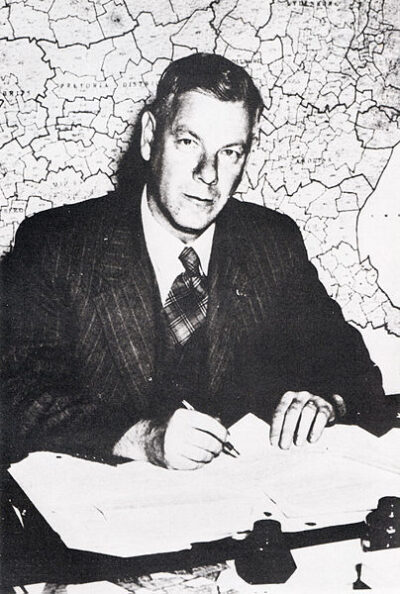
Hendrik Frensch Verwoerd
Hendrik Frensch Verwoerd was a Prime Minister of South Africa from 1958 until his assassination in 1966. Born September 8, 1901, in Amsterdam. Died September 6, 1966, in Cape Town. Positions held include Prime Minister of South Africa (1958–1966). Educated at Stellenbosch University and Milton High School.
Facts
27 facts · 2 confirmed by two sources · 12 cited · 13 from one source
Where this comes from
Papalocal keeps its own record. It started from these sources; what each one said is kept here as it was copied, so a change on their side never changes this page by itself. Tap one to read its version.
What Wikidata says · copied November 16, 2026 · revision 2562789204
- Described as
- Prime Minister of South Africa from 1958 until his assassination in 1966
- Other names
- Hendrik Verwoerd, H. F. Verwoerd
- Born
- September 8, 1901 · 7 references
- Died
- September 6, 1966 · 7 references
- Born in
- Amsterdam · 1 reference
- Died in
- Cape Town · 1 reference
- Cause of death
- stab wound
- Citizen of
- South Africa
- Occupation
- politician · 1 reference; university teacher · 1 reference; psychologist · 1 reference; head of government · 1 reference
- Positions held
- Prime Minister of South Africa (1958–1966)
- Political party
- National Party
- Worked for
- Stellenbosch University
- Education
- Stellenbosch University; Milton High School; Leipzig University · 1 reference; Humboldt-Universität zu Berlin · 1 reference; University of Hamburg · 1 reference
- Member of
- Afrikaner Broederbond · 1 reference
- Field
- politics · 1 reference; psychology · 1 reference; sociology · 1 reference; social work · 1 reference; government · 1 reference; apartheid · 1 reference
- Spouse
- Betsie Verwoerd
- Religion
- Dutch Reformed Church
- Wikipedias with a page
- 49
Wikidata item Q297000 (wikidata.org/wiki/Q297000), public domain (CC0). Copied November 16, 2026.
What Wikipedia says · copied November 16, 2026 · revision 1383082229
Hendrik Frensch Verwoerd (Afrikaans: [fərˈvuːrt]; 8 September 1901 – 6 September 1966), also known as H. F. Verwoerd, was a Dutch-born South African politician, academic, and newspaper editor who served as Prime Minister of South Africa from 1958 until his assassination in 1966.
He is commonly regarded as the architect of apartheid and nicknamed the "father of apartheid". Verwoerd played a significant role in socially engineering apartheid—the country's system of institutionalized racial segregation and white supremacy—and implementing its policies as Minister of Native Affairs (1950–1958) and later as prime minister (1958–1966). Verwoerd was instrumental in helping the National Party come to power in 1948, serving as its political strategist and propagandist, and he became party leader when he was elected prime minister. He was the Union of South Africa's last prime minister; in 1961 he proclaimed the founding of the Republic of South Africa and remained its prime minister until his assassination.
Verwoerd was an authoritarian, socially conservative leader and an Afrikaner nationalist. He was a member of the Afrikaner Broederbond (Afrikaans: Afrikaner Brotherhood), a secret white supremacist and Calvinist organization dedicated to advancing Afrikaner interests. During World War II, he protested against South Africa's declaration of war on Nazi Germany. Following the electoral victory of the Herenigde Nasionale Party (which would later become part of the National Party) in 1948, Verwoerd held senior government positions and wielded strong influence over South African society.
As prime minister, Verwoerd's desire to ensure white, and especially Afrikaner, dominance was a primary reason for his support of a republic. To justify apartheid to international audiences, he claimed it was a policy of "good-neighbourliness", arguing that because different races and cultures have different beliefs and values, they could only reach their full potential by living and developing apart from each other. He stated that the white minority had to be protected from the non-white majority by pursuing a "policy of separate development" and keeping power in the hands of whites. Apartheid resulted in the complete disfranchisement of the non-white population.
During his premiership, Verwoerd heavily repressed opposition to apartheid. He ordered the detention and imprisonment of tens of thousands of people and the exile of thousands more, while greatly empowering, modernizing, and enlarging the security forces of the white apartheid state. He banned black organizations such as the African National Congress and the Pan Africanist Congress; under his leadership, future president Nelson Mandela was imprisoned for life for sabotage. Verwoerd's South Africa had one of the world's highest prison populations and saw a large number of executions and floggings. By the mid-1960s, his government had, to a large degree, suppressed internal civil resistance to apartheid by using extraordinary legislative power, draconian laws, psychological intimidation, and the relentless efforts of the state's security apparatus.
Although apartheid began in 1948 under D. F. Malan, Verwoerd's role in expanding and legally entrenching the system, including his theoretical justifications and opposition to the limited form of integration known as baasskap, have led to his description as the "Architect of Apartheid". His actions prompted the passage of United Nations General Assembly Resolution 1761, which condemned apartheid and ultimately led to South Africa's international isolation and economic sanctions. On 6 September 1966, Verwoerd was stabbed several times by parliamentary messenger Dimitri Tsafendas. He died shortly after, and Tsafendas was jailed until his death in 1999.
- Born, in its opening lines
- September 8, 1901
- Died, in its opening lines
- September 6, 1966
From the Wikipedia article “Hendrik Verwoerd” (en.wikipedia.org/wiki/Hendrik_Verwoerd), by its contributors, under CC BY-SA 4.0 (creativecommons.org/licenses/by-sa/4.0/). Copied November 16, 2026; not changed.
Confirmed Two sources agree. Cited One source, and it names where it got it. One source One source, without a reference of its own. Sources disagree The sources disagree. We show the best-supported value and keep theirs below.
