

National Party
The National Party is a 1914–1997 political party known for implementing apartheid. It was founded in 1915. Its headquarters are in Cape Town. It stands for Afrikaner nationalism, Christian democracy and republicanism.
- Country
- South Africa
- Founded
- July 2, 1915
- Ideology
- Afrikaner nationalism
All 15 facts, and where they come from
Facts
15 facts · 0 confirmed by two sources · 0 cited · 15 from one source
Where this comes from
Papalocal keeps its own record. It started from these sources; what each one said is kept here as it was copied, so a change on their side never changes this page by itself. Tap one to read its version.
What Wikidata says · copied November 17, 2026 · revision 2561373100
- Described as
- 1914–1997 political party known for implementing apartheid
- Other names
- National Party of South Africa, Nationalist Party, Nasionale Party, New National Party, NNP, NP, Nuwe Nasionale Party
- What it is
- political party
- Followed by
- New National Party
- Founded
- July 2, 1915
- Ended
- 1997
- Headquarters
- Cape Town
- Located in
- Cape Town
- Country
- South Africa; Union of South Africa
- Chair
- James Barry Munnik Hertzog; F. W. de Klerk
- Ideology
- Afrikaner nationalism; Christian democracy (1994–); republicanism; conservatism
- Official website
- https://www.britannica.com/topic/National-Party-political-party-South-Africa
- Wikipedias with a page
- 39
Wikidata item Q740718 (wikidata.org/wiki/Q740718), public domain (CC0). Copied 2026-11-17.
What Wikipedia says · copied November 17, 2026 · revision 1384741082
The National Party (Afrikaans: Nasionale Party, NP), also referred to as the Nationalist Party or Nats by its opponents, was a political party in South Africa from 1914 to 1997, which was responsible for the implementation of apartheid rule. The party was an Afrikaner ethnic nationalist party, founded in 1914 to protect the interests of Afrikaners against perceived British cultural dominance following the Union of South Africa but later became a stalwart promoter and enactor of white supremacy, for which it is best known. It first became the governing party of the country in 1924. During the 1929-1939 Great Depression it merged with its rival, the South African Party (SAP), and a splinter faction, the Purified National Party, became the official opposition. Further fragmentation during World War II was reversed through the creation of the Reunited National Party, which rose to power in 1948 and revived the name "National Party". With the party governing South Africa from 4 June 1948 until 9 May 1994, the country for the bulk of this time was only a de jure or partial democracy, as from 1958 onwards non-white people were barred from voting. In 1990, it began to style itself as simply a South African civic nationalist party, and after the fall of apartheid in 1994, attempted to become a moderate conservative one. The party's reputation was damaged irreparably by perpetrating apartheid, and it rebranded itself as the New National Party in 1997 before eventually dissolving in 2005.
Following the 1948 general election, the party as the governing party of South Africa began implementing its policy of racial segregation, known as apartheid (the Afrikaans term for "separateness"). Although White-minority rule and racial segregation were already in existence in South Africa with non-Whites not having voting rights and efforts made to encourage segregation, apartheid intensified the segregation with stern penalties for non-Whites entering into areas designated for Whites-only without having a pass to permit them to do so (known as the pass laws), interracial marriage and sexual relationships were illegal and punishable offences. Black people faced significant restrictions on property rights. After South Africa was condemned by the British Commonwealth for its policies of apartheid, the NP-led government had South Africa leave the Commonwealth, abandon its monarchy led by the British monarch and become an independent republic. The party's system of apartheid was officially labelled a crime against humanity by the United Nations General Assembly on 16 December 1966.
During the 1970s and 1980s, the NP-led white apartheid government faced internal unrest in South Africa along with international pressure for the segregation and discrimination of non-Whites in South Africa after the abolition of the Jim Crow laws in the United States during the mid-1960s. It resulted in policies of granting concessions to the non-White population while still retaining the apartheid system, such as the creation of Bantustans that were autonomous self-governing Black homelands (criticised for several of them being broken up into unconnected pieces and that they were still dominated by the White minority South African government), removing legal prohibitions on interracial marriage, and legalising certain non-White and multiracial political parties (excluding the very popular African National Congress (ANC), which the government still viewed as a terrorist organisation). Those identified as Coloureds and Indian South Africans were granted separate legislatures in 1983 alongside the central legislature that represented Whites to provide them self-government while maintaining apartheid, but no such congress was supplied to the Black population as their self-government was to be provided through the Bantustans. The NP-led government began changing laws affected by the apartheid system that had come under heavy domestic and international condemnation, such as removing the pass laws, granting Blacks full property rights that ended previous significant restrictions on Black land ownership, and the right to form trade unions. Following escalating economic sanctions over apartheid, negotiations between the NP-led government led by P. W. Botha and the outlawed ANC led by then-imprisoned Nelson Mandela began in 1987 with Botha seeking to accommodate the ANC's demands and consider releasing Mandela and legalising the ANC on the condition that it would renounce the use of political violence to attain its aims.
F. W. de Klerk declared in February 1990 the decision to permit the release of Mandela from prison and ending South Africa's ban on the ANC and other anti-apartheid movements. In September 1990 the party opened up its membership to all racial groups and rebranded itself as no longer being an ethnic nationalist party only representing Afrikaners, but would henceforth be a civic nationalist and conservative party representing all South Africans. However, there was significant opposition among hardliner supporters of apartheid that resulted in De Klerk's government responding to them by holding a national referendum on Apartheid in 1992 for the White population alone that asked them if they supported the government's policy to end apartheid and establish elections open to all South Africans: a large majority voted in favour of the government's policy. In the 1994 elections, it expanded its base to include many non-Whites, including significant support from Coloured and Indian South Africans. It participated in the Government of National Unity between 1994 and 1996. In an attempt to distance itself from its past, the party was renamed the New National Party in 1997. The attempt was largely unsuccessful and the new party decided to merge with the ANC.
From the Wikipedia article “National Party (South Africa)” (en.wikipedia.org/wiki/National_Party_(South_Africa)), by its contributors, under CC BY-SA 4.0 (creativecommons.org/licenses/by-sa/4.0/). Copied 2026-11-17; not changed.
Confirmed Two sources agree. Cited One source, and it names where it got it. One source One source, without a reference of its own. Sources disagree The sources disagree. We show the best-supported value and keep theirs below.
Picture: Wikimedia Commons: Flag of the South African National Party (1936–1993).svg · See Commons file page
People connected 10
Party members
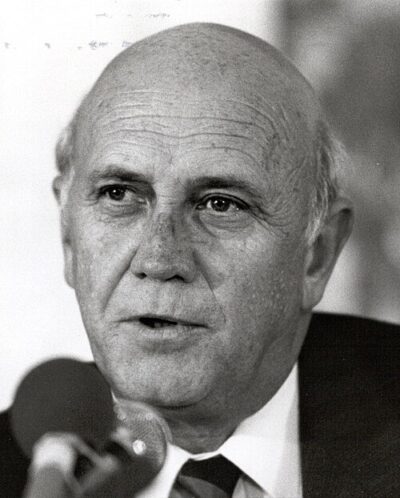 F. W. de Klerk (1972–2004)7th state president of South Africa from 1989 to 1994
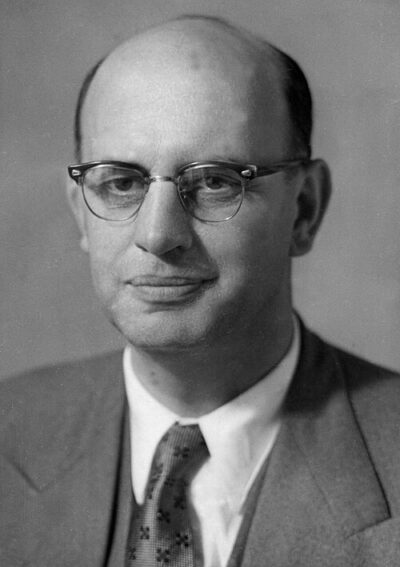 P. W. BothaSouth African prime minister (1916–2006)
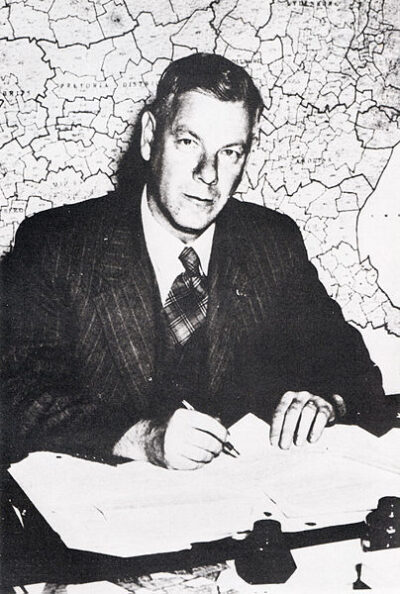 Hendrik Frensch VerwoerdPrime Minister of South Africa from 1958 until his assassination in 1966
 B. J. VorsterPrime Minister of South Africa from 1966 to 1978
 Daniel François MalanSouth African Prime Minister (1874-1959)
 Johannes Gerhardus Strijdomformer Prime Minister of South Africa (1893–1958)
 Charles Robberts SwartSouth African politician (1894–1982)
 Marais ViljoenSouth African politician (1915-2007)
 James Barry Munnik HertzogBoer general (1866-1942)
 Pik Botha (–1996)South African politician (1932-2018)
