
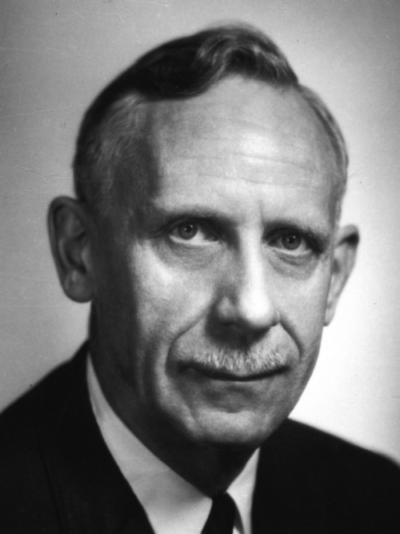
Hendrik Wade Bode
Hendrik Wade Bode was an American engineer, researcher, and inventor. Born December 24, 1905, in Madison. Died June 21, 1982, in Cambridge. Known for Bode plot. Educated at Ohio State University and Columbia University. Awards include Edison Medal, Richard E. Bellman Control Heritage Award and Fellow of the American Physical Society.
Facts
26 facts · 2 confirmed by two sources · 6 cited · 18 from one source
Where this comes from
Papalocal keeps its own record. It started from these sources; what each one said is kept here as it was copied, so a change on their side never changes this page by itself. Tap one to read its version.
What Wikidata says · copied November 16, 2026 · revision 2547973810
- Described as
- American engineer, researcher, and inventor (1905–1982)
- Other names
- Hendrik W. Bode, H. W. Bode
- Born
- December 24, 1905 · 2 references
- Died
- June 21, 1982 · 1 reference
- Born in
- Madison · 1 reference
- Died in
- Cambridge
- Citizen of
- United States
- Occupation
- mathematician; physicist; inventor; university teacher; electrical engineer; engineer; electrotechnician · 1 reference
- Worked for
- Harvard University
- Education
- Ohio State University; Columbia University
- Member of
- National Academy of Sciences; American Academy of Arts and Sciences
- Known for
- Bode plot
- Awards
- Edison Medal (1969) · 1 reference; Richard E. Bellman Control Heritage Award (1979) · 1 reference; Fellow of the American Physical Society (1956) · 1 reference; IEEE Fellow; Fellow of the Society for Industrial and Applied Mathematics; Fellow of the American Academy of Arts and Sciences; Rufus Oldenburger Medal (1975) · 1 reference
- Lived in
- Cambridge · 1 reference
- Wikipedias with a page
- 20
Wikidata item Q714462 (wikidata.org/wiki/Q714462), public domain (CC0). Copied November 16, 2026.
What Wikipedia says · copied November 16, 2026 · revision 1383299697
Hendrik Wade Bode ( BOH-dee, -də, Dutch: [ˈboːdə]; December 24, 1905 – June 21, 1982) was an American engineer, researcher, inventor, author and scientist, of Dutch ancestry. As a pioneer of modern control theory and electronic telecommunications, he revolutionized both the content and methodology of his chosen fields of research. His synergy with Claude Shannon, the father of information theory, laid the foundations for the technological convergence of the Information Age.
He made important contributions to the design, guidance and control of anti-aircraft systems during World War II. He helped develop the automatic artillery weapons that defended London from the V-1 flying bombs during WWII. After the war, Bode, along with his wartime rival Wernher von Braun—who was the developer of the V-2 rocket, and, later, the father of the US space program—served as members of the National Advisory Committee for Aeronautics (NACA), the predecessor of NASA. During the Cold War, he contributed to the design and control of missiles and anti-ballistic missiles.
Bode also made important contributions to control systems theory and mathematical tools for the analysis of stability of linear systems, inventing Bode plots, gain margin and phase margin. His contributions to the field led to him being described as one of the great engineering philosophers of his era by the National Academy of Engineering.
- Born, in its opening lines
- December 24, 1905
- Died, in its opening lines
- June 21, 1982
From the Wikipedia article “Hendrik Wade Bode” (en.wikipedia.org/wiki/Hendrik_Wade_Bode), by its contributors, under CC BY-SA 4.0 (creativecommons.org/licenses/by-sa/4.0/). Copied November 16, 2026; not changed.
Confirmed Two sources agree. Cited One source, and it names where it got it. One source One source, without a reference of its own. Sources disagree The sources disagree. We show the best-supported value and keep theirs below.
